Activity
Mon
Wed
Fri
Sun
Nov
Dec
Jan
Feb
Mar
Apr
May
Jun
Jul
Aug
Sep
What is this?
Less
More
71 contributions to Clief Notes

Aug 6 •
Book Keeper/Accountant /Tax Attorney
I searched through the community to see if anyone posted about the foundation layer of every business: accounting. If I missed a thread on this, please point me toward it! If it hasn't been covered yet, here is what I’m thinking. I'd love to get some ideas on how to design a basic folder setup that every member here could use to kickstart their own accounting department—essentially an ICM Accounting System. I follow a guy on TikTok who leverage trades crypto, which is an absolute accounting nightmare. A member asked him how he handles his taxes, and his answer stuck with me. He said wealthy people rely on three key professionals to minimize their tax burden and preserve long-term wealth: a bookkeeper, an accountant, and a tax attorney, in that exact order. I prompted Gemini for a structure using the ICM methodology framework and got a solid blueprint. Before I take it further: Has anyone else in the group tackled this yet? If not, do you think it would be valuable to build out a basic starter folder structure to share with the group? Just thinking out loud, so I’d really appreciate your input!
1 like • Aug 9
@Oscar Setiawan I’m on your team coach😂
1 like • 1d
@Ruben Aguirre I’ve been working on the structure of the accounting system building it out with my personal company. I’m using real data now and tweaking the files to get the expected output per stage. It’s a work in progress but I’m glad that I decided to use ICM on this project. I’ll update everyone in this post when I have a final version.

15d •
As A Small Business Owner, It Took 5 Months For ICM To "Click"
After 5 months of being in this community, I finally caught the ICM flu... I didn't catch it the first month--we were just having a good time back then. I didn't catch it the second month, either. Those were the "lego" days, and still long before it would really click. I didn't even catch it when I started a second company 6 weeks ago, that I built after being inspired right here in this community. For 5 months, I was vibe coding. Up late, up early, like a middle schooler with a new video game, like the internet just became a thing for the first time... I thought that was the thick of it. No. Oh no.. No, no, no, no, no, no. There are levels, boys, there are levels... I caught the ICM flu once I made a widget that an actual client used. And then it finally clicked. Software. Agents. Human. You can just build a whole foundation for any company using this method. Which, sure, yes, we know that. But, realizing that once you got it... once you've built that first widget, that first workflow tied to a piece of software you coded and an agent you made, you realize... that's the whole thing. Do it once, do it a thousand times. Recycle, reuse. We're all software developers now, baby! About 2 weeks after it finally clicked, I joined the Lyceum because I understood the value of this finally. It does not matter what you plan to do--these skills transfer to ALL SORTS of things. Software, Agents, Human... just apply it to.... anything! As a side note, I have already received value after the first Lyceum session. I finally can see how I can transform my little house cleaning company into a mega machine and create the dream vision I have for this company. FOR ANYONE THAT SAW MY ANNOUNCEMENT ABOUT STARTING A COMPANY... This is going to sound nuts, I know, but Im shutting down the company I just made despite the fact that it's working. I can now see that the greatest play, and most value I can create, is going to come from the company that I have so much experience in already, and not the one that I have limited experience with. My judgements and tastes are strong where I've spent a ton of time already. Really, I have 3 lanes I've spent the majority of my life in, and I've decided I need to see those through at this point because I have way too much specialized knowledge to not do something with it. *And that's the secret sauce.*
1 like • 1d
@Ruby Sparks you gotta love the light bulb moment. It’s hard to turn that light out once it gets lit! Congrats on the breakthrough.💡

3d •
High Tea discussion results in a Win
In yesterday's high tea, we discussed using a Claude skill MD FIle in another AI so that the agent can perform that skill itself, which it otherwise cannot do. In my case, I have a legal AI (not naming it to protect the identity of the guilty) that doesn't allow for much customization to get tasks done; everything is baked into its harness, or at least that is how it used to be. It recently allowed for matter folders to be created. So I had a crazy Idea, what if I took a skill i use in Claude for legal work and pull the MD Files and resources and create a specific skill/instruction folder to house these files and subfolders and use them in this Legal Ai. I gave it a shot and, in the chat, asked it to review the Skill/Instructions first and then take the other matter documents and execute the instruction file to create a specific analysis and document for an asset purchase I am working on for a client. For the first time, this AI analyzed the matter files and drafted a specific type of document that was almost the perfect format I wanted, with minimal editing. This one test has now opened the floodgates on what I can do to improve the outputs of this legal AI platform. I never even thought of trying this until yesterday's discussion over high tea. That one little gold nugget was a big win for me because it makes decent legal ai something more. Thanks @Jake Van Clief
8 likes • 3d
@Matthew Mazur We’re all becoming mad scientists trying this and trying that and when it works it’s like you rubbed the bottle and a genie popped out and granted your wish.🧞♂️

3d •
Gameplan at breakfast, live on YouTube by night... what the @RyMac production line did for me
I used the production line by @Ry Mac to make my second YouTube video, and I want to share how it went. I started the gameplan Saturday morning. By the end of the night the video was on YouTube, the blog post was live on my site, and the lesson was in my Skool classroom. That included the recording and the edit. The line has 9 stages, and it will not let you skip one. Gameplan, script, spec, reader, storyboard, a 90 second test render, the full render, the package, and the blog. I wanted to skip the spec at one point. It stopped me, and it was right, because the spec is where the problems showed up before I recorded anything. A few things that stood out for me: The reader is a slide page I record my voice from. One line at a time, with a hold marker when I need to pause. I recorded the whole script in one take and only had to fix one line. Everything is timed to my real voice. It listened to the recording and lined every slide up to the words I actually said. When I said a line a little differently than the script, it changed the caption to match me. It checks its own work. Before it showed me the final video, it went through every cut and found 3 captions that came up a beat late, and a banner in one of my screen recordings that should not have been public. It fixed them before I saw them. The renders run in the cloud. My laptop stayed free, and all of the rendering for the day cost less than a dollar. It is built as a folder system, the same ICM idea we talk about here. Every stage is a file I can open, so I always knew where it was at. Thank you @Ry Mac . The production-line is amazing!!!

2 likes • 3d
Congrats @Jeff Van Leenen on getting it done. You’re a wise man for taking the path of least resistance. @Ry Mac has been having his head down and running for the end zone for the win. Kudos to both of you!

Jul 3 •
I am but a beginner...but look
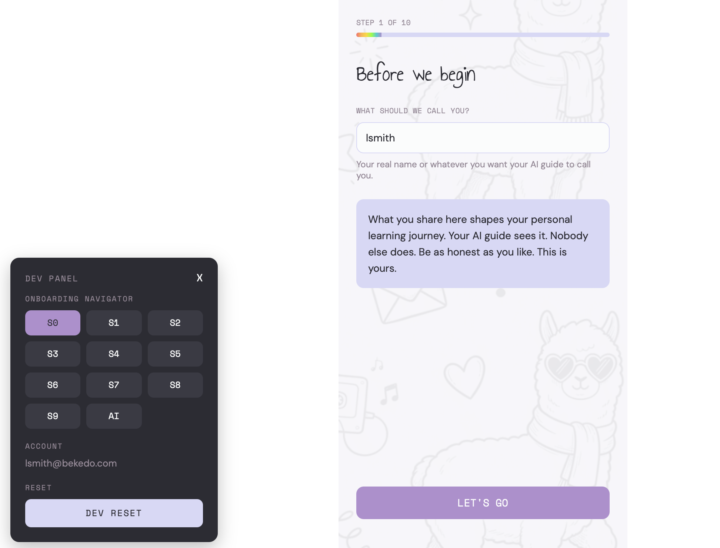
So I am a teacher and honestly I have been trying to get out of it. I have done more certificates than most people I know - I have a Masters a PGCE and I know there are so many more people in the world that are smarter, more capable and honestly doing the things they love. Like this entire community. So in order to change my perspective and get into a field that I will thrive in I started building (using Van Clief Methodology and Claude Code using free credits from Loveable to create the following- I use the client brief method) LlamaLogIt (yes like let me log it...) and the reason is that the onboarding asks questions to meet you where you are at and try to find the optimised journey for your development to get into a new career or grow in your career. And you can go Liani but like so many people are doing this... yes sure I mean it is based on the Duolingo Streaks and motivational quotes that are a bit unhinged #millennial - but it logs any course you do within the site holds your badges (like credly) gives you a personal dashboard you can share with prospective employers but my favourite part is that whilst you are doing it you can update your CV and hopefully match it with a job you like... think Jack & Jill... now is this going to work... nope... will it work for me.. yes... Is it ADHD friendly well I am trying my best...am I building it to work for multiple people (yes and this is the first time I am building for scale instead of private based which I am learning so much). If you said a few months ago I would be building something (even if turns into nothing or whatever) I would scoff and say no way. But I am building something. I am excited and I get to play! So I also added a dev panel so I can make navigation between pages easier and honestly even if no one reads this... Thanks @Jake Van Clief for giving me back my curiosity.
0 likes • 3d
@Liani Smith The best part about AI is it’s an endless playground for the doers and thinkers in this world. Keep your thinking cap on and continue moving forward and great things will happen in your endeavors. 😀
1-10 of 71

@dino-behler-4398
The AI Crypto Guy - Exploring the two technologies shaping the future of humanity.
Active 4h ago
Joined Jul 10, 2026
Louisiana
Powered by