Activity
Mon
Wed
Fri
Sun
Jun
Jul
Aug
Sep
Oct
Nov
Dec
Jan
Feb
Mar
Apr
May
What is this?
Less
More
Memberships
Tech Startup Founders Academy
224 members • Free
Clief Notes
27.3k members • Free
11 contributions to Clief Notes

8d •
I'd love ur feedback on website
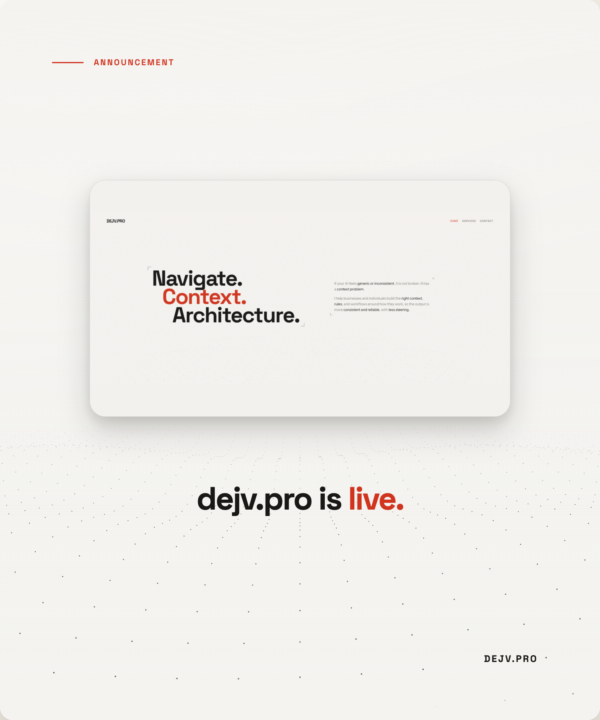
I launched my website https://dejv.pro few days ago. The goal is to consolidate my thoughts into (hopefully) understandable and comprehensive package. As I am locked "inside" i would love some outside perspective and feedback on: - What is overall feeling you get from the site/brand? - What is the message/association you get from a quick skim? - Do you find the content clear or do you feel confusion/ambiguity? - Any other insights! EDIT: Big thanks to everyone taking a time and sharing the feedback! I ve took a lot of inspiration from it and revamped the site a bit. Any feedback/insight is still appreciated! I am glad for the opportunity to get outside constructive perspectives.
0 likes • 4d
@Andrew Carter @David Vogel @Taylor Banks @Jackie Groleau @Ian McCulloch Thank you guys again for the feedback, it is great to get an outside/fresh perspective. I took inspiration from all of your and others insights and revamped the site a bit. Tha site have reached maturity in my view, but again my perspective is from inside. I would be grateful for your perspective again! If you would be so kind and took few minutes to take a look at the updated version and share your thoughts mainly on the message clarity and the ambiguities mentioned before. <3 dejv.pro
0 likes • 4d
@Ian McCulloch Thanks for the feedback! I completely see the point of "If i had not gone through the lessons here i doubt i would process the core of what your trying to communicate." I would love to hear your feedback if the updated version is making a better job in terms of "understandable communication"
8d •
on demand react graphics
Inspired by workspace-blueprint, I've built an "extension" of writing-room, which I use for linkedin posts captions. Wanted to have some consistent visual anchors under a "brand identity". post-designer takes a finalized caption, maps it to the best fitting preset supporting or visualizing the message, finds or designs icons, authors the title, labels, accents, and assembles in react canvas and outputs PNG. An important part for me is visual consistency through different post types, so it operates within a bunch of predefined rules and patterns. I am pretty happy with the results, but I have no idea how efficient this solution actually is :-D Maybe some kind of Figma/Canva mcp would get me there faster. On the other hand, that would be a potential 3rd party cost, and I would miss an opportunity to f**k around to find out ^^.

Apr 2 •
ICM folder structure help..
I have modified and followed the ICM strategy to imporve my folder structure with proper Context.md and other markdown file.. while this setup works well for Claude Code.. but i am facing issues when usung it with Github Copilot or Antigravity.. like they dont follow the instructions alot of times.. do not follow the files indexed.. etc.. i have added proper Agents.md/gemini.md/copilot-instructions.md but still the same problem Anyone else facing this problem? Please do tell me if there's a way which worked for you! Thanks
0 likes • Apr 2
in my experience Antigravity tends to drift from agents/gemini.md instructions especially in agent driven mode. There is need to enforce adherence to runtime design/instruction heavily at top of gemini.md - it makes it better but not bulletproof

Mar 20 •
Hey Jake , question for the community
I am truly amazed by your content. Will it be possible for to create a video about obsidian and claude - obsidian as a second brain ( increase memory -> efficiency) . I am asking the community: who is interested to learn about it ? I can learn by myself but I am sure you will provide tips that will take me weeks to learn.
0 likes • Mar 21
@Hayden Lee I have the same intuition here, looking forward to Jake's insight to this topic. Currently I am creating in project logs and progress keeping in intent, planning, decisions, progress and general overview and routing every session through all of them for context. I can imagine that this may be insufficient on larger scale. But with this kind of everything is in Obsidian approach I dont understand how the filtering and categorization is managed reliably so I dont yet understand the value of obsidian vault over 5 md files per project/workspace.

Mar 19 •
Rapid software prototyping.
I'm about to start recording videos about my software development workflow. I keep telling people about it but i realized after a meeting today about setting up a local vibe coding competition that i should just pump out a program or two on a live stream and then figure out how to edit it down into actual educational videos(I am NOT a teacher). The question i have is would anyone be interested in knowing about when I'm going to be on so they can sit in on the process? This is not going to be an ongoing thing. Just making a few videos to show how I do things.
1 like • Mar 19
Definitely interested! From what I caught up, you are playing on a slightly different field than many of us here. For me it is first fascinating and second valuable in similar way as Jake explaining foundations on which the AI layer exists. It might be good for you to think about whether the streams are for limited audience who can keep up with you naturally or to make sure you incorporate some connecting comments bridging toward what wider audience understands or can relate to.
1-10 of 11

Active 18m ago
Joined Mar 12, 2026
INTJ
Prague
Powered by