Activity
Mon
Wed
Fri
Sun
Jun
Jul
Aug
Sep
Oct
Nov
Dec
Jan
Feb
Mar
Apr
What is this?
Less
More
Memberships
Clief Notes
25.9k members • Free
30 contributions to Clief Notes

9h •
Helping your AI remember tasks between sessions (Session Aware Memory Management )
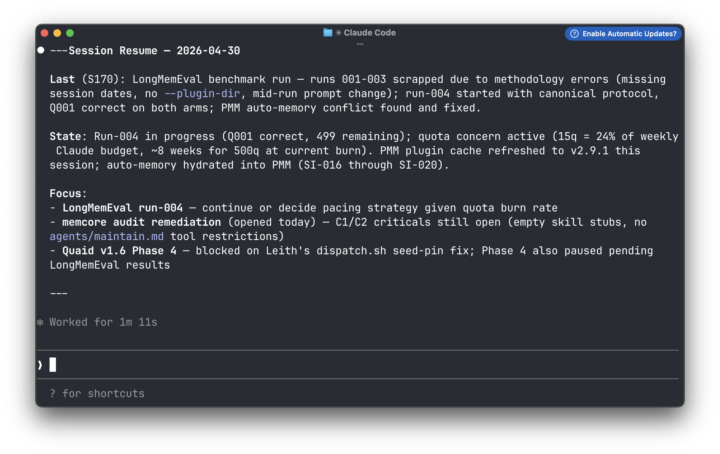
TLDR: LLMs forget everything between sessions. You re-explain yourself constantly, lose progress on long-running work, and have no reliable way to pick up where you left off — especially when switching between models or tools. I built PMM to fix that. @Deacon Wardlow helped me improve it by identifying a specific gap: session continuity — what changed, what’s still open, where you stopped. That’s now live in PMM v 2.8. Edit: I figured screenshots tell a better story => same memory on three different tools with 3 different models, where I've asked the LLM to basically recall outstanding tasks across the 4-5 current projects. Slightly different perspectives because I'm working a slightly different project with each model. I initially built PMM to remember stuff beyond the context window to fix an issue i had with the LLMs I use failing to remember and recall over long conversations. I used it to have the same conversation, while switching between Claude Code CLI and Co-work. Eventually it became a tool for helping me with continuity in my conversations with different LLMs on different apps and harnesses ( I switch a lot between Claude, OpenCode and GitHub Co-Pilot). I now use it to give multiple agents long-term memory (while they switch between different models on Claude, Gemini, Model Ark and a couple of smaller local models) without the use of model routing. I currently deploy it (along with with another agentic plugin I developed) to give agents long-term individual and collective organisaitonal memory in their conversations with multiple users over telegram in a small pilot. @Deacon Wardlow tested PMM in his own workflows, identified a gap in session memory management, and tried a couple of changes, which he outlined in another thread discussing Session Memory Layer + PMM

1 like • 6h
Solid buildout. Let’s keep it evolving.
2d •
Seeking Architecture & Distribution Advice: 85+ Empathy-Driven Life Guides (Pro-Bono / Open Source)
I've spent the last few months building a library of 85+ practical guides for the hardest life situations people face - widowhood, losing a home to foreclosure, military-to-civilian transition, navigating executorship, first apartment, making friends as an adult. The kind of stuff people are Googling at 2am with no one to call. Each guide includes an integrated AI prompt. You fill in your situation, drop it into Claude or a model the person has access to, and it becomes a grounded companion that gets to know your particular circumstances - not a generic response, but one anchored to the specific guide you're working through. The goal is to give people a safe place to ask the questions they're too embarrassed or too isolated to ask another person (I've built-in safety sets and responses to ensure people don't give the AI sensitive information). I have zero interest in monetizing this. I really just want to find a way to help the most people without them having to pay for the assist (they have enough on their plate if they're using one of the guides). Here's where I'm stuck. The guides work. The delivery doesn't. Right now everything lives as .docx files. That's not a real product. I want to move toward a proper web app, then mobile. Three problems I don't have good answers to: Context loading. What's the cleanest approach to make sure the AI is reading the specific guide a user is looking at - not just running off a generic prompt? RAG? Direct document injection? Something else I'm not thinking of? API costs. Companion prompts at any real scale get expensive fast, especially for a free-to-user app. Are there AI for Good grant programs or API credit programs - Anthropic, Google, OpenAI - that fit a project like this? Architecture for handoff. As I'm building this to give it away, what stack gives a small non-profit with minimal technical capacity the best shot at maintaining it long-term? Longer shot, but genuinely asking: does anyone know an organization or NGO that's actively looking for something like this? A fully built content library with AI companion infrastructure, no strings attached.
0 likes • 2d
@Mars B. Thanks. I’m leveraging NotebookLM to research to transition to MD for Claude’s reference and a framework I’ve built with JSON so Claude can start a conversation knowing everything on the document build. Transition to an app should be fairly fluid but as I look at the larger scope, I realize I’ll need a bigger org to support real use of this (ideally beyond just USA). I may reach out to Anthropocene as well since they have divisions for work like this.

🚀
⭐
4d •
🎉 New Course: Davids Corner
🎉 Meet your new admin: @David Vogel Some of you have been watching this happen in real time. David has been quietly turning his "Show Your Work" posts into one of the most useful threads in this community for months. Resource roundups, deep-dives, honest takes on what's actually working in production. No fluff. No hype. 🛠️ So I gave him the keys. 🔑 David is now an admin of Clief Notes, and he has his own classroom: 🏛️ David's Corner. Go check it out. AI Acronym Overload? Here's the Cheat Sheet - Davids Corner 📂 What's in David's Corner He started with the resource post a lot of you bookmarked last week and has been steadily expanding it. As of right now you'll find: 🔥 Must Have Resources - 🎨 Looking for design inspiration? - 🧠 AI Acronym Overload? Here's the Cheat Sheet - ⭐ Some of My Favorite Resources 📚 Learning for Everyone - 🥊 Obsidian is BLOAT! Batter Up - 💰 Flip the Script — It's all about the $$$ - 👻 Do You Have a Soul? - 🔄 My AI Workflow Evolution 👨💻 Developer Resources - 🕵️ LEAKED: Ten Prompts from Experts - ⚡ Introducing the Hermes Stack 🎯 David and Jakes Picks (this one's going to grow) Plus he's curating trusted YouTube channels and a running list of favorite community posts on resources inside the corner. So if you wrote something good about a tool, a stack, or a workflow, that's where it might end up. 👀 He's adding more weekly. If something stops delivering, he wants to hear about it. That's how the corner stays sharp. 🔪 💡 Why this matters The Vault and The Drawing Room give you my methodology. David's Corner gives you a second lens. Same standards (battle-tested, no theory, no marketing slides), different angle. He's been in the trenches with tools and stacks, and he writes about them honestly. ✅ What you can do 1. 🔖 Go bookmark David's Corner in the classroom 2. 💬 Drop a comment under his posts when something works (or doesn't) 3. 📨 Got a resource that should be in there? Tag him. He's curating.
3 likes • 4d
Keep bringing the awesome. The more we all share, the better we get.
6d •
Session Memory Layer + PMM - Never Lose Context Again in Claude CoWork
Here's the problem Claude CoWork doesn't solve out of the box: continuity. Every session starts cold. Claude doesn't remember what you worked on last Tuesday, what decision you made and why, or what you told it to follow up on. You either re-explain everything at the start - or you lose the thread entirely. PMM (Poor Man's Memory), originally inspired by Millennial Cat's work (excellent stuff - definitely check out his threads!), solves the first layer. It gives Claude a structured knowledge base to read at session start. Your contacts, your rules, your processes, your decisions - all formatted as typed markdown files Claude loads before doing anything. But PMM solves what Claude knows about you. It doesn't solve what you and Claude worked on together yesterday. Session Memory Layer solves that. Together, they're a complete two-layer memory system. --- What Each Layer Does PMM — Curated domain knowledge - Who your contacts are and what they need - Your rules, decisions, and processes - Your terminology, preferences, and brand context - Loaded by workspace (sales, writing, legal, etc.) based on routing rules in CLAUDE.md Session Memory Layer - Working continuity - What was worked on in the last 10 sessions (rolling log) - What's still open and needs follow-up (persistent thread tracker) - Loaded at *every* session start, regardless of domain - Updated at *every* session end, automatically Think of PMM as your institutional knowledge base. Think of Session Memory as your working memory - the part that remembers "last time we were halfway through that proposal." ------- The Two Files Session Memory Layer lives in two markdown files. That's it. ### session-log.md A rolling 10-session history. Each entry is lean (about 6 fields, roughly 6–8 lines). It captures: - What was worked on - Decisions made - Files created or modified - Contacts touched - Open threads created - Threads closed Newest entry at the top. When you hit 11 sessions, the oldest one drops off.
1 like • 6d
@Millenial Cat solid recommendation. I’ll test that out to improve the continuity. Extending the startup protocol to trigger post-compact is excellent. This group keeps coming through to help make the system better.
0 likes • 4d
@João Paulo similarly to Millennial Cat, I archive sessions that fall off at 11 as I may want to revive them, but considering the focus of my workflow, it’ll be rare I go past 8 separate sessions as I tend to cycle through a few key workflows. I haven’t seen the redundancy with PMM as sessionnlauered memory is built to compliment PMM, but I’ve also only been running this for a week (I literally created this set last week and shared it once I saw it’s working as intended). Redundancy might be an issue, but not yet. If I skip wrap up, I just drop in that conversation and run it. Sometimes I don’t want to retain the conversation in memory as it’s a test - so it’s good to have tha option to control what continues vs what’s dropped. I tend to add some extra checks with reporting and metrics so I can quickly verify what was written and if I need to touch it. So far it’s good, but having that 30% check helps keep things clean and operating right. Easy to let something slide and issues incrementally build. I tend to treat Claude as a super assistant, I avoid any multitasking and keep the todo clean and sequential so if something gets built and is t right, I can rewind to where things went wrong, adjust and move forward. Parallel tasks are run only to verify reliability of output and strength of a particular process against itself. It’s been a long time since I was a programmer, but getting back into it now has been fun and it’s a bonus all this work directly benefits me as the inprovements help me get more out of Claude and the models I use.

7d •
What ICM looks like at scale: 372 pages in 3 days
Update from the floor at eMerge Americas 2026 in Miami. Before I drove down, I built every exhibitor at this conference their own custom landing page. One person, 3 days, 372 unique sites, each one tuned to a specific company's stack, brand, and AI posture. Forget the logo-swap template thing. Each page is real research. Every site has: - A Big-4-grade read on the company (filings, leadership moves, where AI actually shows up in their stack) - Their brand kit pulled live from their own site (logo, color palette, typography, voice) - A specific thesis on where Eduba fits inside what they already have - Matching case studies from our book of work, routed by vertical - Our 60/30/10 rule applied to their stack, showing exactly where traditional code, rule-based logic, and AI each belong in their environment - My Calendly at the bottom When I walk up to a booth, I already know the company. They already have a page. The conversation starts three beats ahead of where it normally starts. ——— The part nobody is talking about yet. 372 pages is the headline. The bigger unlock was what came after. Once every exhibitor had a page, I fed the whole list back through the folder system and had it score each company across a tiered rubric I wrote: deal size fit, stack readiness, decision-maker presence on the floor, vertical match to active Eduba case studies, and signal strength from their recent moves. Out came three tiers: - Tier 1 (hit first, hit hard): companies where the thesis is strongest and the buyer is likely walking the booth - Tier 2 (warm pass): worth a 5-minute stop, drop the page link, follow up - Tier 3 (skip or graze): acknowledge, move on Then I asked it to build me a walking game plan. Booth numbers, floor map, tier order, clustered by physical location so I wasn't walking the same aisle twice. Morning route, afternoon route, with buffer built in for the Tier 1 conversations that were going to run long.
0 likes • 6d
Great unique approach to making your mark with prospects at a show.
1-10 of 30

@deacon-wardlow-5364
Deacon speaks many languages, pulls espresso, and bartends. Equally comfortable closing a deal or making the drink you need after one falls through.
Active 6h ago
Joined Mar 16, 2026
INTJ
Boulder, Colorado
Powered by