Activity
Mon
Wed
Fri
Sun
Jun
Jul
Aug
Sep
Oct
Nov
Dec
Jan
Feb
Mar
Apr
May
What is this?
Less
More
Memberships
The Energy Data Scientist
691 members • Free
Data Engineering Community
431 members • Free
7 contributions to The Energy Data Scientist

8d •
PDF on China-Australia energy cooperation
I was at a conference, and this is a presentation by a China Analyst, Climate Energy Finance at a conference on Australia–China green economy cooperation. Key points are: - China dominates global clean energy and clean tech manufacturing, holds ~40% of global solar, leads global EV sales (2.4 million in Q1 2025, +36% YoY), and controls over 80% of global manufacturing capacity across 11 clean-tech supply chain segments (solar, batteries, critical minerals processing). - China is Australia's #1 trade partner and offers the world's lowest-cost, most advanced clean tech. - Government needs to build an enabling environment through a future-oriented national China strategy, bilateral decarbonisation agreements, clearer foreign investment rules

0 likes • 4d
@Luis G Thanks for asking. My focus is on photovoltaic as well as energy storage.
0 likes • 4d
@Dr J Fid Yes in my opinion because MSc is two-dimensional—it helps build your research skills, especially if you are interested in future PhD programs, and it can also improve your industry perspective by exposing you to current technology and emerging trends yet to be explored. An MSc can also help you make more informed decisions, including understanding current politics and geopolitics, which is very important depending on your drive—especially in fields like energy

Oct '25 •
Start Here
Welcome to The Energy Data Scientist. This community helps you with your quantitative work in the energy sector, through a personalized self-study program and direct supervision. You also receive full career support. Specifically: 1️⃣ Access to 120 online courses on real-world energy application of data science, machine learning, and optimisation. 📎 Download the course catalogue PDF below to see all 120 courses. 2️⃣ Personalized suggestions on which courses to study next based on your skills and career goals. 3️⃣ Daily support on your progress with the online courses as well as your studies and work projects. 4️⃣ Full support during job applications, with aligned CV and cover letter design. 5️⃣ Weekly job ads for energy roles in industry and academia. About me: I am Dr Spyros Giannelos, with a PhD in Energy from Imperial College London. I have published extensively across energy systems (1400+ citations, h-index 26 on Google Scholar) and with extensive experience in private, government, and European energy projects. To get started: [Subscribe here]
10 likes • Mar 2
Thank you for the invite
1 like • 7d
@Kahu Ngata Thank you

18d •
Portfolio Manager on Exxon Stock
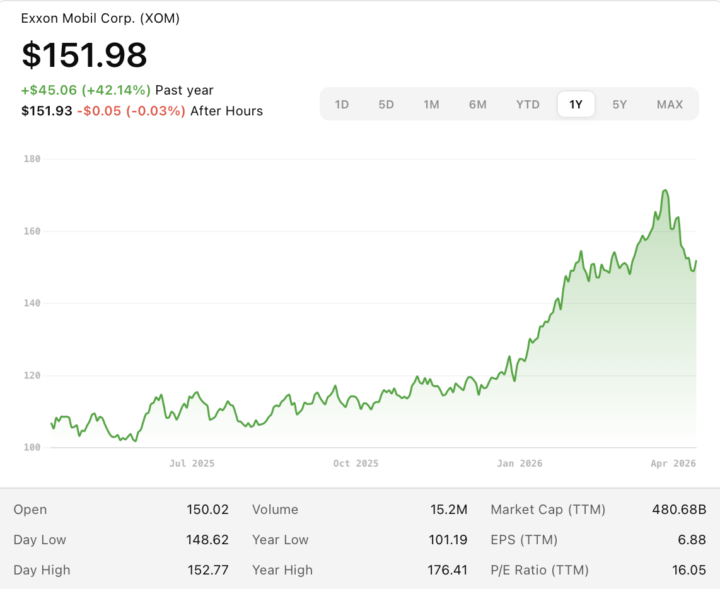
Was chatting with a portfolio manager on the Exxon stock price. See plot which is here attached. It shows Exxon Mobil’s stock price (XOM) over last year until now. XOM is the ticker symbol for Exxon Mobil on the New York Stock Exchange. On 28 February the US and Israel struck Iran, and because roughly a fifth of global petroleum consumption passes through the Strait of Hormuz, markets instantly priced in a supply disruption and so Brent jumped about 43% in March. XOM tracked it almost tick-for-tick. XOM tracks Brent very closely. See that the stock was relatively flat for much of 2025, then rose sharply in early 2026, and later pulled back a bit. So at some point, the market became much more positive about Exxon, likely because of stronger oil and gas expectations. See for example the second attached plot . The blue line is Exxon Mobil’s stock price, and the orange dashed line is Brent crude oil. Before late February, both move around, but nothing dramatic happens. Then, around Feb 28, both jump sharply: Brent rises from about $70 to about $104 per barrel, and Exxon jumps to a March peak of $176.41. After that, both come down. So the message is that a geopolitical shock pushed oil prices up quickly, and Exxon’s stock moved up with it. When oil goes up fast, investors expect a company like Exxon to earn more cash, so the stock price also rises.
1 like • 14d
@Dr. Spyros Giannelos How do investors decide whether to buy oil stocks after a geopolitical shock?
1 like • 13d
@Dr. Spyros Giannelos Thank you Sir

Mar 10 •
Uncomfortable truths for Workplace
I see many students who want to stay home and so they ask for remote work all the time. Also I see many who go to work and do not dress well. Here is the truth for the job: Truth1: Go 3-4 times every week to the office so others see you. Your presence is very important. Smile and be professional. This plays a role for your promotion. If you stay home most of the time, you will not be promoted and people will forget you. Truth2: Do not use AI a lot at workplace because every computer has trackers and gives your managers a distribution of time (with plots) of how much you used AI and for how long. There is a software (hidden) that summarises your activity on the computer at work. So be careful : if they see that you cannot write code, and all you do is copy-paste from Chat GPT the code, they will fire you sooner or later. Silently one day they will fire you and they will not tell you why most likely. Be careful. Also you can use it on your phone, but it is time consuming.. Ofcourse they have AI tools but you must write code yourself. Truth3: If you go to non-code positions, it is more stressful and more competitive than code positions. Often, you get lower salary also. Because people in energy are scared of coding, and do not like it. So you get an advantage if you can code , understand code etc. Not super . Just basic things. Eg understand Python . Understand ML. etc Truth4: Do not share personal stories with co-workers. They are competing with you for promotion so they want you to fail ... Be careful. Do not share sensitive things. Truth5: Becareful of your social media presence. Managers spy on you e.g. they have fake profiles and are your friends. They will find your second, third etc profiles. They can find your anonymous X profile where you troll people . They have the ability to find you because they have software tools that you do not know . Truth6: yes the online courses here are all you need. But please fix your CV. Align it with energy companies. Do not just design your CV yourself. Get feedback here. Most CVs look rubbish. Try work on your CV carefully.
1 like • 14d
Thank you for sharing 🙏
20d •
New Course: Fundamentals of Energy Economics for Electricity Grid Planning
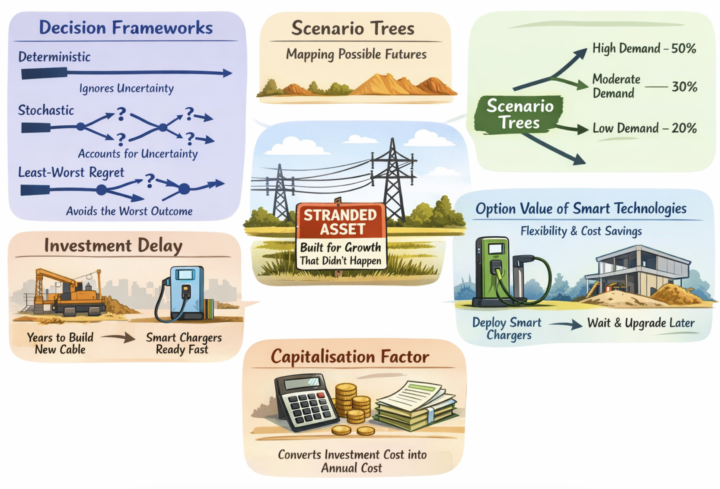
Just released a new course on energy economics, covering important economic concepts behind investment decisions in electricity distribution networks. You'll learn about - decision frameworks (deterministic, stochastic, least-worst regret), - scenario trees, - stranded assets, - option value of smart technologies, - investment delay. All concepts are illustrated through a practical example. No prerequisites. Ideal if you're preparing for energy economics or power system economics roles, or doing research. It is course 120 at the very end of the Classroom. Briefly here are the definitions of fundamental economic concepts in power systems: - Decision frameworks: these are approaches that network planners use to decide where and when to invest in power systems. These frameworks are: deterministic (ignores uncertainty), stochastic (accounts for uncertainty and probabilities), and least-worst regret (accounts for uncertainty but not probabilities). - Scenario trees: A way to map out possible scenarios. Demand might grow a lot, a little, or not at all. The tree captures these paths and their probabilities. - Investment delay: Some investments take longer to build than others. Upgrading a cable might take years; deploying smart chargers can happen faster. This difference matters hugely for planning. - Stranded assets: You invest in upgrading a line expecting electricity demand to grow, but it doesn't. Now you've paid for capacity nobody uses. That's a stranded asset. - Option value of smart technologies: Smart technologies like smart chargers can be deployed quickly, letting planners wait and see how uncertainty plays out before committing to expensive upgrades. The cost savings from having this flexibility is the option value. - Capitalisation factor: Converts a one-off investment cost into an equivalent annual cost, accounting for the asset's lifetime and the discount rate. Attached is a summary slide, and a slide on the concept of option value and stranded assets. No need to fully understand these screenshots . Just to get an idea of what the course teaches.
3 likes • 14d
Thank you sir
1-7 of 7

@dauemi-burutolu-5761
Sustainable Energy MSc| Smart grids, hybrid systems & energy storage | Python, data science & techno-economic analysis | Low-carbon innovation
Active 2h ago
Joined Apr 13, 2026
France