Activity
Mon
Wed
Fri
Sun
Jul
Aug
Sep
Oct
Nov
Dec
Jan
Feb
Mar
Apr
May
Jun
What is this?
Less
More
Memberships
DeFi University
291 members • Free
10 contributions to DeFi University

26d •
Independent AI agent?
Hello team, Have you guys seen this? An AI agent doing your investing for you? Alex Walch from UIG fame created an ai bot that does independent market and chart analysis and manages it's own portfolio, that generated over 10% profits in fees in two weeks, while suffering only mild IL? What do you guys think? https://youtu.be/HjuYTKK_9zw?is=1Sr9CUvKrfLUqJcw

2 likes • 7d
I tried the protocol for a few days, closed my positions and bought BTC instead. I am not an expert, but I’ll give credit where it’s due: Snuggle automatically rebalances your position when it goes out of range, without swapping. That’s a legitimate improvement over traditional rebalance. No manual work. But it does NOT eliminate the structural IL problem. In trending markets you will still underperform vs HODL no matter how smart the rebalancing is. In my opinion, the ~50% less IL claim is just marketing. I could not replicate anything close to that number in real conditions. I’d rather just hold BTC.

Dec '25 •
🎯 The Complete Truth About Uniswap V3 Liquidity: A Quantitative Guide
💡 Introduction: Beyond the Triple-Digit APRs If you've spent any time in DeFi, you've seen them: eye-popping triple-digit APRs on Uniswap V3 liquidity pools. They promise substantial returns and tempt you to deposit your capital, imagining a steady stream of passive income. It seems like the pinnacle of "yield farming"—set your position and let the fees roll in. But this alluring picture is dangerously incomplete. 🚨 Providing liquidity on Uniswap V3 is not a passive, set-and-forget activity. It is mathematically equivalent to actively trading complex financial derivatives. The "yield" you are supposedly farming is, in fact, the premium you receive for underwriting significant, often hidden, risks. This guide reveals the mathematical truths that every Uniswap V3 liquidity provider (LP) must understand. These insights cut through the marketing to expose the structural costs and risks that can turn a seemingly profitable position into a financial drain. 🎭 Truth #1: The "APR" You See Is Not Your Real Return The most prominent number on any analytics dashboard—the APR—is only half the story. It represents your revenue, but it completely ignores your structural costs. The Hidden Cost: Loss-Versus-Rebalancing (LVR) The displayed APR is your Fee Yield. This is the gross income generated from swap fees collected by your position. However, to get this revenue, you incur a hidden and unavoidable cost known as Loss-Versus-Rebalancing (LVR). What is LVR? 📉 LVR is the money your position systematically loses to arbitrageurs. Because the Uniswap pool price only updates when someone trades, it often becomes "stale" compared to the true market price on major exchanges. Arbitrageurs profit by closing this gap, and they do so at your expense. They are essentially forcing your position to "buy high and sell low" relative to the real-time market price. The Real Profitability Formula Your real return is a simple subtraction: Real Return ≈ Fees - LVR The critical decision rule: a position is only viable if its Net Yield is strictly positive. If the fees you earn are only equal to or less than the LVR, you are taking on significant smart contract and market risk for zero or negative expected profit.

3 likes • Dec '25
Great article. It honestly lines up almost perfectly with the conclusions I came to on my own. My approach is pretty straightforward: I look at realized volatility, calculate the expected monthly move using 2 standard deviations (95% confidence), and then cross-check that range with basic technical analysis. For ETH, that pointed to a statistical range of roughly $1,700–$4,100. When I opened the position, I chose $2,100–$4,000 instead (strong support on the downside and a clear psychological resistance on the upside). What I’ve noticed over time is that wide-range LPs almost always have positive P&L over few months or longer, while narrow ranges look great on APR but force you into constant rebalancing, which slowly bleeds P&L. The article basically explains why that happens.
Nov '25 •
The Ether Condor Strategy: A Market-Neutral(ish) Approach to ETH Yield Generation 🦅
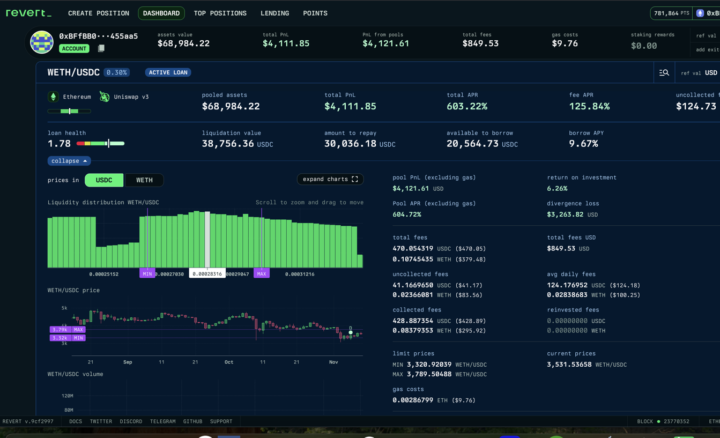
Hey DeFi fam! 👋 Today I'm breaking down an advanced strategy that combines concentrated liquidity provision with perpetual futures hedging - I call it The Ether Condor. Here's a calculator that shows all of the inputs, unfortunately the results section calculations don't work, but you can see all of the inputs for the strategy in one place. That makes it a bit easier to understand the strategy. Divergence Loss (Impermanent Loss) Research Strategy Overview 📊 This is a delta-neutral(ish) yield farming play that aims to harvest both LP fees and funding rates while minimizing directional risk on ETH price movements. The Setup (3 Steps) 🎯 Step 1: Deploy Your Concentrated Liquidity Position 💧 - Allocate 20 ETH to a WETH/USDC pool on Uniswap V3 (Ethereum mainnet) - Use the 0.3% fee tier - ⚠️ Critical: Set your range intentionally OUT OF RANGE (all in ETH) - This positioning is key to the strategy's mechanics Step 2: Leverage Your Position 💰 - Head over to Revert Finance - Borrow 40% of your LP position's USD value in USDC - This gives you working capital without selling your LP tokens Step 3: Create Your Hedge 🛡️ - Take 20% of your LP's USD value as initial margin - Open a SHORT perpetual futures position on GMX - Size = exactly the number of ETH you deployed in Step 1 (20 ETH short) The Math Behind It 🧮 Profit Conditions: Your position becomes profitable when: ✅ CLP Yield + Funding Rate Yield > Divergence Loss on the CLP Risk Profile: - 🔴 Maximum loss scenario: ETH makes a sharp move higher before your CLP fees have time to accumulate - ⏰ The key is that fees need time to offset any divergence loss from price movements Why This Works 💡 1. You're earning from two yield sources simultaneously (LP fees + funding) 💵 2. The short perp hedges your ETH exposure from the CLP 3. When funding rates are positive (longs paying shorts), you're getting paid to hedge 4. The borrowed USDC can be deployed elsewhere or used as additional buffer
1 like • Nov '25
Why is it critical to open an LP fully out of range (100% ETH)? What would be the downside of setting it slightly in range, for example, creating a position that’s 90% ETH and 10% USDC (e.g. 18 ETH and 10% USDC value at current price)? Would it then make sense to size the short hedge only against the ETH portion (e.g. short 18 ETH instead of 20)? Thanks.
0 likes • Nov '25
@David Zimmerman just curious why you created a position on ETH and not on Arb or Base?
Nov '25 •
🔥 Market Intelligence Update: Critical Week Ahead (Nov 17-23)
What's happening right now that matters for your portfolio 👇 📊 The Macro Picture We're entering a CRUCIAL data week with the September jobs report (Thursday) and FOMC minutes (Wednesday). The Fed's getting increasingly cautious - at least 5 officials are now questioning December rate cuts. Kashkari's quote says it all: "When it's foggy, let's just be a little careful and slow down." 🚨 Market Stress Signals - Corporate bankruptcies hit 15-YEAR HIGH (655 YTD vs 687 for all of 2024) - Unusual market action: Stocks AND bonds falling together - Credit spreads failed to confirm recent equity strength (early warning sign) - CTA/volatility control strategies likely net sellers here 💻 AI Trade Under Pressure The AI narrative is facing serious headwinds: - Open-source models (Kimi K2) performing at fraction of GPT costs - Capital becoming THE bottleneck (not just chips/power) - Oracle credit concerns widening - Market questioning massive capex ROI 🪙 Crypto & DeFi Update Price Action: - BTC: $98,329 (-2.61% WoW) - rejected at psychological $100k - ETH: $3,174 (-3.92% WoW) - $463M in liquidations when BTC pulled back from $100k The Bright Spots: 🌟 - USDC exploding: $73.7B circulation (+108% YoY) - Circle net income: $214M (+202% YoY) - Stablecoin rails strengthening everywhere - Major regulatory clarity coming (CFTC leveraged spot trading, UK stablecoin regs, IRS staking guidance) 🎯 Actionable Strategy for This Week Near-term positioning: 1. Stay cautious - Let de-risking run its course 2. Watch credit spreads - They're telling us something's off 3. DeFi focus: Lean into stablecoin infrastructure plays, onchain FX, tokenized funds 4. Key levels: BTC $100k psychological, monitor for stability What I'm watching: - Thursday's jobs report (GS expects +80k NFP) - NVDA earnings (Wed) - Critical for AI capex signals - Credit market deterioration (especially in Industrials/Consumer Discretionary) - Stablecoin adoption metrics
0 likes • Nov '25
@Juri Bastiaans that’s a good strategy but the DCA into an asset is not guaranteed. What if the price never reaches your downside range and instead moves back up out of range on the top side? For example, if you enter single-sided on Solana at 140 with a range of 125–138, and price never falls below 125 — then you don’t accumulate 100% SOL at all. In that case, what is the exit strategy? Exit the position at 130 for example? Thanks for your feedback
Nov '25 •
Bitcoin Weekly SMA200 Pattern – Potential Cycle Top Signal?
Hi all. I recently came across an article that discussed an interesting historical pattern on Bitcoin’s long-term chart. In every major cycle so far, the cycle top tended to occur once the 200week SMA reached the price level of the previous cycle’s all-time high. This dynamic appeared in the transitions from the 2013 cycle to 2017 and again from 2017 to 2021, where the cycle peak happened around the time the weekly SMA200 climbed up to the old ATH. Applying that same idea to the current cycle, the previous top sits around 66k, while the weekly SMA200 is currently near 55k and still trending upward. If the historical pattern were to repeat, the area around 66k could potentially act as the next cycle top once the SMA200 reaches it. Of course, there’s no guarantee this plays out the same way again, but it might be one more indicator worth keeping in mind when thinking about where this cycle could eventually peak.

1-10 of 10

Active 3d ago
Joined Oct 26, 2025
Powered by