Activity
Mon
Wed
Fri
Sun
Apr
May
Jun
Jul
Aug
Sep
Oct
Nov
Dec
Jan
Feb
Mar
What is this?
Less
More
Memberships
DeFi University
260 members • Free
AI Developer Accelerator
11.1k members • Free
The AI Advantage
76.2k members • Free
AI Profit Boardroom
2.6k members • $59/m
6 Figure Tech Freelancer
6.4k members • Free
5 contributions to DeFi University

2d •
🤖 OpenClaw: AI Agents With Hands
Hey fam! 👋 Most users are trapped in "goldfish memory" interfaces where AI resets after every browser refresh. 🐠 OpenClaw, developed by macOS expert Peter Steinberger, represents a fundamental shift toward persistent, local-first autonomous agents. Originally known as Clawdbot (and briefly Moltbot), this framework gives an AI "hands" — the ability to execute terminal commands and manage local files natively on your hardware. 💻 🎯 The Paradigm Shift By moving the cognitive layer from a remote cloud tab to your local system, your Mac becomes an active collaborator rather than a passive tool. 🤝 This architecture allows the agent to interact with macOS-specific integrations like Apple Notes and Reminders, performing tasks that standard LLMs simply cannot reach. 📝 Let me show you 7 things you probably didn't know your Mac could do with AI. 👇 🙌 1. The Agentic Shift: Giving AI "Hands" The difference between ChatGPT in a browser tab and OpenClaw is like the difference between talking to a consultant vs hiring an employee. 💼 ChatGPT in browser: 🗣️ Resets every session (goldfish memory) Can only talk, can't execute No access to your files No persistence across conversations OpenClaw: 🤖 Persistent memory across all sessions Executes terminal commands Manages local files natively Integrates with macOS (Notes, Reminders, etc.) Translation: OpenClaw isn't just answering questions. It's DOING things. On your Mac. While you're away. This is the agentic shift. 🚀 🧠 2. Your AI has a "Soul" (and It's a Markdown File) OpenClaw rejects opaque cloud databases in favor of a "local-first" data architecture. Every personality trait and memory is stored in human-readable Markdown files within your ~/.openclaw/workspace/ directory. 📁 This transparency ensures that you — not a service provider — own the agent's "brain." 🔐 📄 The Three Core Files SOUL.md: 👻 Defines the core personality, tone, and behavioral constraints Example: "You are a concise, technical assistant who prefers terminal commands over GUI"


0 likes • 2d
Is he my to do list to do this agent zero looks very good too
7d •
Lightning & Nostr Theme Song by Chunky D
Check this out, listen to the lyrics, its all about Lightning/Nostr terms: https://suno.com/s/auWqm3dEiwHVgBE7
1 like • 7d
🤣
13d •
📊 The Structural Edge That's Been Hiding in Plain Sight for 30 Years
Hey fam! 👋 Let me hit you with a statistical fact that changes everything about how you should think about options trading: The options market has systematically overpriced volatility for over 30 years. Not occasionally. Not sometimes. Persistently. 📈 🔍 The Numbers Don't Lie From 1990 to 2018, the VIX averaged 19.3% while the S&P 500's actual realized volatility averaged only 15.1%. That 4.2 percentage point gap is a structural anomaly, and it has shown up year after year, across market regimes, confirmed by academic studies from: 🎓 Princeton 🎓 EUR Erasmus 🎓 CBOE This isn't theory. This is documented, peer-reviewed, academically verified edge. And I built a free educational resource that breaks down exactly how to build a mechanical process around it. 🎯 📚 Introducing: Options Strategies — Statistical Edge Analysis This isn't a trading course or a Discord signal group. It's a research-backed breakdown of the quantitative foundation behind 7 systematic options strategies — the kind of rigorous, data-driven analysis you'd typically find buried in an academic thesis. 🧠 Every claim cites primary sources. Every performance number comes from CBOE index studies, peer-reviewed papers, or documented backtests. No opinions dressed up as strategy. ✅ ⚡ The Three Edges Everything Is Built On 1️⃣ Volatility Risk Premium (VRP) IV has overstated realized vol by ~4.2pp on average over three decades. Translation: Options buyers consistently overpay for insurance. Option sellers collect that structural overpayment. This is the foundation. 💰 2️⃣ Theta Decay Acceleration Extrinsic premium decays non-linearly. The 45→21 DTE window is where it bleeds fastest. Knowing when to enter and exit is as important as knowing what to sell. This is the timing edge. ⏰ 3️⃣ IV Mean Reversion Implied volatility is bounded. High IVR environments revert, generating "IV crush" alpha even when the underlying doesn't move at all. You can make money when the market goes sideways. This is the volatility edge. 📉

0 likes • 11d
cool
Jul '25 •
Welcome to DeFi U!
Hello everyone and welcome. As we begin building out DeFi University together, please know that any ideas you may have for a new tool, a new live call, a new course, anything that you'd like to build or incorporate in to add more value for us, the community members, that is 100% a yes here. This community is AI first, which simply means that we learn together how to use AI tools to build what will generate more value for us, the community members. We hope to foster an environment of learning and growth in many different areas of life within our DeFi University community, and now with these new AI tools any suggestion that any member has which will add value can quickly be built out and incorporated in. It's a very exciting and transformative time that we live in. To foster a sense of community spirit, please introduce yourself in the general chat as you join, and share a bit about yourself so that we can all get to know one another better. Live calls in the community take place every day Monday through Friday and they are open to all members. See you on the next live call and in the DeFi U chats! -David
3 likes • 14d
I started in crypto in 2020 mining with GPU rigs, which taught me a lot about networks, hardware, and market cycles. When mining margins shrank, I shifted fully into investing and trading. Since then, I’ve been focused on understanding market structure, risk management, and long-term positioning. I also invest in stocks and follow broader markets closely. Recently I’ve been diving into AI, and it’s impressive how much more I can get done in less time using it. These days I split my time between my full-time job, AI, crypto, stocks, and growing my own food. Excited to connect, learn, and share ideas.
Feb 6 •
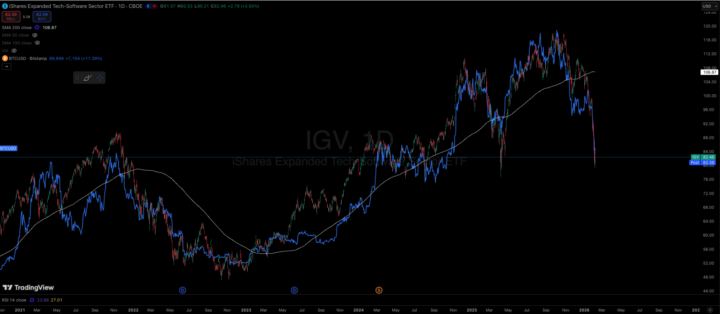
📊 BTC x Software: The Correlation You Can't Ignore
Quick observation from the charts: Bitcoin and IGV (iShares Expanded Tech-Software ETF) have been moving in near-lockstep since 2023. What we're seeing: - Both assets rallied hard through 2024, peaking around the same time - The recent pullback? Nearly identical trajectory - BTC currently at ~$69.9k, IGV at $82.46 - both down from recent highs Why this matters: This tight correlation tells us Bitcoin is still trading as a risk-on tech asset, not the "digital gold" narrative many hoped for. When software stocks sneeze, BTC catches a cold. For DeFi investors: - Macro tech sentiment matters MORE than you think - Fed policy, tech earnings, and Nasdaq movements should be on your radar - Diversification within crypto alone isn't true diversification if you're ignoring the tech correlation The days of "BTC is uncorrelated" are behind us. We're in the institutional era now - which means macro matters. What are you watching to gauge risk sentiment? Drop your thoughts below. 👇 Not financial advice. Chart analysis for educational purposes.
1 like • 14d
Fear and greed indexes
1-5 of 5

@daniel-santiago-8281
Just a normal guy working of being a better version of myself.
Active 6m ago
Joined Feb 25, 2026
Powered by