Activity
Mon
Wed
Fri
Sun
Jul
Aug
Sep
Oct
Nov
Dec
Jan
Feb
Mar
Apr
May
Jun
What is this?
Less
More
Memberships
Conversation OS™
1.3k members • Free
Imperium Academy™
66.2k members • Free
AI AUTOMATION INSIDERS
4.3k members • Free
ship - mobile app founders
1.4k members • Free
ChatGPT Users
12.7k members • Free
Aminos Community
6.2k members • Free
Machine Room
619 members • Free
48 contributions to AI AUTOMATION INSIDERS

May 4 •
Turn Claude Into a Precision Editor
Hello nerds. Claude writes solid copy. Editing it is the part that breaks. You ask Claude to tweak one line in a 2000-word script and it rewrites half the doc. Every time. So I built one command to fix this: "notes". Here's what "notes" actually does: 1. I type "notes" to Claude after it generates the long output. 2. It pulls the full script out of the chat and opens it cleanly in my browser. 3. The script loads into a proper editing interface, not a chat window. Now the workflow flips. Instead of re-prompting, I highlight the line I want changed and leave a comment on it. Claude reads the comment in context and rewrites only that line. The rest of the doc stays untouched. It's the difference between fighting with a chatbot and working with a real editor. This one command saves me hours a week on scripts, ads, emails, and long content drafts. Now, to make this work behind the scenes, there’s a bit more going on. But if you want access to the exact “notes” command - with all the skills and setup files you need just comment “Notes” below and I’ll send it over.

0 likes • May 6
Here is how to work a solution to Claude constantly rewriting larger files, without fussing about with code, and it is just as capable (well, about 70% as capable as the code solution at least. 🤣😁). Simply use Claude Artifacts’ native highlight editing for the fastest, lowest effort. There are other code-based options if you’re using Claude Code, but I’m making the assumption that most will be using the web interface. Artefacts automatically appear as a side panel/separate preview window beside the chat when Claude generates something substantial, such as a document, code block, React component, HTML page, SVG, diagram, or long-form content. 1. Ask Claude your question or what you need from your generation needs. 2. Before hitting enter, add this line to the bottom of your prompt: “Generate the response as a Markdown [or whatever format is needed] artefact, not as chat text. After creating it, I will highlight sections inside the artifact and ask for edits. Rules for future edits: Only edit the highlighted text, preserve every unhighlighted word exactly, never regenerate the full document unless I explicitly ask, and, If my requested edit affects surrounding flow, tell me briefly and then ask before changing anything.” 3.After Claude creates the artefact, highlight the line, use the artefact edit/comment flow, and ask it to, “make this sharper and less hypey. Only replace the highlighted sentence,” or, whatever you need. If you have already generated the document, you can simply ask Claude to, “turn the following draft into an editable artefact,” and then paste the output from a previous prompt/convo, along with the editing instructions. Claude Artifacts are available on Free, Pro, Max, Team, and Enterprise. You just have to check to make sure that they have been enabled in your settings. 😊
0 likes • 26d
@Ayebaemi Theophilus I was showing that you can probably get the same functionality that Jay was offering, but without all the code and stuff that he was probably going to give you. 😊

May 10 •
What is the best framework/guide to building agentic chatbots?
What is the quickest way to get to building out a chatbot that could handle outbound email or text campaigns? Whenever I try building one out with claude it defaults to inserted prompts, but it doesn't feel as agentic or natural in the conversation flow as OpenClaw would
0 likes • May 14
I have to admit that I’m a little confused, but that’s pretty common for me these days. 🤣 Claude Code uses Claude models as the underlying drivers (among other API/Token driven models), so it’s interesting to hear that one does not sound as authentic as the other when, effectively, they are the same thing. 🤣😊
0 likes • May 14
@Gabriel Nicholls, The missing piece is that CC is the workshop, not the engine running the live chatbot. CC can help build the agent, but the deployed system still needs an LLM/API, token budget, tools, memory/state, and channel integrations. The fastest sensible path is to avoid building a “free roaming” agent is to firstly build a stateful campaign assistant that knows the lead stage, previous replies, objections, offer rules, opt-out status, and next allowed action. Then it drafts or sends through Twilio, Instantly, Resend, Gmail, etc, depending on the channel. The natural feel will come less from picking LangGraph versus PydanticAI (apologies @Thomas Klein 😁), and more from conversation memory, examples of good human replies, and tight send/no-send rules. Start with human approval (HITL) on outbound messages, then automate only the boring low-risk steps once the system has proven itself.

Apr 24 •
Okay, so We had the call yesterday,
alright guys my first really good call since along time, CRM - Odoo already in place, but they want an intelligent, as much as possible automized, (perhaps ai-based) prequalification system for their leads and + intelligent chat, voice bot inklusive. all relevent inflow requests.. my AI client and partner - it turns out his input is rather moderate to say it politely.. it all comes down on me - as it seems. (we also have multiple sales inflow channel, like high-end enterprise clients, prosects, and multipliers--- such as channel partners - small to medium sized kraftsmen, handyworkers.. that install their product as part of their service when building homes etc.. . Core Question: is shall we built a system that is interfacing or integrating directly on to their ODoo crm and subsequently have also our telesales work then directly in their systems or set up an entire new based on GHL crm, marketing system resell it to them, and 2nd what is a reliable and automated lead prequalification system? especially for small businesses that no always have a strong or any internet presence at all. because as far as I unterstand those work on signal bases, via perplexity and so forth... and only the ver hot leads then enter their crm system.. oh dear.. tuff questions -- so I appreciate any input from you guys. @Jay Feldman & team I will have to provide them today with free slots for the second call then also including not only the owner like yesterday but also his marketing manager we will have togehter with. kind Regards T.
2 likes • May 14
I know that you are probably well Down the client acquisition/help path by now, so I post this to potentially help others who stumble across your post, like I did 🤣 Before even thinking about a system/process solution, I’d ask these questions in a discovery call. They will shape your solution design and result in a better fit for the client: The second call should be a discovery call, not a demo of some imagined AI monster. You would need to ask: What are the exact lead sources today? What counts as a qualified lead? What makes a lead “hot”? What are the disqualification rules? What fields must land in Odoo? Who follows up, how fast, and through which channel? What sales stages already exist in Odoo? What historical won/lost data exists? Is the client trying to qualify inbound, outbound, channel partners, or all three? What compliance constraints apply in their country and market? Tye basics of the solution would be: Keep Odoo (less friction) Build qual layer around Odoo n8n as orchestration (existing API node) Scoring with simple rules AI only to classify, summarise, enrich, etc. Use practical intent sources, not web sigs Using the discovery call, and their definition of “qualified”, you can then propose a small pilot of one or two channels, one scoring model, and one Odoo integration, measuring speed-to-lead and sales acceptance rate.
May 12 •
Cultural Nuances in B2B Buying in the EU/UK vs. US: My honest optionen and experiences share
Why One GHL Funnel Strategy Doesn't Fit All – From US to DACH, North to South & East Europe ☺️ I've helped IT / software mainly but recently also renewable energy agencies and service providers scale across borders with GoHighLevel funnels for years. One hard lesson: copy-pasting a US-style funnel into Germany, Spain, or Poland will quietly kill your conversions, inflate CPA, and tank CLV. B2B buying isn't universal. Cultural wiring shapes trust, decision speed, risk tolerance, and what feels "salesy" vs. professional. Here's a practical breakdown with direct implications for your GHL funnels (order bumps, upsells, VSLs, forms, etc.). 1. US: Fast, Visionary, Transactional - Style: Individualistic, risk-tolerant, benefit-driven. Buyers respond to bold claims, urgency, and quick wins. Decisions often by one or few influencers. - Funnel fit: High-converting order bumps work great ("Add this for just $47?"). Aggressive scarcity, guarantee stacking, and emotional VSLs. Short forms, fast checkout. - KPIs: Great for lowering CPA via volume and boosting immediate AOV. CLV can be solid with strong onboarding but churn risk if delivery doesn't match hype. 2. UK: Somewhere in Between – Polite but Pragmatic - More reserved than US but still deal-focused. Values clarity, proof, and relationships without excessive formality. - Funnel tweaks: Tone down the hype slightly. Use subtle urgency and strong social proof/testimonials. Order bumps can work if they feel helpful rather than pushy. 3. DACH (Germany, Austria, Switzerland): Logic, Precision, Risk-Averse - High uncertainty avoidance + detail-oriented. Buyers crave specs, certifications, transparency, reliability, and long-term value. Emotional/fluffy copy feels unprofessional. Sales cycles 2-3x longer than US. Loyalty, once earned, is much higher. - Funnel implications: Order bumps: Often counterproductive if they feel impulsive or add complexity. Better as clear-value add-ons with detailed benefits/specs. Heavy on data, case studies (local if possible), guarantees, and T&Cs upfront. Avoid hard scarcity or "limited spots" – it can trigger skepticism. Result: Higher CPA initially (slower trust-building), but potentially much better CLV through retention. - Pro tip: Build in more nurturing sequences and detailed comparison pages.
1 like • May 14
You forgot Australia and NZ who are not into pressure sales at all. In fact, such a tactic is seen as being “way too American”, causing immediate rejection, regardless of the message. 🤷🏻♂️🤣 Aussies need “three yeses” before even thinking about reading more details, and we prefer (need) the longer term nurturing engagement and proof of value. Any upsells need to be softly applied, if at all, with a later reengagement approach used in preference to upsells in a funnel. Forget FOMO and scarcity psychological games with your chosen copy as we will simply ignore it. We bristle when we see and feel that rubbish. 😊
Jan 24 •
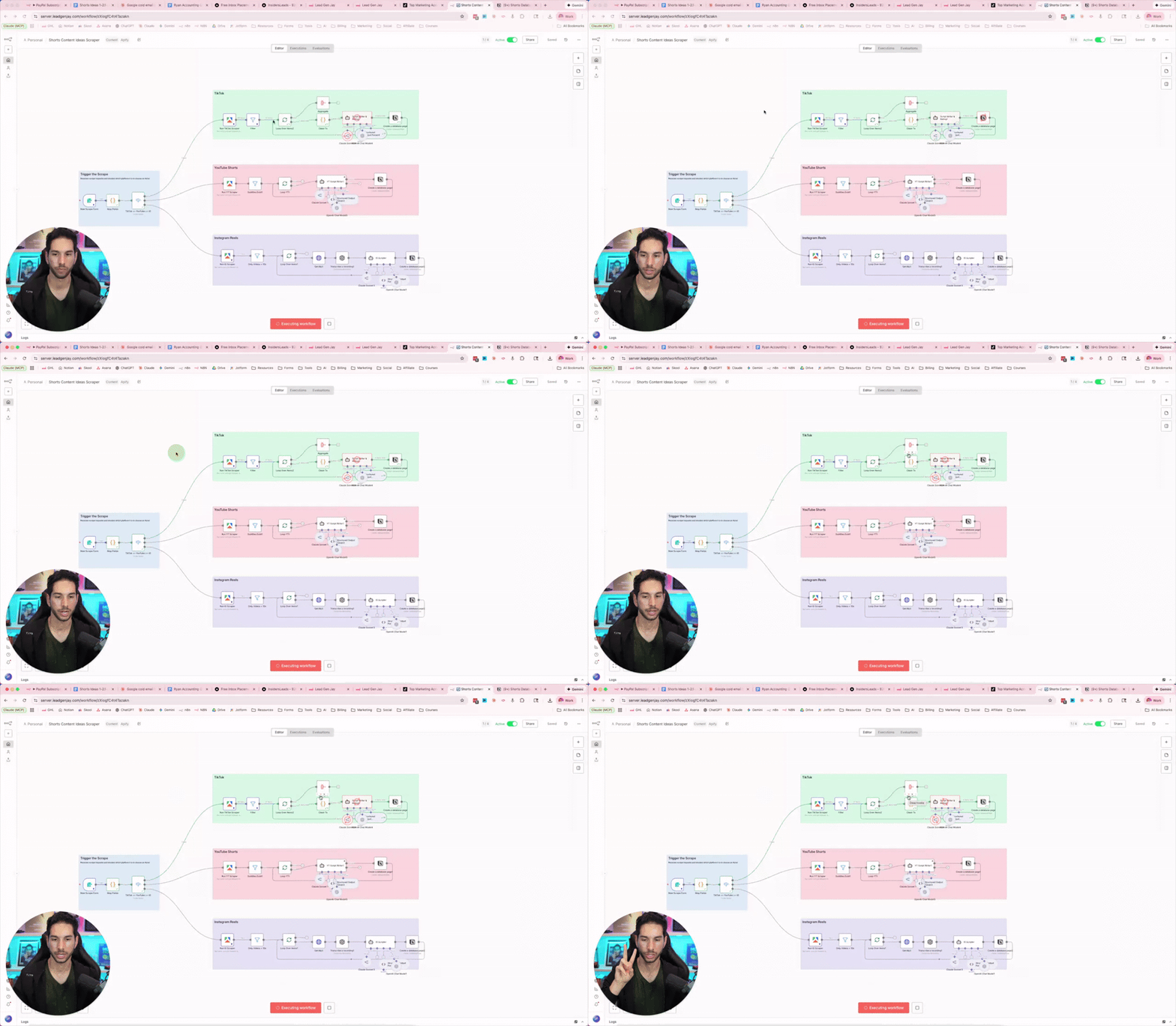
UPDATE: Shorts Idea Scraper V2 is LIVE
One of my favorite automations was long overdue for an overhaul and improvement. Please watch this video to learn about the patch for this must-have automation for content creators. The updated JSON is available in the Social Media module as well as the link to the Notion database to copy. For those not yet in the AI Automation Insiders Premium, NOW is your time. Get in here to access all my best templates, tools, and coaching. Thank you and enjoy!!!
2 likes • May 14
@Peter Litke did you peak behind the paywall? 🤔
1 like • May 14
@Jay Feldman I have a random suggestion for you in order to improve your value to those who are not in your premium/paid group. Perhaps, when you release a V2 of something, you make the V1 available to everyone. It would potentially, and dramatically, improve your standing with those who are not paying for your premium offering, yet still serve as your upgrade path. In that way, such an offering serves to establish value and trust that are otherwise sadly lacking. 🤷🏻♂️😊
1-10 of 48