Activity
Mon
Wed
Fri
Sun
Feb
Mar
Apr
May
Jun
Jul
Aug
Sep
Oct
Nov
Dec
Jan
What is this?
Less
More
Memberships
Exploring Peptides Community
10k members • Free
Peptide Price
8.5k members • Free
45 contributions to Peptide Price

🔥
19h •
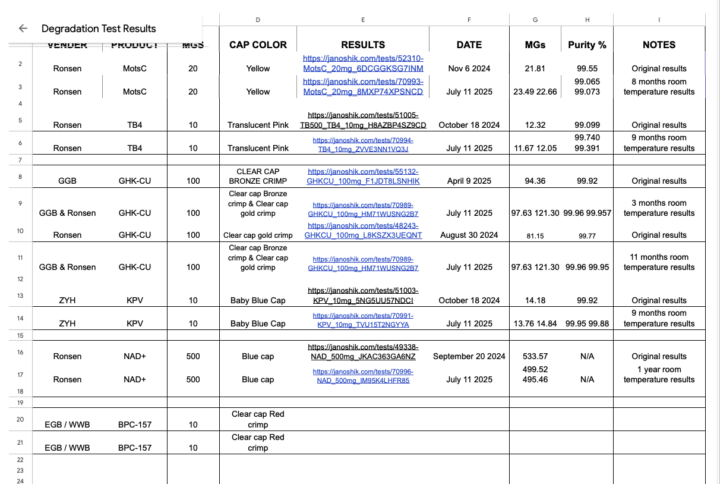
Do Lyophilized Peptides Actually Last at Room Temperature? Real-World Degradation Data 📊
Ever question whether those lyophilized peptides really last for years at room temperature, or do they degrade right away? @Brady Faught shared this little group study from another Telegram group. They took a handful of different peptides, tested them fresh, then left another sample from the batch, let it sit at room temperature and retested months later. There were two lyophilized samples, one tested originally and the other tests n number of months later. Here's what they found: Mots-C (20mg) - Fresh: 99.55% purity at 21.81mg - After 8 months at room temp: 99.07% purity at 22.66mg average - Basically held steady TB4 / TB-500 (10mg) - Fresh: 99.1% purity at 12.32mg - After 9 months at room temp: 99.39% purity at 12.05mg average - No meaningful degradation GHK-Cu (100mg) - Fresh (April): 99.92% purity at 94.36mg - After 3 months: 99.96% at 121.30mg (overfilled vial) - After 11 months: 99.95% at 121.30mg - Rock solid stability KPV (10mg) - Fresh: 99.92% purity at 14.18mg - After 9 months at room temp: 99.88% purity at 14.84mg average - Held up great NAD+ (500mg) - Fresh: N/A purity listed, 533.57mg - After 1 year at room temp: N/A purity, 495.46mg - Some quantity loss but still viable after a full year The takeaway? These peptides showed remarkable stability sitting at room temperature for extended periods. Obviously refrigeration or freezing is still best practice for long-term storage, but if you're worried about a vial that sat out for a few weeks or months, this data suggests you're probably fine. Pretty cool to see actual real-world testing rather than just speculation. - Derek peptideprice.store

1 like • 19h
Interesting, especially since I’ve only heard and read (with no data) that the mitochondrial peptides tend to degrade quickly. Someone give me a couple million and I’ll run this test with as many peptides as y’all want.
🔥
24h •
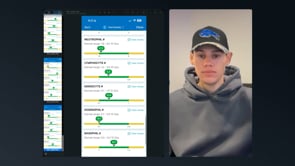
🧪 How to Read Your Bloodwork (Using My Labs as an Example)
This post is for educational purposes only and is not medical advice. Always consult with a qualified healthcare provider before making decisions about your health. Most people get bloodwork back, see "normal" on everything, and move on. But knowing how to actually read your labs—not just glance at the reference ranges—can tell you a completely different story. I'm going to walk you through how I analyze my own bloodwork, what markers I look at, and how I connect the dots. Hopefully this helps you do the same with yours. I recorded a full walkthrough of my actual labs if you want to see the numbers yourself: Watch the video breakdown here Step 1: Don't Just Look at "Normal" — Look at Where in the Range Lab reference ranges are built to catch disease, not optimize health. "Normal" just means you're not flagged as sick. When I pulled my results, most looked textbook healthy: - Blood sugar: dialed - A1C: low - Cholesterol: solid - Body fat: trending down On paper? Great. But a few numbers weren't bad... they were just sitting in odd places within the range. That's where the real information was hiding. Step 2: Start with Fasting Insulin (Most People Skip This) This is one of the most underrated markers. Most standard panels don't even include it—you often have to ask. Mine came back at 2 μIU/mL. Most people hear "low insulin" and think that's a win. And it is—to a point. It means you're insulin sensitive, your body handles glucose efficiently, you're not resistant. But here's what most people miss: insulin is also a metabolic signal. It tells your body "Energy is available. Run normal operations." When insulin stays rock-bottom for too long, your body starts interpreting that as a shortage. That's when other systems start quietly downregulating. What to look for in your own labs: - Fasting insulin between 3-8 μIU/mL is generally a good functional range - Under 3 μIU/mL can indicate you've been in a deficit too long - Over 10 μIU/mL starts suggesting insulin resistance
1 like • 23h
@Deborah Brown he went to his primary care doctor for this I believe. The labs look like they were sent to quest.

0 likes • 3d
Should give you a decent breakdown. Search function for the win. https://www.skool.com/peptide-price-9771/survodutide-retatrutide-without-the-gip?p=eb360967

3d •
Glutathione
Looking at ordering Glutathione. It come in a 1509mg vial. How much bac water should be added? I’m assuming only 3ml will fit in the vial. Is that enough?
1 like • 3d
Usually glutathione comes in larger vials. See the guide below. If it’s in a larger vial, I’d use 7.5 mls of Bac water for easy calculations. https://www.skool.com/peptide-price-9771/classroom/61f30e91?md=1bdd6598431b46d8bcff59cf6c1e9698 There is also a peptide calculator you can use for reconstitution purposes. https://peptideprice.store/calculator

3d •
Alcohol
Good evening community. I have a question regarding wine and alcohol. I have not had any alcohol since being on peptides but i miss wine and was thinking of having a glass or two during a special event. Im currently on Reta, motsc ss31 bpc-157 tb500 chkcu tesamorelin. Has anyone had issues with alcohol?
1 like • 3d
I haven’t drank in months, but have drank on GLPs and hangovers felt worse and lasted longer. Might want to invest in some glutathione if you do have more than a couple. Should be fine though if you are only having a couple though.
1-10 of 45

Online now
Joined Oct 8, 2025