Activity
Mon
Wed
Fri
Sun
Jul
Aug
Sep
Oct
Nov
Dec
Jan
Feb
Mar
Apr
May
Jun
What is this?
Less
More
Owned by Camela
Exploring regenerative intelligence through water, light, frequency, and cellular systems for human and planetary healing.
Memberships
Earth 2.0 Community
1.8k members • Free
Govermillions
564 members • $600
Symoné GovTech Community(Free)
23.5k members • Free
Flowcast Collective
27 members • Free
Spirituality and the Law
104 members • $9/month
Job Seekers Community
3.3k members • Free
WFH Remote Empire
1.8k members • Free
The Investigator Network
25 members • Free
Thrive Federal Network
100 members • Free
7 contributions to Luminary Lab

May 6 •
We are Magnetic Beings
Dr. Jack Kruse links ancient Mayan (and broader Mesoamerican) structures—primarily pyramids and volcanic basalt architecture—to a form of "original Neuralink" technology for handling geomagnetic excursions and maintaining biological coherence. threadreaderapp.com This idea appears in his recent X thread (and teased blog) connecting quantum biology, light/water/magnetism (LWM), deuterium management, and Earth's weakening magnetic field (e.g., South Atlantic Anomaly/SAA effects). It is speculative/fringe but grounded in his broader theories on piezo/pyroelectric collagen, semiconduction in tissues, proton spin, and 160 THz (UV/IR-related) signaling in biology. threadreaderapp.com Core Concept: Pyramids and Basalt as Magnetic "Devices"Kruse describes Mayan pyramids (e.g., in Yucatán, Guatemala, near cenotes) not primarily as tombs or calendars, but as passive magnetic transducers, "lighthouses," or "isotopic rectifiers" built during periods of magnetic instability: threadreaderapp.com Magnetic flux concentration: Pyramids (often stepped, high-aspect-ratio) act like reverse volcanoes or funnels. They couple Earth's crustal magnetic field (Z-axis/inclination) to the ionosphere and a hypothesized "Universal Stator" (cosmic magnetic fields). This is said to "pin" proton spins and prevent dielectric collapse in water/tissues. threadreaderapp.com Basalt/paramagnetism: Mayans favored volcanic basalt stone (rich in magnetite/iron, highly paramagnetic). It acts as a "solid-state magnetic amplifier" or antenna, gathering/amplifying flux lines. Black sand beaches in places like El Salvador (volcanic) are seen as decentralized paramagnetic arrays. Volcanic rock reportedly retains "magnetic memory" from past field strengths. threadreaderapp.com Water interaction (cenotes/aquifers): Built over water sources (magnetic dipoles). The structure allegedly creates vortex effects (à la Schauberger) for isotopic fractionation—separating deuterium (D+) from protium to produce deuterium-depleted water (DDW). This supports structured/"living" water, better semiconduction in collagen/stroma, and resists "viscosity shifts" linked to disease (e.g., lymphedema, cartilage issues in his follow-up post).
0
0
Apr 17 •
Remote Gene Control
Interesting what can be done remotely to the cells. https://www.cell.com/cell/abstract/S0092-8674(26)00330-2
1
0
Mar 26 •
The Frequent Flyer Heart Problem
https://open.substack.com/pub/biogenesishealing/p/the-frequent-flyer-heart-problem?utm_source=share&utm_medium=android&r=z7cdu
1
0
Feb 21 •
Vagus Nerve Stimulation
https://www.nature.com/articles/s41467-026-69579-7 Ultrasound on the Vagus Nerve especially - and in other regions where Neurons encode Memories - which is categorically also happening in your *Vagus Nerve* - is one of the best neuro-interventions you can make that doesn't involve drugs or brain implants. This is even one of those things you can even if you already have a half-decent memory ! 5-Days was all it took to see a 25% improvement. Precision neuromodulation has reached a critical milestone. Recent research into Theta-burst Transcranial Ultrasound Stimulation (TB-TUS) reveals a profound capacity to recalibrate the human semantic network. Targeting the left inferior temporal gyrus with a 1 MHz carrier frequency at 6 Hz theta rhythms, the protocol mimics endogenous oscillations to facilitate long-term potentiation. The biochemical results are stark: a 12% increase in glutamate and an 8% reduction in GABA. This neurochemical shift, paired with a 0.8% increase in gray matter volume, indicates genuine structural plasticity. Participants demonstrated an 18% improvement in semantic retrieval accuracy, compounding to 25% over a five-day protocol. This represents a literal tuning of neural architecture. It provides a high-precision, non-invasive roadmap for reversing cognitive attrition in aging and neurodegenerative disorders. nature.com/articles/s4146…
2
0
Nov '25 •
Hydrogels - What are they?
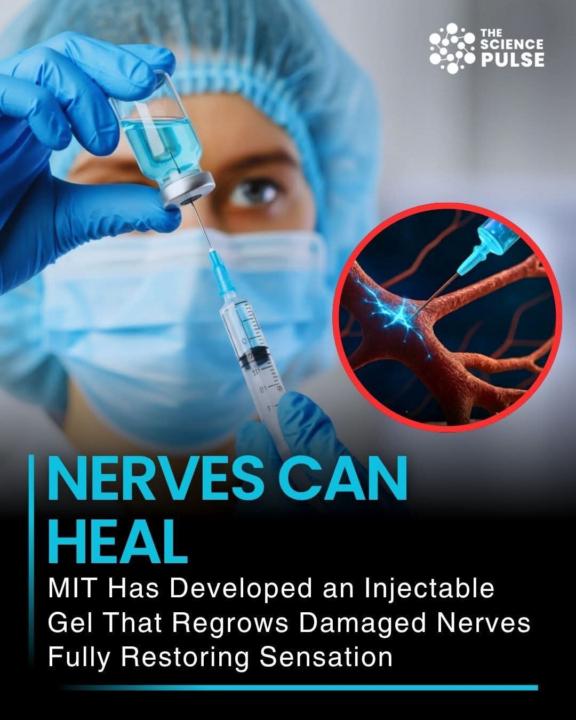
MIT’s “injectable biomaterial hydrogel” designed to guide peripheral nerve regeneration. MIT has several research groups working on nerve-healing gels, but the one this post speaks to is a peptide-based, self-assembling hydrogel that forms a scaffolding around damaged nerves. It’s still experimental, not FDA-approved, and not yet available in clinical use. What the gel actually is A biomimetic hydrogel—basically a soft, jelly-like material made of engineered peptides (short chains of amino acids). When injected, these peptides self-assemble into a nanofiber matrix that: mimics the structure of natural nerve tissue provides a protected “tunnel” for axons to regrow carries growth factors that stimulate nerve regeneration reduces inflammation and scarring (both of which block nerve repair) Why it matters Peripheral nerves grow extremely slowly and often incompletely. Traditional surgical grafts don’t always restore function. This gel removes some of the biggest barriers to regeneration by giving nerves an ideal environment to reconnect. What the research actually shows Animal studies (mostly rodents) demonstrated: faster axon regrowth stronger functional recovery restoration of sensation and movement in nerves that were previously nonfunctional significantly less scar tissue That’s impressive, but it’s still preclinical. No human trials yet. Potential future uses If it translates to humans, the applications are huge: traumatic nerve injuries (cuts, crush injuries) diabetic neuropathy post-surgical nerve damage spinal or plexus injuries (more complex, but possible) targeted nerve repair without major surgery Bottom line This is real science, extremely promising, but early-stage. It’s not something a doctor can inject today. The viral posts make it sound like it’s on the market—it's not. 🔬 Self-Assembling Hydrogels — What They Really Are These are engineered biomaterials made from peptides or polymers that automatically arrange themselves into a 3D structure after being injected into the body.
1 like • Nov '25
@Cathy Pascale I thought this was answered. I'm just starting to get the hand of this platform. Let me post what I got.
1 like • Nov '25
Self-assembling hydrogels—such as the peptide-based injectable materials developed in ongoing MIT research—are designed to support peripheral nerve regeneration, not systemic neurodegenerative conditions like ALS. These gels form a 3D biomimetic scaffold after injection, guiding axons across an injury site, reducing local inflammation, and preventing scar formation. This is effective primarily in localized peripheral nerve injuries, such as cut or crushed nerves, where the upstream neuron cell bodies remain intact. ALS (amyotrophic lateral sclerosis) is a fundamentally different biological problem. Instead of localized injury, ALS involves widespread degeneration of motor neurons in the cortex, brainstem, and spinal cord. The disease is driven by toxic protein misfolding, including TDP-43, SOD1, and FUS, with evidence of prion-like spread of these misfolded proteins through neural pathways. Because the underlying pathology is diffuse and progressive, a localized hydrogel scaffold cannot address the core mechanisms that cause motor neurons to die throughout the nervous system. Although these hydrogels are not a treatment for ALS, they are beginning to appear in ALS-adjacent research in three main ways: 1. Stem-cell delivery support: Hydrogels are used as carriers for glial or stem cells delivered to the spinal cord. The material protects transplanted cells, improves survival, and distributes them more evenly across the cord. 2. 3D disease modeling: Hydrogel platforms are used to build neuromuscular junction and spinal-motor-unit models for drug screening, allowing researchers to study ALS pathology in more realistic environments. 3. Localized tissue support: In some animal studies, hydrogels deliver growth factors or therapeutic molecules to muscle or spinal tissue, providing local protective effects. Overall, self-assembling hydrogels represent an important biomaterial technology for regeneration, modeling, and drug delivery, but they are not currently capable of reversing or halting ALS, which requires interventions targeting protein misfolding, neuroinflammation, and widespread motor neuron loss.
1-7 of 7

@camela-braswell-9118
Founder- Luminary Lab ✨Regenerative Intelligence Architect 👷🏻♀️
Bridging water, light, frequency & smart data for human & planetary healing. 💦🌞🛜
Active 9d ago
Joined Nov 9, 2025