Activity
Mon
Wed
Fri
Sun
Aug
Sep
Oct
Nov
Dec
Jan
Feb
Mar
Apr
May
Jun
Jul
What is this?
Less
More
Owned by Mary
Where midlife women find empowering, science-based solutions for hormone balance, metabolic health & weight loss so they can live in bodies they love!
Peri/menopause hormones, metabolic health & weight loss: guiding women to live in bodies they love with science-based solutions & lasting results.
Memberships
Facebook Ads Scaling Lab
81 members • $199/month
HBA Mastery
27 members • Free
Health Business Accelerator
222 members • Free
43 contributions to Better Beyond 40 Formula FREE

10d •
Expose in sardines (Canada)
Such a popular health food and a great source of protein and omega-3…but consumer beware! https://youtu.be/opUpjikN8GU Concerns: nasty oil, too much salt, BPA, not actually sardines(!) Brands to buy: - King Oscar (Norwegian) - Clover leaf (Canadian) - Rain Coast (USA) - Brands to avoid: - Ocean prince - Brunswick (oh no, I used to buy these!) - bumblebee - chicken of the sea
0 likes • 6d
@Lisa Amstutz ha ha that's fair! :)
0 likes • 6d
@Jes Solo So did I! 🫣 Not anymore...
May 29 •
Better, less toxic sunscreens + some tips!
As the weather heats up, I wanted to point you to some better, less toxic sunscreen options and sunscreen tips - important for the wee ones especially! First, a couple of QUICK hot tips 🔥 on sunscreen use: 1. https://www.instagram.com/p/DY6AoQNPS07/ UV is most damaging beginning and end of day, not just mid-day! 2. https://www.instagram.com/p/DY7bdrhvyaL/ SPF value tops out around 70 Second, on TOXIC sunscreens: Here's a little expose podcast from Dr Tyna Moore that really blew my mind! (Or watch on YouTube.) In a nutshell: - Most "clean mineral sunscreens" aren't! They have nasty chemical sunblocks that are questionable (esp for sensitive children!)...even those recommended by dermatologists. - To block UVA and UVB, a sunscreen needs to be at LEAST 18%! - She calls out leading brands that aren't doing your skin justice! - Here are her recommendations (+ a couple others) - 00:54:55: 1. Sky and Sol - Affordable! Shortest ingredients list (but smells like sunscreen = a bit sus). Available in USA + Canada. (Use that link for a discount or use code MARYP for 10% off.) 2. Tanit - Canadian. A bit pricier, but they run great sales. 3. Vanicream - Best price point, no fragrance. USA only. 4. Kelly Slater’s Freaks of Nature. Pricey. USA + Canada. 5. Dr Few - Pricey but maybe best. USA only? 6. Clear Stem’s You Are Sunshine - Especially good for those with acne prone skin 7. RMS beauty. USA only. Note that all non-toxic sunscreens are gonna leave a bit of a white "zombie" film for the first few mins, but I promise it goes away!
0 likes • 7d
@Jes Solo Nice! I love Yuka. :) I recommend it in the program too. So good!
11d •
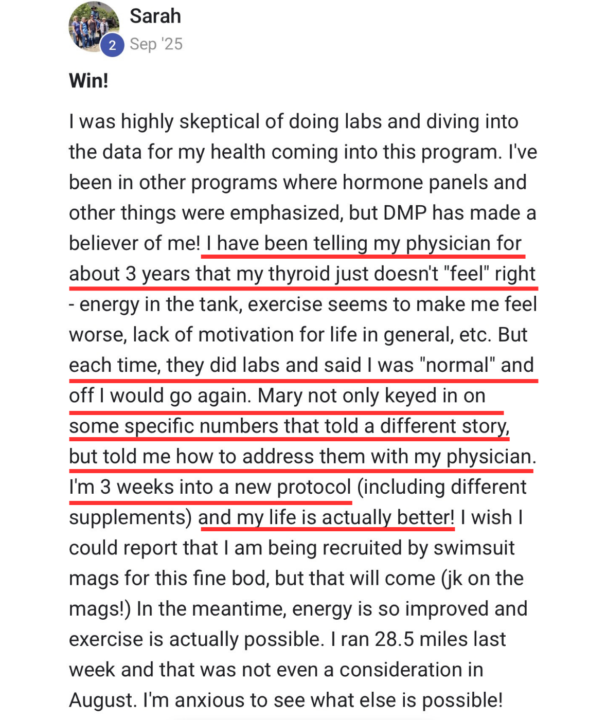
A thyroid story. (If you feel dismissed by your doctor, please read this.)
In case you missed it, here's a common client story from my latest newsletter - one you may relate to if you've ever felt exhausted and desperate, but dismissed by your doctor. ❤️ ====================== Sarah’s story is a powerful example of what happens when we stop settling for “you’re fine” and start looking towards optimal health instead. Sarah is 49, a high-powered executive at a financial firm with an insanely full life: A demanding career, husband, two kids and a dream of getting back to running races for fun like she used to. She had been dragging her butt through every day for years with severe fatigue, brain fog, mood swings and an extra 40 pounds that seemed to come out of nowhere. These symptoms were starting to threaten everything she cared about: her work, her family life, and the active lifestyle she missed dearly. Her GP kept telling her that her blood work was “normal.” Every visit, she left feeling brushed off and discouraged. Deep down, she knew something was wrong. When Sarah and I began working together, I reviewed her labs through a functional medicine lens: Instead of asking “Is this in the normal range?”, I asked, “Is this truly optimal for a woman in midlife who wants energy, stable mood, a healthy metabolism and weight loss?” The answer is almost always no when I review labs… That difference means everything. Through midlife and beyond, it becomes especially important that markers like thyroid hormones, blood sugar, insulin, vitamin D and key nutrients fall into narrower, ideal ranges - not just anywhere inside the conventional “normal” range. These finer distinctions really matter when we care about energy, weight, sleep, longevity and disease prevention…when we want to feel GREAT in our bodies! Through that lens, it became clear that Sarah was functionally hypothyroid and had been for YEARS! This means her thyroid function was too low for her body to thrive (ie. make enough energy, lose weight, sleep well, feel good), even though it didn’t trip the alarms on standard tests.
Apr 26 •
Women should never be told to stop/avoid hormone therapy based on age.
This keeps coming up on calls lately, so I wanted to repost this recent research review article from 2024 - see attached. Here's a nice highlight on its findings by a trusted name in the space, Dr Mary Claire Haver, which makes it easy to understand the importance of the findings: https://www.instagram.com/reels/DXAQQ2Ll-9U/ So, for anyone who was told by a medical provider that "it's too late because you're 10 years past menopause," or you "should stop HRT once you hit menopause"...they're wrong. Plain and simple. LOTS of data out to support that, as illustrated here. Please share this paper to anyone still offering this advice. Thank you! If you want more support with hormones, HRT or midlife wellness in general, I'm here for it. Check out my Masterclass or DM me and we can chat about the options. I'm here to support the best and highest outcomes for ALL women. ❤️
1
0
1-10 of 43

@better-beyond-40-formula
Biomedical Scientist & Longevity Expert helping midlife women balance their hormones + metabolism to so they can beat symptoms, lose weight & THRIVE!
Active 1h ago
Joined Apr 15, 2025
Squamish, BC, Canada
Powered by