Activity
Mon
Wed
Fri
Sun
Jun
Jul
Aug
Sep
Oct
Nov
Dec
Jan
Feb
Mar
Apr
What is this?
Less
More
Memberships
Research Career Club
664 members • Free
95 contributions to Research Career Club
2d •
Some people think I respond with AI - while I just talk to my PC!
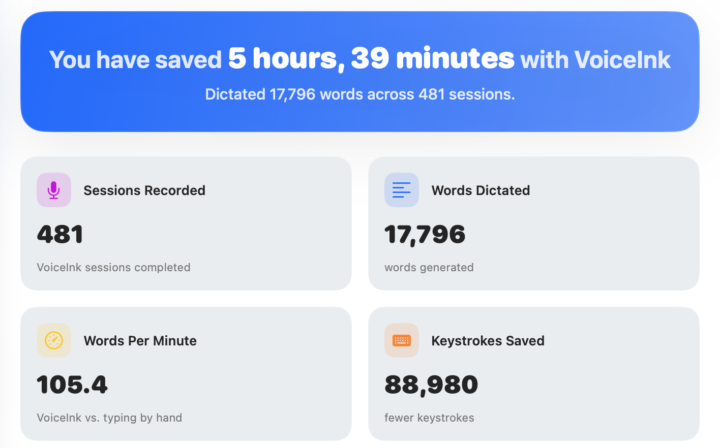
A few weeks back, I started using VoiceIn - I'm now talking to my PC rather than typing on my keyboard. I use it for anything from LinkedIn posts to comments, through to comments on articles and reports from my students. Over the past two weeks, I've saved almost a full day of work that I could dedicate to my research. Earlier today, we had an Inner Circle call, and some of you asked me how I manage to do everything I do. And this is one of the examples how I try to optimize my time. Rather than thinking about which activities I can cut, I'm thinking about how I can become more efficient at the things I usually do. I type quite fast anyway, but it is much easier & faster to speak rather than type. Obviously, these kinds of tools are not perfect; you still have to correct them sometimes, and you have to assess and make sure that their output aligns with what you wanted to say. It might also be less structured, so you might need to improve the structure of your writing. If you want to try here's a link that's an affiliate link. You can try it for free for 7 seven days - that's what I did. Then I decided to get a full license. It's not that expensive $29 for a lifetime so it's not even a subscription Let me know whether you've tried it and what you think. https://tryvoiceink.com?atp=drhanak
0 likes • 1d
Not yet
3d •
Which aspects of academic publishing and dissemination do you find most difficult?
Tell me what support do you need to inform the activities in this community.
Poll
8 members have voted
0 likes • 1d
Discussion is the hardest part at all
1 like • 1d
@Shakirah Singh which is?
6d •
Progress is never linear in research
If last week felt messy, slow or “not enough”, you’re not alone. Research is supposed to feel like that most of the time. Progress in our world is rarely a big breakthrough; it is “a series of small things brought together.” So this week, measure success differently. Did you show up for that one focused writing block? Did you move an analysis one step forward? Did you send that email you’ve been avoiding? Each small action is a seed, not the harvest. Your future self will not remember how “behind” you felt on a Monday. But they will benefit from the quiet, imperfect, consistent work you choose to do today. You are capable of more than you think; start this week believing it, and let your actions do the talking. Let’s make this a week of small, deliberate moves that compound. I’m cheering you on. 🙌
1 like • 5d
You are absolutely right, and thank you for this timely motivation. It truly hits home.
7d •
Why non-thinking time is important for your research
Most breakthroughs in your thinking happen when you’re not “doing research” at all — they show up when you’re painting a wall or scrubbing the kitchen. When you stop actively focusing on a problem and switch to something simple and physical, your brain shifts from focused work into what neuroscientists call the default mode network. This network kicks in when you’re doing low-demand tasks: showering, walking, gardening… or painting a room. In that state, your mind quietly replays ideas, makes unexpected connections, and spots patterns you missed at your desk. What looks like “not working” is actually your brain running a background computation on your research questions. For researchers, this is gold. You spend hours reading, coding, analysing data, writing — that’s loading your mental “buffer” with information. But consolidation and genuine insight often require off-line processing, where the system is free from the pressure to perform. If you never step away, you’re constantly stuffing more in without giving your mind time to organise it, which leads to the familiar feeling of staring at a problem and going nowhere. In my own work on carbon capture and process engineering, many of the cleanest model tweaks or paper angles have come to me while doing something completely unrelated, like DIY, walking, or tidying the house after a long day at the office. Most researchers respond to feeling stuck by forcing more screen time. But the real career impact often comes from trusting these “non‑academic” moments enough to step away and let your subconscious do its job. How about you? When you step away from your desk, what’s the one activity (like your painting) where good ideas quietly show up? Drop your answer below 👇
2 likes • 7d
Agree . I’ve definitely been neglecting this. I tend to push myself in too many directions at once, but it’s clear I need to rethink my approach and give my mind some room to breathe.
2 likes • 7d
@Humberto Santos i heard some coach sayed that you have to write thoughts and idea on paper specially before sleep .it make positive things.
11d •
Responsible use of AI in the classroom
I’m hosting a Professional Development session about Responsible AI policies in the classroom on 29th April 2026, and would love it if you could join me in a conversation about how to navigate the evolving AI landscape. We’ll briefly cover AI detection, what other educators are doing, and media literacy in the age of AI. I’ve recently become a GPTZero Ambassador (for those who don’t know, GPTZero is an AI writing detector), so all attendees of this webinar will receive 1 semester of GPTZero Premium for free! Join here: 29 April 2026, 10 am BST https://meet.google.com/qnd-kdtg-epf
2 likes • 10d
Can i share the event on socials
1-10 of 95
@basma-mansor-3989
Basma Mansor Elhebbasi
post graduate student and teaching stuff.
Faculty of dentistry
Oral medicine unit
University of Tripoli _libya
Active 6h ago
Joined Oct 20, 2025
Tripoli