Activity
Mon
Wed
Fri
Sun
Jun
Jul
Aug
Sep
Oct
Nov
Dec
Jan
Feb
Mar
Apr
What is this?
Less
More
Memberships
MonkeyDo Movement
138 members • Free
Innaworx
4 members • Free
Peak Parenting
127 members • Free
Holistic Family Wellness
10 members • Free
Coven of Theia, Energy Witch
62 members • Free
Granny Wisdom, Hippie Vibes
344 members • Free
The Vaccine Free Child & Detox
784 members • Free
Spiritual Beekeeping
306 members • Free
Psychonaut Academy
850 members • Free
86 contributions to Grounded Roots Parenting 🌿

4d •
Kitten Update 🐾
For those who have been following along, look how big they are getting! They charge around like little maniacs!


3 likes • 3d
Where are those kittens.😍
8d •
✨Daily Trait – Sounds That Need to Come Out 🔊
Trait: Repeats words, phrases, sounds, or noises — not to communicate, but because it feels good or necessary. What it can look like: Humming, clicking, or making repetitive sounds Repeating a word or phrase over and over Echoing things they've heard from TV or conversations Narrating or sound-effecting constantly while playing This is verbal stimming. Stimming — short for self-stimulatory behaviour — is the brain and body's way of regulating itself through repetition. Verbal stimming uses sound and speech the same way others might rock, fidget, or pace. It can signal joy, excitement, anxiety, or simply the need to process. Gentle guidance: Don't silence it — find out what it's communicating first Notice when it increases — it's often a sign something is building Create spaces where sounds are welcome and free Only redirect when it's causing a real barrier — not just discomfort for others The sounds aren't random — they're the nervous system doing its job out loud. 🌿

1 like • 7d
John does a lot of this. Car and vehicle noises and any adverts that he sees repeatedly on TV.
14d •
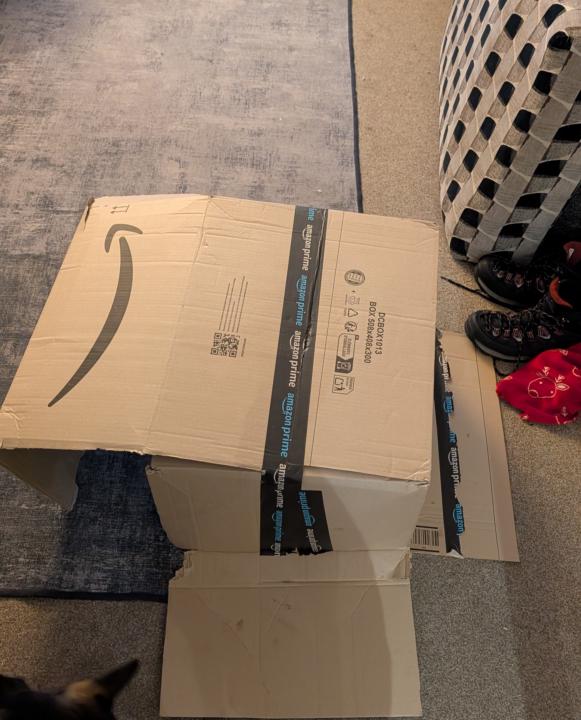
🌿 She regulated herself in a cardboard box today. 📦🌿
And it was one of the most beautiful things I've watched her do. She was sad. She found the box. She climbed in with her blanket. Over the course of thirty minutes she self regulated - began playing with the box for a while and came out — calm, playing, herself again. No prompting from me. No reward. No strategy. Just her, doing exactly what her nervous system needed. Here's what I've learned about small, enclosed spaces for kids like mine: They reduce input — less visual noise, less to process Create clear edges — the world feels held instead of huge Restore control — she chose to go there, she controls who comes near They let her feel without having to explain or perform For PDA profiles especially, that self-chosen retreat is everything. It's regulation without demand. It's safe without being prescribed. The fact she moved from sadness → playing for half an hour? That's not withdrawal. That's processing. That cardboard box is basically doing the job of a £200 sensory pod. If your child does something similar, here's what seems to help: Keep it theirs — no entering, no commenting too much Add soft things they already love (blanket, dim light, cushion) Make it available, not prescribed — not "go there when you're upset" Let them leave on their own terms, always She chose it. She stayed regulated. She came out on her own. That's the whole win. Does your child have a go-to space like this? I'd love to hear what it looks like for you. 🌿
4 likes • 13d
I took my daughter to a Pokémon game group today. She's been doing a few weeks with Rebecca at the shop, and they've had quiet afternoons to play. Today was a group afternoon and she had to deal with meeting new people, kids and parents. She was struggling to hold her emotions steady. And it took her over an hour to finally feel ok to have a game with one of the mum's. Kay did really well. It helped that they all seemed to understand that she needed to be given time and space. No body ridiculed her for being 18 and having sensory overload issues.
4 likes • 13d
@Ellie Hayes I'm glad I helped her meet up with the shop owners. Now she's got a place to meet people with similar interests and she can learn more ways to be independent. Little step by little step.
15d •
✨Daily Trait – Can't Start Without You 🧲
Trait: Has the ability to do something independently but needs another person present to begin. What it can look like: Sitting frozen in front of a task until someone sits nearby Asking "will you stay with me?" before starting Capable of finishing alone — but launching feels impossible Following you from room to room before settling This isn't clinginess or laziness. For some brains, another person's presence acts as a regulator — it lowers the activation energy needed to get going and makes the task feel possible. Gentle guidance: Start together, then quietly fade back Don't push independence before the connection is established Your presence is not a crutch — it's a scaffold Celebrate the start, not just the finish Sometimes all they need to fly is to know you're still in the room. 🌿

5 likes • 15d
My two boys need help starting new projects. My daughter has enough ideas to get started but needs a bit of help to keep going or complete a project.
15d •
Hard mornings 🌅😮💨
Morning isn't always about getting out the door. Sometimes it's the first battle of the day — before breakfast. Before shoes. Before anyone's even said good morning. For some children, waking up is genuinely hard. Not laziness. Not attitude. A nervous system that needs more time to move from rest to ready. A few things that can help ease that transition: – Natural light as soon as possible (open the curtains first) – A consistent wake-up sound or playlist — same every day – Low demand for the first 10–15 minutes (no questions, no rushing) – Something warm to hold — a drink, a blanket, a body 🫶 – A predictable sequence they can almost do on autopilot Not to "fix" mornings instantly — but to take the shock out of them. Because regulation comes more easily when the body isn't being launched straight into survival mode. If mornings are hard in your house — what's one thing that's helped? 💕

6 likes • 15d
I just let the kids wake up at their own pace. Two teenagers don't do early mornings. Opening curtains is usually the first thing I do. If we need to go out in the morning I try and give them at least an hour to sort themselves out before leaving. My 7 year old son spends his time in underwear and maybe a t-shirt, until he goes out anywhere...then puts his trousers socks and shoes on.
1-10 of 86
@sylv-davies-6560
Home ed mum of 3 kids. Life long interest in the spiritual side. 55 and going thru Menopause naturally, feeling a lot of shifts and reconnections
Active 4h ago
Joined Jan 21, 2026
Exeter, Devon.