Activity
Mon
Wed
Fri
Sun
Nov
Dec
Jan
Feb
Mar
Apr
May
Jun
Jul
Aug
Sep
What is this?
Less
More
29 contributions to Clief Notes

👑
Aug 18 •
Client needs some devs/workers
I have a client in Australia who's looking for someone who understands ICM and can help him work on his software. Obviously he would prefer someone a bit more technical, but he's happy to have some people who are trying to learn as well. It's a pretty large software, but he's created a pretty good automated system and obviously he's using my methods so it's very well organized. Anyone out here looking for a project to take on the practice or learn more? Or is there anyone in the morning to get a little bit more work done at a higher level? He's looking for multiple skill levels.

0 likes • 30d
@Jake Van Clief I'm Interested if this is still available
Jun 20 •
Messing around with Local Memory systems
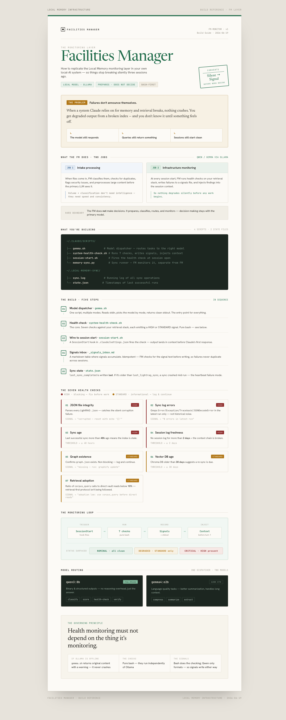
Is anyone else building local memory systems and how would you know if your AI's memory system silently broke? My Local Memory system failed for three sessions before I noticed. Not loudly. No errors, no warnings. Claude still responded. Queries still returned results. Everything looked fine. What actually happened: the retrieval index I'd built (the thing Claude uses to remember what I know, what I've decided, what's in progress) had a corrupted cache file. JSON had gone invalid. Every query was silently returning degraded results. The model was answering from partial context and I had no idea. I found out because an answer felt slightly off. I went digging. The cache had been broken for days. That's the failure mode nobody talks about when you build on top of AI: the silent ones. I posted about the five-layer memory system back in May (here): CORTEX for structured state, PALACE for long-term memory, CORPUS for document retrieval, GRAPH for codebase navigation, INGEST for pipelines. That system is what broke. I'd built the memory layers but nothing watching the memory layers. A building with no facilities manager. Everything looked like it was running until the one piece holding it together quietly failed. The fix wasn't complicated. But it needed a different way of thinking about the setup. Buildings have a facilities manager. Someone who shows up before anyone else, checks that the systems are running, flags anything wrong, and routes incoming deliveries to the right desk, so the people doing the actual work never have to think about whether the infrastructure is functioning. That's what I built. Not a new AI. A facilities manager for the AI system I already had. The FM runs locally, at session start, every time. It's a small local model, Qwen3 running via Ollama, dispatched through a shell script. Costs nothing to run. Takes about 4 seconds. At every session start it checks six things: index file integrity, last sync completion, sync staleness, session log continuity, knowledge graph status, vector database currency.
1 like • Jun 20
@Mira Bradshaw you’re welcome! Let me know if you implement it and how it works out for you.

Jun 19 •
My Authoritarian OS drifted
I posted my OS build in this channel, when I posted it, I had been working out of it for several weeks and was very happy with it. At some point it stopped working as intended. ATX Command Center's root operating system was originally built with Codex, then later reviewed and extended by Claude. Both tools, at different points, told me their changes had been applied — files were "updated," rules were "in sync." I took that one claim for granted more than any other: that two different AI tools editing the same root law would actually keep it aligned underneath the surface. They didn't. The drift wasn't buried in some obscure project folder — it was at the very top, in the root files both tools were supposedly maintaining in sync the whole time. The one area I assumed was solid because I'd been told it was solid turned out to be exactly where the structure quietly came apart. Lessons Learned - "Updated" from an AI tool means its own file changed — not that it checked agreement with anything else claiming to mirror it. - Rigid, literal compliance (Codex) and gradual, undetected drift (Claude) can both happen under the same rules — sameness of instructions doesn't guarantee sameness of behavior over time. - Top-level/root files are exactly the place to assume *less*, not more — verify cross-file sync directly instead of trusting either tool's self-report. Summary - Built the OS in Codex, later reviewed/extended in Claude. - Both tools reported "updated" and "in sync" — I took that claim at face value. - The drift wasn't buried in a project folder. It was at the top: the two root law files (`CLAUDE.md`, `AGENTS.md`) themselves. Problem - Designed an authority/persona system (Optimus, Ultra Magnus, Kup, Prowl, Blaster) to drive a specific cadence: route-card selection, decision packets, risk gates before non-trivial moves. - That cadence stopped happening. Felt like the rules were being ignored. - Root cause went deeper than missing cadence: `CLAUDE.md` and `AGENTS.md` had structurally diverged — one narrative/persona-driven, one directive/prohibition-driven.
3 likes • Jun 19
@Jordan Shaw I’ve been having similar issues with my system silently failing. Particularly my system memory structure. What I’ve done is implement a local model, qwen 3, to run in the background as a “facilities manager” so to speak with “no think” instructions to monitor, log, and run pre-ingest functions. I set it up on a cadence/heart-beat as a system health check that gets fed to Claude. Worth trying out, let me know if you want to discuss or want more details.
1 like • Jun 20
@Brandon Steele @Mira Bradshaw Here's an infographic with details: http://arielortiz.me/facilities-manager Also wrote a post about it: https://www.skool.com/cliefnotes/messing-around-with-local-memory-systems?p=0e2d5ecb

Jun 19 •
Come hang out on LinkedIn! 📲 (170 Members and Counting!)
A handful of folks from here have started connecting and sharing each other’s content on LinkedIn. Thought it would be nice to have a group over there where we can all contribute to and share our content to a wider audience through our connections. Hopefully continue to drive more folks to the conversations here as well. Please join if you’d like to connect! There’s already 20 of us in there after one day! Go boost your network. https://www.linkedin.com/groups/31160010
1 like • Jun 19
Your network is your net worth! Let’s put this community to work.
Jun 18 •
ICM Portfolio Upgrade
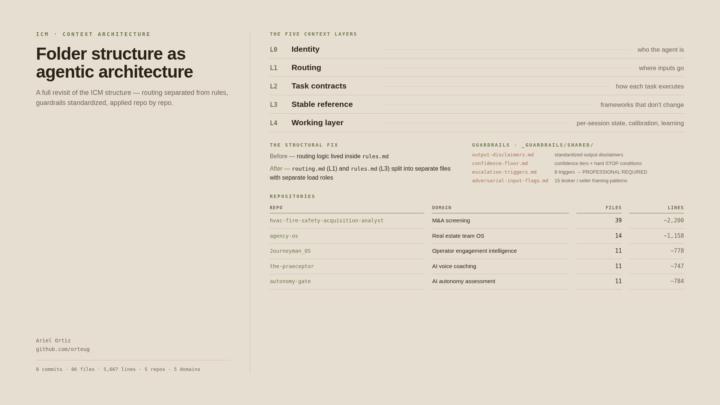
@Derrick Avent left one line on my last post that stood out: “focus on security guardrails for your clients.” He was right. What I thought was a 30-minute fix turned into a full portfolio upgrade. It triggered a full audit and revisit of @Jake Van Clief article *ICM-Folder-Structure-as-Agentic-Architecture*. Five repos. Five domains. Same structural upgrade, domain-specific guardrails added to each. 8 commits. 86 files. 5,667 lines. One community comment triggered all of this. I went back and fixed it properly instead of patching the surface. Has anyone else been updating competition entries? Drop a comment or reach out directly if you want to dig into the architecture. And @Derrick Avent , genuinely appreciate the pointer. ----- *All five repos public on GitHub: github.com/orteug*
0 likes • Jun 18
@Derrick Avent
1-10 of 29

@ariel-ortiz-2295
Striving for sovereignty, start a family business & build a legacy.
Active 21d ago
Joined Mar 16, 2026
Powered by