Activity
Mon
Wed
Fri
Sun
Nov
Dec
Jan
Feb
Mar
Apr
May
Jun
Jul
Aug
Sep
Oct
What is this?
Less
More
Owned by Anna
A learning space for people who put the horse first.
20/20 Horsemanship
31
Free
Google Ads Skool
5.2k
Free
Unforgettable Coaches
921
Free
Template Skool
3.6k
5.0
$39/m
The Facebook Ads Clinic
7.2k
5.0
Free
Skoolers
150.6k
Free
93 contributions to The Happy Horse and Rider Lab
9d •
Remember to Exhale
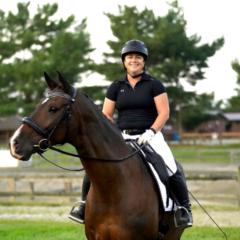
Remember to exhale. We talk a lot about breathing when we ride. When to breathe. How deeply to breathe. How many counts to inhale and how many to exhale. For something our bodies do naturally, we've managed to make it surprisingly complicated. What if we made it simpler? I say remember to exhale. Your body won't forget to inhale. But.... I know you don't need one more thing to think about while you're riding. So, what if you connected the idea to exhale to something meaningful? Exhale as you ask for a downward transition. Exhale as you halt. Exhale when your horse offers a moment of softness. Let the exhale become part of those moments. Something your brain begins to associate with slowing down, softening, and finding balance. We often talk about horses being mirrors of ourselves. If our horses are so sensitive to our emotions, our tension, our energy, and the smallest changes in our bodies, why wouldn't they respond to the changes that come with our breathing? Breathing is an important part of nervous system regulation. And while our horses may not literally match every breath we take, they can certainly feel the changes in our bodies when we stop holding our breath and begin to relax. Our muscles soften. Our movement changes. Our communication becomes a little less guarded. Maybe that gives our horses an opportunity to soften, too. The beautiful thing about connecting an exhale to an action is that, with repetition, we don't have to keep reminding ourselves. The action itself becomes the reminder. A downward transition becomes more than a change of gait. It's an opportunity for both of you to reorganize, rebalance, and find a little more ease. Riders spend so much time trying to develop better habits in their horses. This is one of the simplest habits you can develop for yourself. Not a complicated breathing exercise. JUST REMEMBER TO EXHALE. And see what happens when you give both yourself and your horse a little room to breathe. Pic of me reminding myself to exhale while I'm at the gym and still have a podcast to edit 😉💙

2 likes • 9d
P.S. This works when you are working with your horse on the ground too! Or just hanging out with them. Practice the exhale and see what you notice about your horse 😉
0 likes • 2d
@Erin Conley so easy to do. You’re welcome!
4d •
This Week’s 10-Minute Experiment: Can You Walk 7 Steps and Stop?
This week’s experiment comes from Daniel Dauphin, and it starts with a deceptively simple question: Can you ask your horse to walk exactly seven steps… and stop? Not six-ish. Not eight because the halt got a little late. Seven. Spend a few minutes seeing how accurately you can feel and influence each step. Once that starts to feel easy, refine it. Can you ask your horse to step off with the left front foot first? What about the right front? And if that gets easy, here’s the next level: Can you ask your horse to step off with a hind foot first? The goal isn’t perfection. It’s awareness. How clearly can you feel where your horse’s feet are—and how intentionally can you influence what happens next? That’s where “feel” starts becoming something you can actually use. Your question for the week: How much control do I really have over each individual step? Was this harder or easier than you thought? P.S. - You can do this while leading your horse too! You don't have to be sitting on their back. If you're leading them, how do you make it harder once you've mastered 7 steps?
0
0

13d •
Happy Sunday Everyone!
Let's welcome our newest members @Chris Gregory @Peggy Hoyt @Charlotte Romy @Evelyn Wei @Erin Conley . Share a picture of your amazing horse(s) and let us know why you joined the community! I'd also love to know how I can support you through the community in your equestrian endeavors. Go 👇😊
1 like • 9d
@Erin Conley I love this! I’m planning a free workshop series you will probably enjoy! In the meantime, work on the 10 minute Tuesdays & if you need it modified to suit you better, just ask. Same if you have questions & feel free to pop into the office hours. I’m going to change them to Tuesday evenings.
11d •
Ten-Minute Tuesday
What if the biggest obstacle to better communication with your horse isn't that they aren't listening to you? What if it's that you're afraid to listen to them? I recently had a wonderful conversation with Mary Miller Jordan of I AM HERD Mustang Sanctuary about her upcoming Celebration of the Horse-Human Relationship. We share a belief that I think deserves more attention in the equestrian industry: We need to become better listeners of the horse. I think there's a reason many horse lovers struggle with this. We're afraid of what our horses might tell us. When a horse hesitates, turns away, or quietly communicates discomfort, our brains can turn that small moment into something much bigger. "My horse doesn't like me." "My horse doesn't want to be ridden." "My horse will never willingly do what I want." Suddenly, one little "no" feels like a threat to everything we've dreamed of accomplishing together. So we ignore it. We push through. We convince ourselves the horse needs to learn to accept what we're asking but we might be missing an opportunity to learn something important. A "no" in this moment does not mean "no" forever. It doesn't necessarily mean your horse dislikes you, doesn't trust you, or isn't capable of becoming the willing partner you envision. In the moment, they might be; uncomfortable or confused. Or maybe you need to ask differently. The only way to find out is to become curious. And that brings me to this week's experiment. 🧪 10-Minute Tuesday: Hearing the NO Spend ten minutes exploring how your horse responds to your approach. With your horse loose in a safe environment or wearing a halter (not cross-tied), slowly approach one side and then the other. Pay attention. Does your horse follow you with their head? Do they turn their head and neck in front of you as you approach? Does their expression change? Is one side different from the other? If your horse appears to hesitate or block your approach, **stop.** Wait. Maybe take a step backward.
1
0


19d •
Horse Brain Science Simplified - waiting for my new book
Recently purchased Dr. Stephen Peters new book, Horse Brain Science Simplified. Just out October 1, 2026. Karen Rolf did a great interview with him. Can't wait to dig in.
1 like • 18d
I can't wait to hear about the book! I've read some of his others.
1 like • 13d
@Shelayne Fico finally! The pod with Karen was very good.
1-10 of 93
@anna-fox-2551
Horse & Rider Success Coach: turning frustration into feel, fear into freedom, and rides into wins.
Active 8h ago
Joined Aug 22, 2025
Culpeper, VA