Activity
Mon
Wed
Fri
Sun
Jun
Jul
Aug
Sep
Oct
Nov
Dec
Jan
Feb
Mar
Apr
What is this?
Less
More
Memberships
AI Automation Society
349.1k members • Free
Leverage
991 members • $27/m
FC
Flips4Miles Coaching Program
1k members • Free
4 contributions to AI Automation Society

Mar 29 •
Made a valuable post demonstrating how I used Claude to increase my SEO/GEO
https://www.linkedin.com/feed/update/urn:li:activity:7444095320415846400/?originTrackingId=WNIdpEba%2FWLAZei633n3Lw%3D%3D
1 like • Mar 29
@Patrick Stefurak Yep! I like to see what exactly it’s doing and act as an architect with it. But it’s great for executing tasks you have in mind
0 likes • Mar 29
@Patrick Stefurak that’s awesome! I’m actually the co-founder of Nvestiq. We’re an AI trading platform that helps people build strategies without coding. All 100% accurate and research backed

💎
⭐
Dec '25 •
🚀New Video: DON'T Build Another AI Agent Until You Watch This
In this video, I break down the AI systems pyramid and explain how I decide what type of system to build for a given problem. We walk through all four layers, starting with custom GPTs, then simple workflow automations with no AI, followed by AI workflows, and finally full AI agents. As you move up the pyramid, complexity, cost, and the chance of things going wrong all increase, and I explain exactly why that matters in real projects. I also show real examples of each layer so you can see how these systems actually work in practice. By the end of the video, you should be able to confidently decide which type of AI system you need to build and avoid overengineering solutions that do not need it. Access the Decision Tree HERE
9 likes • Dec '25
Been using zapier mainly but n8n seems like a great option

🔥
Dec '25 •
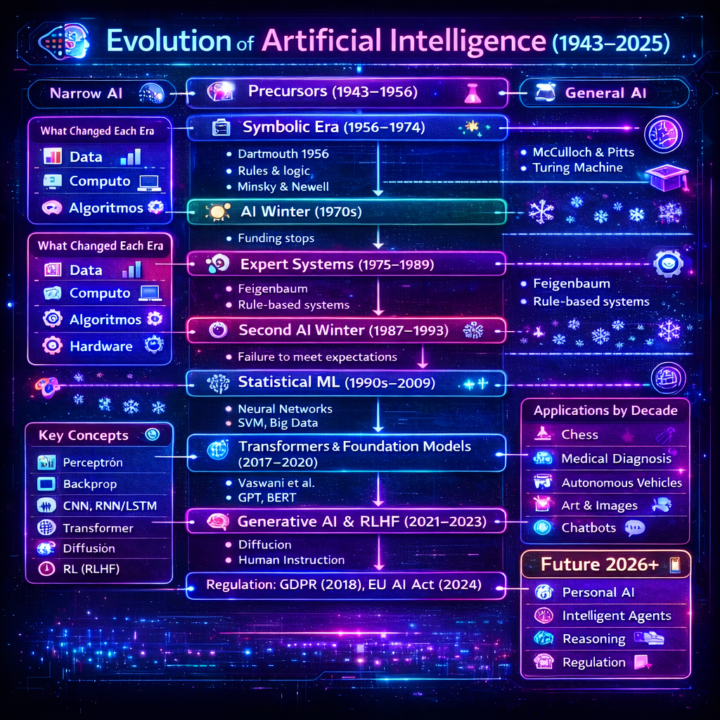
🧠 The Evolution of AI (1943–2025): from rules to agents… and what’s next 🚀🤖
If AI can write, design, code, and “think” with you today… it’s not magic. It’s decades of progress (with a couple of AI winters ❄️). Here’s the full timeline in plain English—what changed in each era and why we’re here now. 🧩 1) Precursors (1943–1956): the idea is born The early foundations appear: - Early neural models (McCulloch & Pitts) - The question: can machines simulate intelligence? - The theoretical groundwork that sparks everything 🧪 Key shift: imagining intelligence as something computable. 🧠 2) Symbolic Era (1956–1974): AI = rules + logic The Dartmouth moment (1956) kicks off the “classic” approach: - Rule-based reasoning (“if X, then Y”) - Logic and symbolic representations - Big promises… too early 😅 Key shift: intelligence was hand-coded. ❄️ 3) AI Winter (1970s): hype cools down Why it happened: - Not enough compute power - Not enough data - Overpromised outcomes Lesson: hype without infrastructure is expensive. 🧑⚕️ 4) Expert Systems (1975–1989): AI works in narrow domains AI becomes practical in specific contexts: - Strong rule systems in controlled environments - Use cases like diagnostics and industry - Feigenbaum as a key reference Key shift: AI succeeds when the world is structured and predictable. ❄️ 5) Second AI Winter (1987–1993): another downturn Another reset due to: - High costs - Hard maintenance - Rule-based limitations 📊 6) Statistical ML (1990s–2009): data starts winning Major paradigm change: - Instead of writing rules, you train on examples - SVMs, statistical learning, Big Data - Neural nets return to the stage Key shift: data + statistics + compute beats “rules”. 🔥 7) Deep Learning (2010–2016): the big leap With GPUs + massive datasets: - Backprop + deep networks - CNNs transform vision; speech improves fast 📸🎙️ - Hinton / LeCun / Bengio become central names Key shift: AI gets dramatically better at perception. 🧱 8) Transformers & Foundation Models (2017–2020)
2 likes • Dec '25
This is solid💯I think this resonates perfectly with modern society today for all people involved in various industries
0 likes • Dec '25
@Caspian Rhodes going pretty well. I’m the co-founder of Nvestiq, an AI trading platform, and I definitely feel that being ahead of AI (now more than ever) is absolutely crucial
💎
⭐
Oct '24 •
Welcome! Introduce yourself + share a career goal you have 🎉
Let's get to know each other! Comment below sharing where you are in the world, a career goal you have, and something you like to do for fun. 😊
4 likes • Dec '25
Hi everyone, I’m the co-founder of Nvestiq. We’re working on making advanced trading and decision insights accessible without code. We’ve hit our first major growth milestone and are now focused on scaling the right way. Excited to learn, share, and connect with other builders here.
1-4 of 4

Active 16d ago
Joined Dec 16, 2025
Miami, FL
Powered by