Activity
Mon
Wed
Fri
Sun
Aug
Sep
Oct
Nov
Dec
Jan
Feb
Mar
Apr
May
Jun
What is this?
Less
More
Memberships
AI Automation Society
418.9k members • Free
MasterLive - 10K EN PUBLIC
16k members • Free
Authentic Reselling ERT
100 members • Free
Free SystemKit
1.9k members • Free
Skool Incubator (Gratuit)
23.3k members • Free
7 contributions to AI Automation Society

1h •
Fix CLAUDE response style
I’m struggling with Claude’s response style. Almost every answer is packed with complex jargon, feels overly long, and doesn’t give a clear or straightforward explanation. It often ends up sounding vague instead of helpful. Is there a way to adjust Claude so it gives simpler, more direct responses? Any skills/changing instructions on CLAUDE.md or something that makes claude the way i want it to behave. Thanks!

0 likes • 1h
Honestly, you can fix this pretty easily. Two quick things: 1. Settings — Go to Custom Instructions and just write: “Keep it short and direct. No jargon. One clear answer.” 2. In your prompts — Just tell Claude what you want. “Give me one sentence answer then brief explanation” or “ELI5 (Explain like im 5) this” works instantly. The thing is, Claude actually responds to how you ask. Nobody realizes you can just say “shorter responses” and it adjusts. Try it next time you’re writing a prompt. Honestly changes everything. If you’re coding, just throw that into your system prompt too.

3h •
Cancer Research Journey: From Grok to Claude + Code
Over the past six months, I dedicated significant effort to cancer research using Grok, focusing on microfluidic biochips, single-cell separation, and CTC detection technologies. While Grok proved to be a capable and insightful AI assistant, the inherent complexity of oncology—spanning molecular pathways, heterogeneous data, and multi-omics integration—often demanded extensive manual refinement, repeated iterations, and additional validation steps. However, after integrating Claude AI with coding capabilities, I discovered a far more efficient platform. This combination has dramatically streamlined literature synthesis, data analysis, workflow automation, and hypothesis generation. As a result, I can now complete future research projects in half the time or even less effort compared to using Grok alone, accelerating progress in precision oncology and enabling faster translation of complex findings into practical applications. You can click the link of my cancer research detail as follow: https://www.linkedin.com/pulse/unveiling-comprehensive-cancer-insights-solo-journey-data-danny-chan-coosc/
1 like • 2h
What aspect of your research workflow wastes the most time right now ? literature synthesis, data analysis, or iterating on hypotheses ?
1 like • 1h
@Danny Chan Thank you !
1h •
Who was your first automation client?
Who was your first automation client? How did you find them, and what did you automate first? Curious how others found their first paying customer. Did you pitch cold, use your network, or stumble into it?
2h •
How did you find your first automation niche?
Personally, I'm starting local—restaurants, real estate agencies, tradespeople around me. Small market, real problems, fast feedback. Once it works, you scale. How did you start? Straight into a specific market or did you test multiple niches before finding the right one?
1 like • 2h
if you have any answer write it below ! Thank you 🙏
2h •
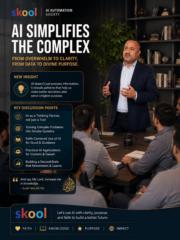
Most people automate tasks. Few automate demand.
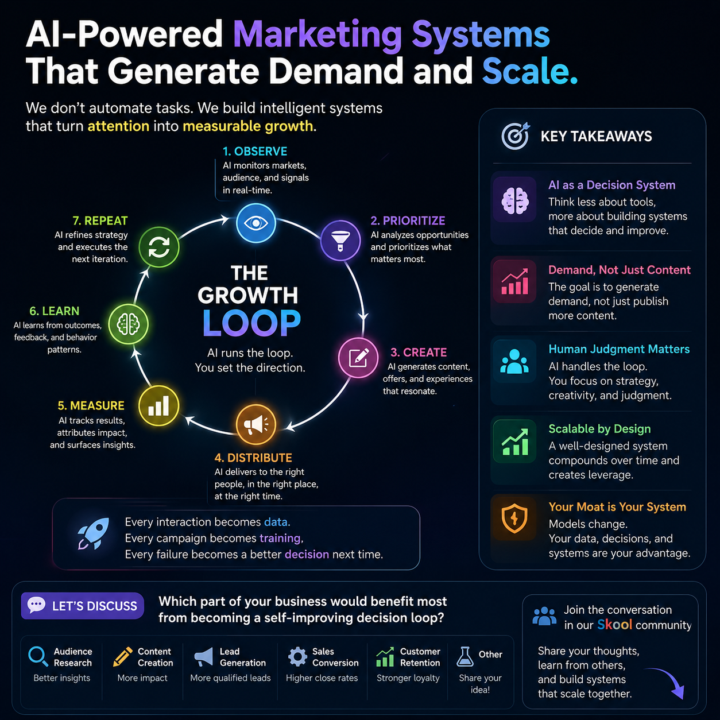
That's the difference between saving time and building a growth engine. I've been thinking about AI less as a collection of tools and more as a network of decision systems. Instead of asking: "How can AI write this post?" I ask: "How can this system continuously discover opportunities, decide what matters, create value, measure outcomes, and improve itself?" That changes everything. A scalable AI marketing system isn't a chatbot. It's a loop. Observe → Prioritize → Create → Distribute → Measure → Learn → Repeat. Every interaction becomes data. Every campaign becomes training. Every customer question becomes market research. Every failure becomes a better decision next time. The goal isn't to automate people. The goal is to automate everything around people so human judgment becomes more valuable, not less. I believe the next generation of businesses won't compete on who has the best AI model. They'll compete on who has built the best decision loops around that model. Models will keep changing. Decision systems will keep compounding. That's where durable advantage comes from. What part of your business would benefit most from becoming a self-improving decision loop rather than another isolated AI workflow? @Nate Herk @Frank van Bokhorst
1 like • 2h
@Fouad Jabal The moment you close that feedback loop, you stop fighting friction and start building momentum.
1 like • 2h
@Fouad Jabal nice post I liked !
1-7 of 7

Active 32m ago
Joined Jul 2, 2026
Powered by