Activity
Mon
Wed
Fri
Sun
Aug
Sep
Oct
Nov
Dec
Jan
Feb
Mar
Apr
May
Jun
Jul
What is this?
Less
More
Memberships
AI Automation Society
419.3k members • Free
83 contributions to AI Automation Society
15h •
Why AI Doesn’t Remember the Way You Think
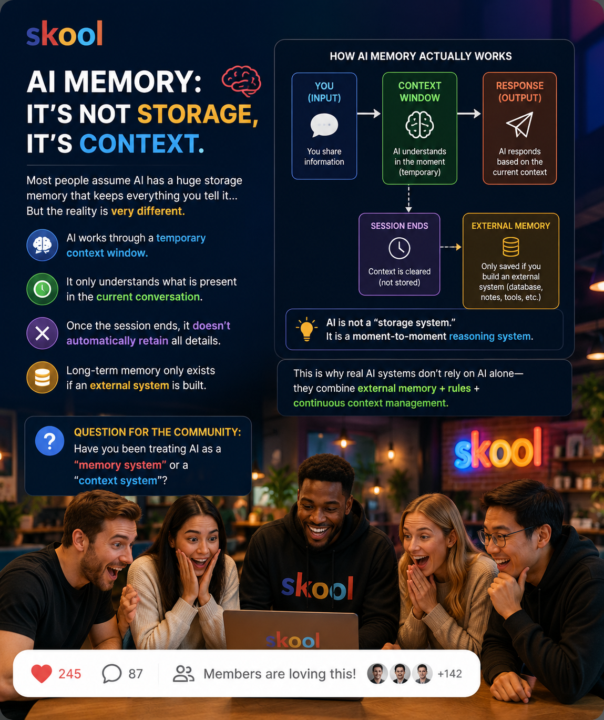
Most people assume AI has a huge storage memory that keeps everything you tell it… But the reality is very different 👇 AI doesn’t “store” information like a phone or a database. It works through a temporary context window. Meaning: It only understands what is present in the current conversation Once the session ends, it doesn’t automatically retain all details Long-term memory only exists if an external system is built around it 📌 So AI is not a “storage system” It is a moment-to-moment reasoning system The key difference: Storage = permanent retention Context = temporary understanding based on what’s currently available 💡 This is why real AI systems don’t rely on AI alone— they combine external memory + rules + continuous context management Question for the community: Have you been treating AI as a “memory system” or a “context system”? 🤔 #AI Email Agent (9/20/24) @Nate Herk
0 likes • 15h
🚀 Level 6 unlocked in Skool community! Grateful for this journey of learning, sharing, and growing with you all. Every level here is not just a number, but a step deeper into understanding and building better systems of thinking. Let’s keep going higher together 🤝🔥
19h •
Most people automate tasks. Few automate demand.
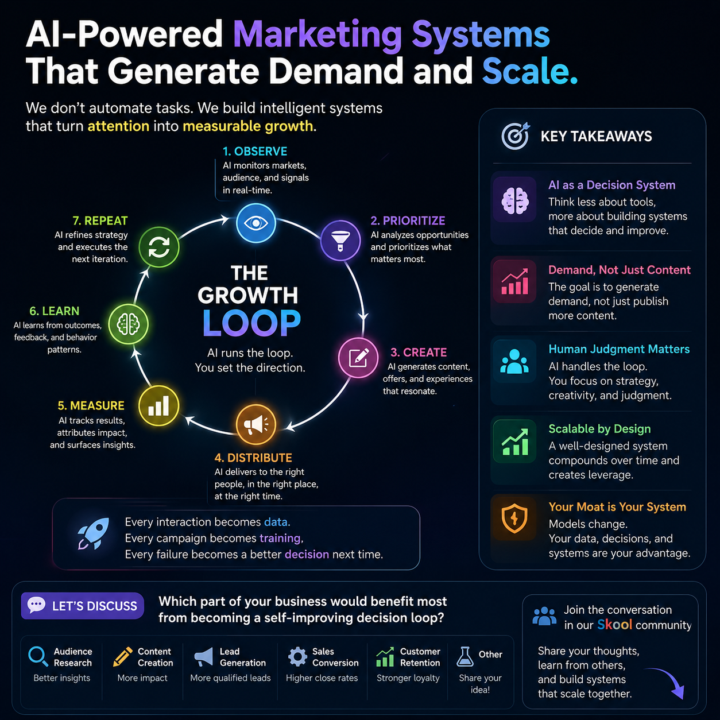
That's the difference between saving time and building a growth engine. I've been thinking about AI less as a collection of tools and more as a network of decision systems. Instead of asking: "How can AI write this post?" I ask: "How can this system continuously discover opportunities, decide what matters, create value, measure outcomes, and improve itself?" That changes everything. A scalable AI marketing system isn't a chatbot. It's a loop. Observe → Prioritize → Create → Distribute → Measure → Learn → Repeat. Every interaction becomes data. Every campaign becomes training. Every customer question becomes market research. Every failure becomes a better decision next time. The goal isn't to automate people. The goal is to automate everything around people so human judgment becomes more valuable, not less. I believe the next generation of businesses won't compete on who has the best AI model. They'll compete on who has built the best decision loops around that model. Models will keep changing. Decision systems will keep compounding. That's where durable advantage comes from. What part of your business would benefit most from becoming a self-improving decision loop rather than another isolated AI workflow? @Nate Herk @Frank van Bokhorst
2 likes • 16h
@Radim Soukal Yes—completely agree. If the logic is clear and repeatable, “if” conditions are often more reliable than AI. AI is better only when the problem is too complex or unclear to define with rules.
3 likes • 16h
@Dieva Varest In most real systems, it’s actually the measurement leg that’s missing more often than the metric. People usually do define a metric (reply rate, CTR, conversions), but they don’t set up reliable, automated measurement that continuously feeds back into the system. So the loop looks complete on paper—but it never actually closes. Without consistent measurement, the system can’t compare “before vs after,” so it never truly learns—it just restarts experiments.

17h •
EA vs AIOS
I am still struggling to understand the need of both an EA and a AIOS especially since a lot of the context are repeated. Can anyone give an actual example of when to use an EA and when to use the AIOS? Thanks in advance!
0 likes • 16h
@M W The overlap in context is expected—the separation isn’t about information, it’s about function. Clear distinction: AIOS = decides + orchestrates Sets goals, priorities, rules Chooses what matters now Breaks work into tasks EA = executes Takes one task Produces output Doesn’t re-decide strategy Real example: You want to grow a newsletter. AIOS: “This week focus on retention” “We’ll test storytelling hooks” “Plan: 3 emails + 2 experiments” EA: Writes Email #1 using storytelling hook Rewrites subject line variants Summarizes feedback from Email #1 Why context repeats: Because both operate on the same system state—but: AIOS uses it for decisions EA uses it for execution Simple rule: If you’re asking “what should we do?” → AIOS If you’re asking “do this task” → EA
3d •
I used to think writing hooks was about creativity…
But the more I created content, the more I realized it’s actually a system of patterns. So I started breaking my process into steps instead of guessing: Idea → Hook → Structure → Rewrite → Publish It completely changed how I approach content creation. Curious—do you follow a structured process when writing, or is it more spontaneous for you?

1 like • 3d
@Jason Elam “This is a strong operating model 🔥 What you’ve built is a clear separation between intent, expansion, and judgment. Most people collapse these steps and end up outsourcing both thinking and taste to the model. Your final ‘human pass’ is actually the core quality control layer.”
0 likes • 18h
@Dionny Chejito That’s a strong pattern. Specificity cuts through noise—when you anchor on one concrete observation, you avoid abstraction drift and keep the reader’s attention grounded in something real. It also makes the hook more credible, because you’re not inferring, you’re extracting.
2d •
The Next AI Advantage Isn't a Better Model Everyone is chasing the next model.
Bigger context. Faster responses. More reasoning. I think they're looking in the wrong direction. The next competitive advantage won't be the AI you use. It will be the memory you build around it. Imagine two people using the exact same model. One starts every conversation from zero. The other has years of documented decisions, workflows, lessons learned, failed experiments, writing style, business rules, and personal frameworks. Same AI. Completely different results. We're moving from prompt engineering to memory engineering. The people who systematically capture and organize their thinking today may have an enormous advantage in a few years—not because the AI is smarter, but because it understands their way of thinking. Maybe the most valuable asset we're building isn't another prompt library. Maybe it's a second brain that grows with us. Question: If your AI could permanently remember only one thing about how you work, what would you want it to remember? #AI Email Agent (9/20/24) #RAG Chatbot AI Agent (9/22/24) @Nate Herk
0 likes • 20h
@Jay Mansperger I completely agree. The competitive advantage is shifting from model selection to context design. When your decisions, principles, and lessons learned become part of a structured knowledge base, AI stops behaving like a generic assistant and starts operating like a teammate that's already onboarded. That's much harder to replicate than access to the latest model.
0 likes • 19h
@Jörg Madeheim Nice—this is exactly the kind of habit that compounds. Turning insights into structured “memory” is what makes your workflow more reusable and intentional over time.
1-10 of 83
@fouadabd-fouad-6946
Using AI to help others create income and grow online.
Active 14h ago
Joined Jun 15, 2026
ISTJ
Yemen
Powered by