Activity
Mon
Wed
Fri
Sun
Aug
Sep
Oct
Nov
Dec
Jan
Feb
Mar
Apr
May
Jun
Jul
What is this?
Less
More
Memberships
Crust & Crumb Academy
1.1k members • Free
183 contributions to Crust & Crumb Academy


10 likes • 9d
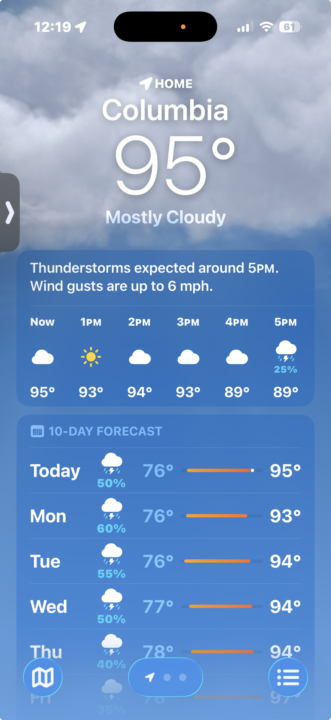
The reason there’s 40 million people in California is the weather…🤷♂️
1 like • 8d
I lived in Scottsdale, Arizona for 15 years. Every summer it would get up to 115°f for a couple of weeks. Occasionally it will get up to 121°f. Once while I lived there they actually close the airport when the temperature reached 121°f. The air there is so dry that at that temperature there’s not enough lift for heavy commercial aircraft to take off. But I’ve been in Florida too with that high heat and high humidity…😖

13d •
Baguette versus French bread
I made the baguette (poolish) recipe 2 days ago and yesterday made the French bread. My French bread was so soft and sticky, and I'm not sure why. That's not my question.. I love in TN and you can cut the air with a knife right now. But, my French Loaves are so soft and delicious. What makes the difference in the hard chewiness of the baguette versus the French bread? Is it just the water? Because it a bit sloppy and I wasn't sure if it would rise in the oven, but I like how soft they turned out. So my guess is the high water content? Family is taking them to church as sandwiches tonight. I just really want to understand the science. I'd love some day to not have to look up recipes but to know generally what I'm doing. Thanks!
3 likes • 12d
@Dusty Sessions this will help you understand what’s happening and why… https://youtu.be/DflJtGiHenA

13d •
Fred and Roy - Mold Mold Mold
Fred and Roy are dead, Long live Roy! Long story short - First everything is good. My wife and I had an emergency trip this week and were gone for a few days. Fred and Roy were left sitting on the counter like always. I checked on them after we got back home. Both had mold... I will be starting a new Roy with rye flour today. I have decided not to start a new Fred, because the white flour did not develop the same flavor as the rye flour. Thanks to everybody here, I and my family are addicted to real Sourdough Bread.
3 likes • 13d
@Mike Worley … have you considered going on Nextdoor in your area and asking locals if you could have 30 grams of their established sourdough starter? I’ve volunteered my starter whenever I see that request online. Or if there is a bakery in your area that sells sourdough products they are usually generous with their starter too. It will save time and labor…👍
13d •
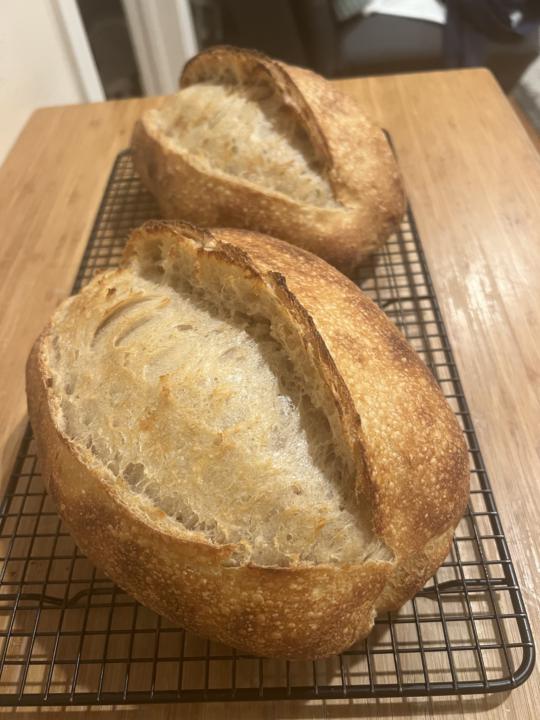
78% hydration dough experiments… Batch A and Batch B
Batch A risen to 55% and then cold proofed overnight. I will bake it tomorrow morning. Batch B risen to 70% and baked this evening. Crumb shots tomorrow. June 30, 2026 Experiment… 78% hydration open crumb attempt: BATCH B - baked same day, tonight Formula: 100/78/2/10 With 100% hydration starter Recipe: 2 loaves 540g high gluten flour 540g all purpose flour 816g water I held back 36g water to dissolve the salt to be added after the Fermentolyse 240g Hank = 120g h20 + 60g HG flour + 30g WW flour + 25g dark rye flour = 10% of total flour weight. 24g salt —————- 2160g total weight 600g HG flour = 50% 540g AP flour = 45% 30g WW flour = 2.5% 30g dark rye flour = 2.5% ——————————————- 5:00pm: mix using warm water… for 1 hour Fermentolyse. Dough temperature 86°f. 6:00pm: add salt & water. Do through mix using pincher/Rubaud/slap & folds methods. Bench rest 25 minutes. Dough temperature 84°f. 6:30pm: slap & folds. Dough temperature 83°f. Bench rest 25 minutes. 7:00pm: coil folds. Passed the windowpane test. Put dough in cambro + put cambro 4.5” on heat pad set at 82°f. Dough has risen 12%. Dough temperature 80°f. Keep heat pad warm until dough has risen 55%. 7:30pm: 4.75” = 19% rise 8:00pm: 5” = 25% rise 8:30pm: 5.5” = 38% rise 9:00pm: 6.2” = 55% rise 9:35pm: 6.8” = 70% rise. 9:40pm: divide into equal portions + preshape + cover with mixing bowls. Bench rest 20 minutes. 10:00pm: final shape + put in bannetons + bench rest 10 minutes + lace bottom seam to add surface tension + room temperature final proofing. 10:22pm: put dough on preheated baking steel at 510°f unscored. Bake shell on for 7 minutes. Remove shell, score dough, replace shell and continue baking as normal. 10:42pm: remove shell so the crust can brown and the interior continue baking until it reaches 205/210°f. 11:03pm: interior temperature 210°f… transfer loaf to cooling rack. Reheat baking steel to 500°f. 11:25pm: put loaf #2 onto the steel, unscored. Bake 7 minutes shell on. Remove shell, score dough, replace shell and bake as usual.
3 likes • 13d
Batch B crumb shot…
2 likes • 13d
Batch A crumb shot…

🔥
15d •
Dessert for brekkie — YES PLEASE 🫶🏻
Who says you can't have DESSERT for breakfast? Behold my sourdough fruit pizza. For the crust – simply unfed starter, that's it! Easy peasy! Form into a round (as best as you can, I use a soup ladel lol) and placed into my 8" cast iron. I baked the crust for 10 min at 425° flipped and added the bananas and strawberries. Baked for another 10 minutes. Topped with raspberries, grapes, and my vegan cool whip! Just aquafaba and maple syrup. Then of course I devoured it 😆

2 likes • 13d
Very nice work @Jenny Rader-Bakos both the food and photography.🙏🏻🙏🏻🙏🏻
1-10 of 183

@gaylord-foreman-9623
Just an old retired guy that likes making sourdough bread…👨🍳
Active 4h ago
Joined Apr 9, 2026