Activity
Mon
Wed
Fri
Sun
Jun
Jul
Aug
Sep
Oct
Nov
Dec
Jan
Feb
Mar
Apr
May
What is this?
Less
More
Owned by Jessica
🌟 Transform your health in 12 weeks: learn the art of self healing and lose weight through Food, Fitness, Faith & Fasting. Support and strategy!
Memberships
Profit Consultants Network
10.4k members • Free
AC
AI CEO Accelerator
18 members • Free
The Art of Integration
61 members • Free
Evolve Now Social
1.8k members • Free
SkoolHers
563 members • $9/month
Skoolers
190.6k members • Free
Tube Empire 2.0
284 members • Free
50 contributions to Divine Body Blueprint

9d •
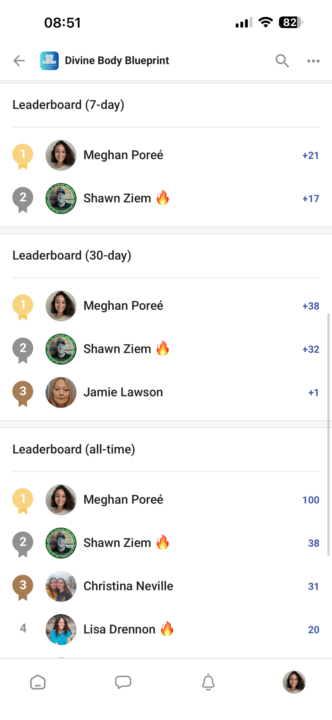
Top in Leaderboards!
Okay!! Let’s go Meghan hahah. Now watch how my health transforms too and I’ll come back and see if it has to do with my intentionality in this group and focusing on my body. 🙌🏽🔥 (hint: I know it does). Shout out to Ms. Jessica @Jessica Leibovich on teaching what she does in here so I can apply it to my life and have real results. Whooo!!! Thanks girl!
1 like • 9d
Your dedication to your own health and well being should be an inspiration to us all! When we make ourselves and our health a priority we show up for everything else in a better way and you are living proof!
14d •
Strengthen your spirit and improve your health
I want to ask you something that goes a little deeper today. Where is your flesh winning right now? Is it the late night snacking? The workouts you keep skipping? The extra wine at night before bed? The meals you keep saying you'll make but don't? I'm not asking to make you feel bad. I'm asking because awareness is where the work actually begins. When we can honestly look at where we are giving into our flesh over our spirit we can finally start to address the real root of what's keeping us stuck. This week I want you to try something. Before you reach for the thing you know isn't serving you, pause, take a breath, and ask God for the strength to make a different choice. Then come back here and tell me what happened.
3
0
15d •
This matters more than you think
I want to address timing for a second because this is one of the an overlooked pieces of the strategy of body re-composition and getting fit. What you eat before a workout and what you eat after are two completely different conversations with your body. Before your workout your body wants simple carbs, a banana, a rice cake, something it can convert to energy fast so you can perform with energy. After your workout your body wants protein to rebuild and recover. Many people are doing this backwards or not thinking about it at all and then wondering why they are tired on their workouts, can't perform, or not getting the results they want. Try adjusting your timing this week and then come back and tell me if you feel a difference. Your body will respond faster than you think.
1 like • 14d
@Meghan Poreé yes when you start to implement this workout become easier and results are amplified!
15d •
I Challenge You This Week....
This week I want to challenge you to cook as many of your meals at home as you possibly can. And before you tell me you don't have time, I want you to hear me out because this does not have to be complicated. At all. We are not talking about elaborate recipes or spending hours in the kitchen. We are talking about real whole food, simply prepared. A potato chopped up and thrown in the air fryer. A steak cooked in a pan. A piece of fish or a steak that takes less than 10 minutes start to finish. Ground beef and rice or sweet potatoes. Single ingredient meals that your body knows exactly what to do with. If you don't have an air fryer I highly recommend getting one. It is one of the best tools you can have in your kitchen for making real food fast. No fuss, no mess, and the results are actually delicious. Here is why this challenge matters. When you cook your own food you know exactly what is going in your body. No hidden oils, no mystery ingredients, no extra fat or sugar you didn't ask for. You are in complete control and that control is where your results live. This week I want you to commit to as many home cooked meals as you can manage. Start simple. Stay consistent. And if you need ideas on exactly what to eat and how to put it together, go check out Eat This to Lose Weight right here in the group. Everything you need is already there waiting for you. Drop a comment below and tell me you are in. And at the end of the week come back and tell me how it went. I will be right here cheering you on every single day. Let's go!
1 like • 15d
@Meghan Poreé Love it! It sounds so good and healthy!
🔥
18d •
The Accountability Edge
"You don't have to be great to start, but you have to start to be great!" Publicly committing to a start makes you much more likely to finish. What is one goal you’re willing to put out there right now so this community can check in on your progress next week?
1 like • 17d
@Meghan Poreé I started lifting again also the past few months using progressive overload. 3 sets. First set is a warm up you can do up to 15 reps. But the next two increase the weight so you can not do more than 10. Do 6-9 exercises and then incline walk on 12 for at least 20 minutes. Its the perfect workout!
1 like • 17d
@Meghan Poreé I am here when you need accountability, advice, and support!
1-10 of 50
@jessica-leibovich-4192
Helping you lose weight with personalized strategies that work for your body today. Nutritional chef with 28 years of experience.
Active 2d ago
Joined Sep 28, 2025
Carlsbad, CA