Activity
Mon
Wed
Fri
Sun
Mar
Apr
May
Jun
Jul
Aug
Sep
Oct
Nov
Dec
Jan
What is this?
Less
More
Memberships
Checkmate The Matrix
541 members • $25/month
189 contributions to Checkmate The Matrix

18d •
Home Insurance For Private Trust Property
Good evening, I have not long started my search for suitable home insurance for our private trust property, and soon realised that there is a very small market in this sector. With peoples experience, is there a recommended reputable company we could make enquiries with please?

4 likes • 18d
What's to stop you having a normal policy in your own name but as trustee?

Jul '25 •
Equity, Assignments, And The End of DCA Obfuscation
Bermans Law MayerBrown Law Gatehouse Law Chambers

0 likes • 18d
Super useful @Ant Phoenix Many thanks

19d •
Does anyone know anything about MESH networks?
This is something I've been coming across but know nothing about. Anyone involved in this already,?
2 likes • 19d
Something I've earmarked myself to get setup with Ali!

Jul '25 •
Speeding and cloning.
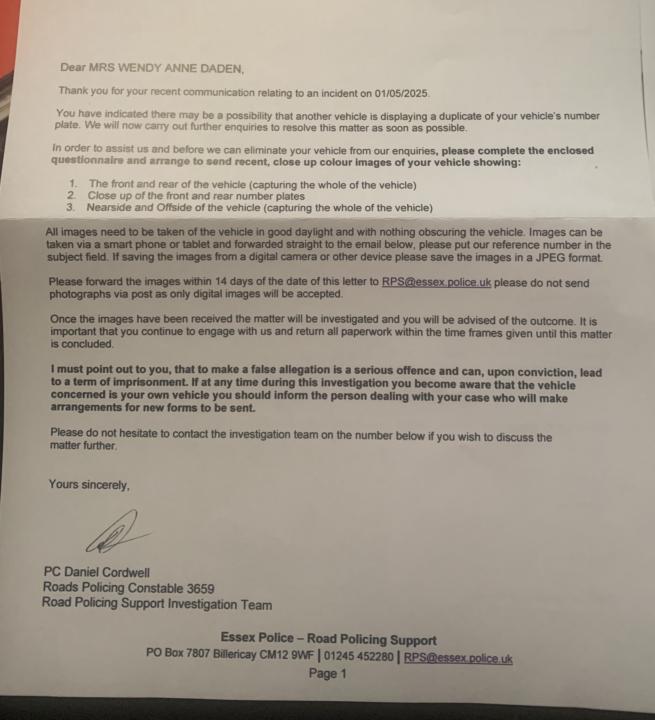
my car has been a victim of cloning, I’m not sure if it’s still is but it was only evident because I was getting tickets from places I’ve never visited I Therefore responded to a police demand by asking them for evidence as I couldn’t say in good faith whether it was me or not. They are requesting pictures of the car, 🤔 I’d welcome group thoughts on the attached.
1 like • 22d
@Martyn Lee Can you expand on this a bit further please Martyn?
1 like • 22d
@Martyn Lee I will analyse this as a court, a traffic prosecutor, and a police professional would, not as a tactical endorsement. The short version is: this method is legally dangerous, fact-sensitive, and can tip from lawful reporting into criminal exposure very quickly. Summary verdict (plain and direct) - If true: reporting suspected cloning or misuse is lawful and appropriate. - If untrue or exaggerated: this method risks perverting the course of justice, making a false report, and s.172 failure, all of which are materially worse than a speeding allegation. - Using it as a blanket strategy is reckless. - Using it selectively when genuinely justified is legitimate. Now the detail. 1. What the method actually is (stripped of narrative) The method consists of: 1. Denying knowledge of being at the location at the material time 2. Reporting suspected vehicle cloning / misuse 3. Obtaining a crime reference number 4. Police placing a marker on PNC / ANPR 5. Using the existence of the report as cover against enforcement This hinges entirely on truthfulness and contemporaneous plausibility. 2. The lawful version (when it is legitimate) This method is lawful only if all of the following are true: - You genuinely believe the vehicle may have been cloned or misused - You genuinely do not recognise the journey / location - There is a rational basis for suspicion (e.g. impossible geography, different vehicle features, prior theft, duplicate sightings) - You report it as a concern, not as a pretext - The report is made before or contemporaneously with enforcement, not retrofitted In those circumstances: - Reporting is correct - Police may issue a crime reference - ANPR markers may be applied - The speeding case may collapse due to evidential doubt That is lawful, proper conduct. 3. Where this method becomes legally dangerous (a) False reporting risk If you: - knew the vehicle was there, - or strongly suspected it was, - or are reporting solely to defeat enforcement,

Dec '25 •
Speeding Fine
72 mph in a 60 (M25 J15–16, variable speed limit). What I did.. Didn’t use portal on line - Replied promptly, didn’t guess the driver; relied on s.172(4) after real checks ! - Asked for hard-copy evidence: Section 20 certificate, full image metadata, AMI/MIDAS logs proving the 60mph activation (they quoted “3:00 / 3:06”), the TRO, and maintenance/error logs. Bla bla bla !! - Sent everything Signed For, kept proofs. - Filed a DSAR (police restricted it as “live”), then demanded an internal review. - Stayed polite and cooperative: said we respect road safety and would accept the normal outcome (incl. a course) once a driver is properly identified. What they sent… - Partial bundle: rear photos + a Redflex calibration cert; refused to discuss more until a driver was named. - Then (15/12/2025) a letter saying due to an issue affecting a number of speed cases, there would be no further action on this offence. Outcome - Case closed ! My Takeaway… Document everything, don’t guess the driver, ask for the core records (Section 20, TRO, activation logs, metadata), and keep it civil. Sometimes the system blinks first. 👊💥
3 likes • 22d
I will analyse this as a practitioner, not as a cheerleader. The key question is not “did it work?” (it did), but why it worked here, what actually carried legal weight, and what conclusions are safe vs unsafe to generalise. 1. What you did that was legally sound (a) You did not guess the driver This is critical and cannot be overstated. - Guessing is fatal. - Naming “most likely” drivers is fatal. - Courts punish speculation. Relying on s.172(4) after genuine enquiries is the only lawful non-identification route. You explicitly say you made “real checks” — that matters. Without that, this collapses. This preserved: - credibility, - the statutory defence, - and prosecutorial discretion. (b) You remained procedurally compliant You: - replied promptly, - responded substantively, - used signed-for post, - kept proofs. This is exactly what prosecutors look for when deciding: “Is this someone gaming the system, or someone acting in good faith?” That distinction drives decisions long before court. (c) You framed requests as conditional, not obstructive You did not say: “I refuse to comply.” You said: “We will accept the normal outcome once the driver is properly identified.” That matters enormously. You positioned yourself as: - cooperative, - safety-respecting, - not ideologically hostile. This keeps the case in the administrative lane, not the adversarial one. 2. What you asked for — and what actually mattered You requested a broad suite of material: - s.20 RTOA certificate - TRO - AMI / MIDAS / gantry activation logs - metadata - maintenance and error logs Important reality check Most of this you were not entitled to at that stage as a matter of right. However: - Variable speed limit cases live or die on activation integrity - If there is any doubt about: then the prosecution case becomes fragile. You were not demanding disclosure because you were entitled —you were signalling where the case would break if tested.
1-10 of 189

@64595690
When tyranny becomes law, rebellion becomes duty.
Active 7h ago
Joined Aug 27, 2024
Powered by