
Write something
2d •
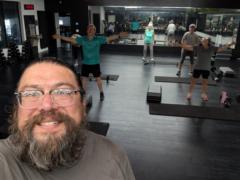
No Tai Chi Today
I'm sorry, I'm fighting a head cold and gonna lay low this morning. We'll shoot for thursday.
3
0
3d •
A great list of the fundamentals of Yang Tai Chi
https://yangfamilytaichi.com/2019/08/28/the-ten-essentials-of-tai-chi-chuan/ This list is integral into all styles of Tai Chi and to a major extent Qigong as a whole. This page is a literal translation and is confusing if you just take it at face value without context. 1) Crown to the sky, loose like the wind. This is my idea of the principle. Energetically speaking, the goal of all Qigong is to let the energy flow Heaven to Earth, Earth to Heaven and mix with Nature in the middle. The head extended upward keeps the neck long and loose and not stiff and rigid nor hunching inward, especially in light of the second fundamental. 2) Let your body hang like a coat on a hanger. This is my interpretation of the translation, "Hold in the Chest and Slightly Round The Back". I believe this to be more instructional and make more sense. If you stand at attention, you puff up your chest, arch your back, suck in your stomach. Where as the command, "At Ease" lets you relax without losing integrity of your posture. A coat hanging on a hanger still has form but cannot crumple into a pile as if it was dropped on the floor. The structure is relaxed but holds integrity. 3) Relax the waist. Simple instruction yet hard to master. Do anything and one of the first reactions is to brace the core. In Qigong, this is to shut off the flow of energy from your center. Plus, when moving, this will make us rigid and robotic not flowing and relaxed. If you contemplate a spring or an exercise ball, they deform and adapt to the pressure because they are relaxed not rigid yet still hold form because of what they are. Relax is not release just as much as it is not rigid. 4) Separate Empty and Full is the translation. It is referring to the weight shifts that should occur with the natural movement. When performing the Beijing 24, there is a rocking back and forth of weight to the left foot and right that allows the movements to happen. I refer to this as sloshing the water. If you imagine yourself as the cork on the wave, the rising and falling from crest to trough allows you to move. At the crest, you are lifted off the seabed and can move easily on the water. When in the trough, you settle back on the sand and are rooted. This is one of the major struggles as people learn any form and often leaves them in a balanced, 50/50 stance. That stability makes it impossible to move.
2
0
3d •
Ramen Restomod: Five Ways to Upgrade a Struggle Meal
There was a time that I was eating ramen noodles that I cooked by leaving the noodles in a cleaned out peanut butter jar on my dashboard in the summer. You could call it an early solar oven. Despite that being one of my primary meals for months, I still love cheap ramen noodles and always have them in my pantry. Thankfully, I can upgrade that ramen experience now but that doesn't mean I don't enjoy the convenience and economy of that packet. Here's a recipe book I put together for my students that are on a tight budget to upgrade their 75 cent ramen to a decent meal without having to get $25 a bowl take out.
1
0
5d •
Here are the handouts to go with the lectures.
This is a tidal wave of information that one of my colleagues described as two semesters of nutritional biochemistry summed up in an hour.
1
0
6d •
The follow up to the original video...
This puts calorie consumption into a completely new paradigm. Not calories but actual atoms of food and where that goes. https://youtu.be/nM-ySWyID9o?si=pHB803nvWEouZxei
1
0
1-30 of 64
powered by
skool.com/wild-physique-1598
Coach Rich Kahle teaches you how to Build strength, master mindset, optimize health, and live the Stealth Life. No shortcuts—just growth.
Suggested communities
Powered by