
Write something

2d •
I DO NOT GATE KEEP!
One thing I’ve noticed in this space is that a lot of people guard information. They won’t share other teachers, other communities, or other platforms because they’re afraid their students might leave. I don’t see it that way. The only competition I see is the competition against ignorance. If someone is teaching people how to understand rights, property, lawful process, money, trusts, and structure correctly, then we’re on the same team. Yes, there are things I may not personally agree with in this space. That’s normal. But that doesn’t require animosity. We should act like adults. We should act like men and women who understand that clarity benefits everyone. There’s enough confusion already. For that reason, I want to share a community I genuinely respect. Out of everyone I’ve seen in this arena, I have rarely found someone with as much real-world experience and structured clarity as Joseph Lusty and his Skool community, Liberty Foundation. It is a private lawful education community focused on practical understanding of rights, property control, and lawful options — without hype, shortcuts, or theory that falls apart in real life. What stands out to me is the structure. Everything is step-by-step. Real examples. Documented processes. Weekly live Q&A. No magic phrases. No “secret scripts.” No emotional escalation. You learn how to: • Stand on your rights calmly and lawfully • Understand what actually applies to you and what does not • Use proper process instead of conflict It fills in gaps I’ve seen many people miss. I’m part of the community myself. If this type of education resonates with you, I recommend you check it out. We are not competitors. We are on the same side. Clarity over confusion. Process over noise. Freedom isn’t handed to you. It’s understood. With knowledge, we stand tall. Here is the link to Joseph Lusty’s group Liberty Foundation enjoy! https://link.skool.com/ls/click?upn=u001.wK6x93jhdVos-2F3TofGJCJhjCCMpNgLJK-2Bho0s3QBPM60GTnfwhC0JhQUT9TGoxbWlEZ5VMlmKXubHsemz22Gxw-3D-3Dx2bj_LF7iY4MkFpG-2Fy-2BaJoG0TDHmF5d6VyOHKqvGOg41AdxRCJ-2FTEqDTdbFo36AODZ1mK4adTQ7D8sFz1SyWlXHcH8KxKUC-2FsvMPBpUptLzPDkW-2FlOl7CfLnrxOqve2hck6bST4J-2BRnpHNeN4P5mGK9UxKbcqxzXvdoXa5RsLo1ib9HVkbMGeyrFfPeCseDZd3Zvg5ReM-2BeSRvRCnE3tFu-2BY0-2FVIMd6kqnABGb6hVJF1Hu6PFPZLdEFYQUQlWtbWt3hjBcQ9ci7PyhK-2B7CNcAPaOFQOszu55Hcf7Yr10JrHXfgLN-2BW7vThLuKAWHaKF4w5VKU65-2FTudo-2FS9N18ijI-2FRJjGF-2FGLtSwSqmFZkxGjQK4r-2FoXatK6cHgx2FedjYMIbo-2Fm5eBF6T-2FDKeYUNvuz7v-2FUyGoFvFaWSZ7RhPayqNfNAIbAYLgacgc6KQu69DHmyFUQTBxxq-2Bypg0or516BujkfykeLdaI5P-2F3RztAVCWSmIBqzMyvTGLkJB3lbJzpyslHuYK-2FAjoIM0MDqVjWcWT6m7w-3D-3D
14d •
Did you know the “Courts of Baal” STILL exist today?
In biblical times Baal worship was not just spiritual idolatry. It was institutional power. Baal temples functioned as economic, judicial, and political centers. Baal high Priests mediated land use, tribute, debt, and covenants. Authority flowed from temple to ruler to people. Allegiance to Baal was enforced through economic dependence. This structure stood in direct opposition to the Ten Commandments. It divided sovereignty from the creator. Affirmed idol authority, theft, and very wicked things as we know. The Hebrew’s could only recognize God’s law… this was a big problem for both sides. Hebrews recognized the land was ultimately God’s. Debt had limits. Jubilee reset bondage. The biblical system restrained permanent economic enslavement. Baal systems did the opposite. They centralized power. They fused religion and state. They normalized tribute and debt extraction. They treated people as resources of the temple-state and worse as sacrifices to Baal. When the Hebrews rejected God’s order and adopted surrounding systems, the prophets called it “harlotry” - political and economic entanglement with foreign powers. Then came Babylon. Babylon perfected imperial administration. It merged law, commerce, and sovereign authority. It cataloged populations. It extracted tribute. It monetized conquest. It codified obedience. Rome inherited and expanded this model. Roman civil law systematized hierarchy, status, property registration, and state supremacy. This was further refined by Constantine as he merged the Roman courts (of Baal) with Christianity. Which is in part why we have the Bible in the modern day courtrooms. It also why we have weird remnants of pegan holidays today. Most biblical scholars agree Christ birth was not in December. Christmas for example was originally recognized as a Roman holiday for solstice worship replaced by Constantine with the recognition of the birth of Christ. Over time, Baal courts aligned adjacent with ecclesiastical courts layering spiritual authority over civil structure. The root word of Attorney is “Attorn” - to turn over. An attorneys job is to move or “attorn” you from that ecclesiastical jurisdiction to the courts of Baal. Luke chapter 11 states:

15d •
Berth Certificate Truth
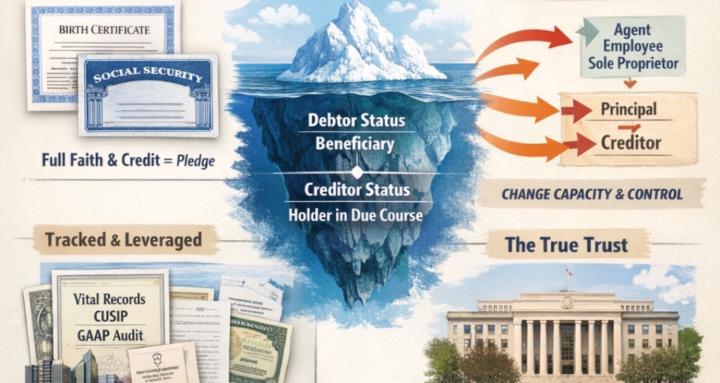
Birth Certificate Truths: To understand the modern birth certificate, you first have to understand commercial law and how value is structured in the United States. The Uniform Commercial Code, known as the UCC, is a standardized body of commercial law adopted across all fifty states to harmonize rules governing trade, sales, and financial transactions. In practical terms, it functions as the operational framework of commerce in America. Commerce does not run on random policy. It runs on uniform systems. Historically, empires required unified trade rules so that commerce could function consistently across jurisdictions. The Roman Empire operated this way. Trade was standardized. Rules were centralized. Over time, commercial systems evolved from maritime and mercantile traditions into codified commercial law. Modern commercial law did not arise in a vacuum. It developed from older European legal frameworks, including Roman civil and canon systems that influenced Western legal structure. Now let’s connect this to birth. The word berth refers to a ship docking at port. When a vessel arrives and comes to rest at the dock, it has reached its berth. Under maritime tradition, when a ship enters port, the captain must present a manifest to authorities. The manifest lists what the vessel carries: cargo, crew, passengers. It identifies and accounts for what has arrived. This is important. Maritime commerce requires documentation of value and contents. That documentation establishes identity, status, and accountability within the commercial system. Now consider birth. A child emerges from the mother’s water. The language is birth, but the structure mirrors the arrival of a vessel. Upon arrival, documentation is created. That document is the birth certificate. It establishes identity within the system. It registers the new individual into the public record. Modern governments operate on credit systems. Since 1933, U.S. currency has not been backed by gold or silver. It is backed by the full faith and credit of the United States. That phrase is not symbolic. It refers to the productive capacity of the nation. The ability of its people to labor, generate income, and be taxed. Future productivity backs present borrowing.
1
0

18d •
Warren Buffets Greatest Speech
In 1998, Warren Buffett quietly explained how to never lose money in just one hour. Almost nobody paid attention. The company built on those principles is now worth nearly $1 trillion. This is the closest thing to a cheat code you’ll ever see. https://x.com/cryptotony__/status/2022705393080922425?s=46&t=vB5syPBTZaz4p1Wqq9Ra4Q
0
0
Feb 2 •
What it takes to achieve a perfect 850 credit score:
The two sure ways I have witnessed: 1. Do what my boy Joey Kimbrough did and sue the credit reporting agencies for an 850 😂 you can see exactly how he did it here: https://www.courtlistener.com/docket/63389647/kimbrough-v-snap-on-credit-llc/ he and Brandon Joe Williams also did a YT video recently talking about that case and how it all happened. I’ve attached the link below. I highly recommend watching it. 2. Then there’s the good ol’ boy method of which requires: • Oldest account: 21 years • Payment history: 0 missed payments — ever • Credit utilization: 1% • Average age of accounts: 11 years • Open accounts: 7 credit cards + 1 secured loan • Interest-bearing debt: $0 • Hard inquiries (last 24 months): 3 The simple formula: Build strong relationships with banks and lenders. Use your credit consistently. Pay it off early—every single time. Keep balances low (below 25% usage) and never miss a payment. This is how you reach 850 credit without carrying debt or paying a penny in interest. Let me say that again so it sticks… FREE MONEY AND FLIGHTS!!! WITHOUT PAYING A CENT IN INTEREST!
1-30 of 53
powered by
skool.com/title-8-academy-1862
PRIVATE - FINANCIAL LITERACY AT ITS FINE$T In Layman Terms 🙂
What Are "Dollars" 💰 Anyway?
Ask: “How Do The Rich & Famous Pay Less Taxes Than Me?
Suggested communities
Powered by