

9h •
🔬 There's a Peptide That Fights Bacteria Like a Tiny Sword — And Your Body Makes It Every Day
Your immune system has its own built-in antibiotic, and it's called LL-37. It's a 37-amino acid peptide that your body produces as a first line of defense against invaders. Unlike regular antibiotics that target one specific weakness in bacteria, LL-37 physically punches holes in bacterial membranes. That's an important distinction because it makes it incredibly hard for bacteria to develop resistance. But here's where it gets really interesting. LL-37 doesn't just kill bacteria floating around freely. It also breaks apart biofilms, which are those sticky protective communities that bacteria hide inside when they want to survive. Think of biofilms like a fortress wall that regular antibiotics can't get through. LL-37 can actually penetrate that wall. On top of that, it neutralizes bacterial toxins AND calls in backup by attracting your immune cells to the site of infection. One molecule doing four jobs at once. Here's what the research found 👇 ✅ A Swedish clinical trial showed topical LL-37 helped heal chronic wounds that weren't responding to other treatments ✅ Studies show LL-37 production is directly controlled by your vitamin D levels, which means your vitamin D status is literally tied to how well this defense system works ✅ Researchers are now studying it as a potential answer to the antibiotic resistance crisis since bacteria struggle to outsmart a physical membrane attack Have you ever looked into the connection between vitamin D and immune function? This peptide is basically the missing link that explains why it matters so much. For research purposes only.
0
0
13h •
💬 If You Could Fix One Thing About How Your Body Feels Right Now, What Would It Be?
I talk to a lot of people in this community and one thing always stands out. Almost nobody starts looking into peptides because everything is going great. There's usually that one thing that finally pushed you to start digging deeper. Maybe it was joint pain that wouldn't quit, brain fog that made you feel ten years older, sleep that stopped being restful, or just watching your energy slowly fade and thinking "this can't be normal." What's interesting is that most people I talk to don't even realize how connected their issues are until they start learning about the science. Gut problems linked to inflammation. Poor sleep wrecking recovery. Stress hormones messing with everything from skin to body composition. Once you start pulling the thread, it changes how you think about your own health entirely. So here's what I'm curious about 👇 ✅ What's the one thing you'd fix about how you feel day to day? ✅ What led you down the rabbit hole of researching peptides or compounds? ✅ What's something you wish you had understood about your body sooner? No wrong answers here. Whether you've been researching for years or you just found this community last week, drop your story below. Chances are someone else is dealing with the exact same thing and hasn't said it out loud yet. For research purposes only.
0
0
18h •
🧬 There's a Peptide That Works Like Your Brain's Own Desire Switch — And the FDA Actually Approved It
Most people think desire is purely psychological. But researchers at the University of Arizona discovered something fascinating while studying a tanning peptide. Volunteers kept reporting an unexpected side effect — a significant increase in sexual arousal. That accidental finding led to the development of PT-141, also known as Bremelanotide, which became the first and only FDA-approved peptide that works on desire at the brain level. Here's why that matters. Medications like Viagra and Cialis work on blood flow — they're basically plumbing fixes. PT-141 does something completely different. It activates melanocortin receptors in your hypothalamus, the part of your brain that regulates motivation, arousal, and reward. When those receptors are triggered, your brain releases more dopamine in the pathways responsible for wanting and desire. It's not changing circulation. It's changing the signal at the source. The clinical data behind it is solid 👇 ✅ Two Phase III trials with over 1,200 women showed significant increases in desire and reductions in distress related to low libido ✅ Earlier Phase II research in men showed 80% of subjects experienced a measurable response compared to 20% on placebo ✅ It was approved by the FDA in 2019 under the brand name Vyleesi for hypoactive sexual desire disorder in premenopausal women What makes this peptide so interesting from a research perspective is that it proved something scientists had debated for years — that desire has a concrete neurochemical basis, and it can be modulated through specific receptor pathways in the brain. That opens doors well beyond sexual health into how we understand motivation and reward at a molecular level. Did you know desire had its own receptor system in the brain, or is this completely new to you? For research purposes only.
0
0
1d •
🔬 There's a Peptide That Protects Your Heart by Telling Damaged Cells Exactly Where to Go
TB-500 is one of those compounds that makes you wonder why more people aren't talking about it. It's based on a protein your body already produces called Thymosin Beta-4, which is found in almost every cell you have. Its main job is controlling a protein called actin, which is basically the scaffolding that gives your cells their shape and ability to move. When tissue gets damaged, TB-500 helps repair cells migrate to the injury site and kicks off the process of building new blood vessels to supply that area. Here's where it gets really interesting. A landmark study published in Nature found that TB-500 reduced the size of heart damage after a cardiac event by roughly 50% in animal models. It did this by activating a survival pathway called Akt that keeps heart cells alive under stress. A follow-up study, also in Nature, showed it could actually reactivate dormant stem cells in heart tissue and turn them into brand new heart muscle cells. That's not just repair, that's regeneration. What makes TB-500 unique compared to other repair peptides is that it doesn't need to be applied right at the injury. Because of its low molecular weight, it distributes throughout the body and finds damaged tissue on its own. Studies have also shown it promotes healing in skin wounds, brain injuries, tendons, and even the cornea. Here's what the research highlights 👇 ✅ Reduced cardiac tissue damage by approximately 50% in preclinical models ✅ Promoted new blood vessel formation and cell migration to injury sites ✅ Reactivated dormant stem cells capable of becoming new heart muscle Have you ever come across a compound that made you rethink what the body is actually capable of repairing? For research purposes only.
0
0
2d •
💬 What's the One Health Goal You've Been Chasing the Longest — And What Finally Started Moving the Needle?
I talk to people every day who are deep into researching peptides, and one thing I've noticed is that almost nobody starts here randomly. There's always a story. Maybe it was joint pain that wouldn't quit, brain fog that made you feel like a different person, or watching your recovery time get longer every year and thinking "this shouldn't be this hard yet." What I find really interesting is that most people don't come to peptide research because they want to experiment with something new. They come because they already tried the conventional path and still felt like something was missing. They did the bloodwork, adjusted the diet, dialed in the sleep, and still hit a wall. That's usually when the deeper questions start. So here's what I want to know 👇 What's the health goal that's been on your mind the longest? Could be gut health, recovery, energy, body composition, sharper thinking, better sleep, anything. And what's one thing you wish someone had told you earlier in that journey? Drop it below because I guarantee someone else in here is dealing with the exact same thing and feeling like they're the only one. For research purposes only.
0
0
1-30 of 91
skool.com/thecompoundlab
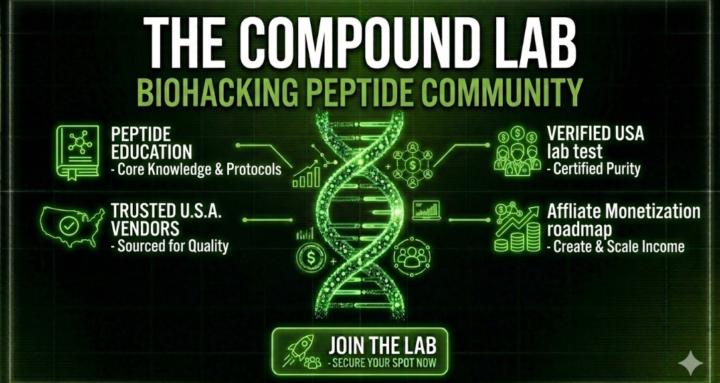
Private biohacking community for peptide education, trusted sourcing, and ethical affiliate monetization. Education-first.
Leaderboard (30-day)
1

+6
2
+4
3

+4
4

+4
5

+3
Powered by