
Pinned
7d •
START HERE
🧬 Welcome to The Compound Lab Your Research Starts Here. We're glad you're here. Follow these 4 steps to get plugged in: ✅ STEP 1: Introduce Yourself Drop a comment below — tell us who you are, what brought you here, and what your goals are as a Compound Researcher. Ask any questions you have. We're all here to help. 📚 STEP 2: Head to the Classroom Tab This is where your education begins. Start with Module 1 and work your way through our in-depth research compound breakdowns, biohacking science, and compliance training. 🔬 STEP 3: Check Out Our Verified Vendors Every vendor in our network is COA certified and fully research compliant. No guesswork — just trusted sources for serious researchers. For research purposes only. Not for human consumption. 💰 STEP 4: Get Your Affiliate Link Ready to earn? Once you're a verified researcher, our vendors will assign you a personal affiliate link so you can earn recurring commissions sharing what you already know. "Learn it. Source it. Share it. Earn from it." 🧬 Welcome to the family — now let's get to work.
2h •
🔬 What's the One Thing That Led You Down the Peptide Rabbit Hole?
Everyone has that moment. Maybe it was a nagging injury that wouldn't heal. Maybe it was watching your energy slowly decline year after year and thinking "this can't be normal." Maybe you stumbled across a study about GLP-1 compounds or BPC-157 and thought... wait, why didn't anyone tell me about this sooner? For a lot of people in this space, it starts with one specific frustration. Something traditional approaches didn't fully solve. Gut issues, stubborn body composition, brain fog, skin aging faster than expected, sleep that never feels deep enough. Then you start reading, and suddenly you realize there's an entire world of published research on compounds that most people have never even heard of. So here's what I want to know 👇 ✅ What health goal originally brought you to peptide research? ✅ What's something you wish you had learned about sooner? ✅ What's the one area you're most focused on improving right now... recovery, cognition, body composition, longevity, gut health? Drop it below. No wrong answers here. Whether you've been deep in the literature for years or you're brand new and just trying to make sense of all the acronyms, this is the place to ask questions and share what you've learned. For research purposes only.
0
0
2h •
💬 Before You Ever Heard the Word 'Peptide' — What Were You Actually Searching For?
Most people don't wake up one day and say "I want to learn about peptides." Usually it starts with something personal. Maybe you were dealing with an injury that wouldn't heal, or brain fog that made you feel like a different person, or you just hit a wall with energy and recovery that nothing seemed to fix. You searched for answers, went down a few rabbit holes, and somehow ended up here. That's honestly how the best research journeys start. Not with a compound name, but with a real problem you wanted to solve. And once you start understanding how your body actually works at the cellular level, things like tissue repair signaling, gut inflammation pathways, or why your mitochondria slow down with age, it changes how you think about health entirely. The science stops being abstract and starts feeling personal. So here's what I'm curious about 👇 What was the original goal or frustration that led you into this world? Was it recovery, sleep, cognition, body composition, aging, gut health, something else? And looking back now, what's one thing you wish you had understood sooner about how your body works? Drop it below. Genuinely want to hear what brought this community together. For research purposes only.
0
0
7h •
🔬 There's a Peptide That Helps Your Body Grow New Blood Vessels to Heal Faster
Your body has a built-in repair system that sends cells rushing to an injury site, builds new blood vessels to deliver nutrients, and lays down fresh tissue. What if there was a molecule that could amplify every step of that process? That's essentially what TB-500 does. It's a synthetic version of Thymosin Beta-4, a protein found in nearly every cell in your body. Its main job is managing something called actin, which is basically the scaffolding inside your cells that controls how they move and where they go. Here's where it gets interesting. Most repair peptides need to be applied right at the injury to work. TB-500 is different. Because of its unique low molecular weight structure, research shows it can travel systemically, meaning it doesn't have to be local to the damaged area to have an effect. It tells your repair cells to migrate toward the injury, helps build brand new blood vessels to feed that tissue, and dials down inflammatory signals that slow everything down. What studies have found 👇 ✅ A landmark 2004 study published in Nature showed TB-500 reduced heart tissue damage by roughly 50% after cardiac injury in animal models by activating a key survival pathway called Akt ✅ Full-thickness wound studies found it improved closure rates by approximately 40% compared to controls, with increased collagen production and new blood vessel formation ✅ Traumatic brain injury research showed improved neurological recovery, reduced lesion size, and even new nerve cell generation ✅ A 2007 Nature study found it could reactivate dormant stem cells in heart tissue, opening the door to the body regenerating its own cardiac cells The research spans everything from tendon and ligament repair to corneal healing to liver fibrosis. It's one of those compounds where the more you read, the more you realize how fundamental this molecule is to how your body puts itself back together. What area of healing research interests you most? For research purposes only.
0
0

1-30 of 36
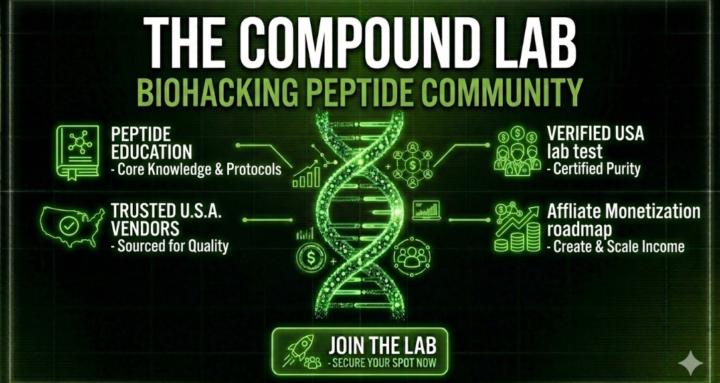
skool.com/thecompoundlab
Private biohacking community for peptide education, trusted sourcing, and ethical affiliate monetization. Education-first.
Leaderboard (30-day)
1

+6
2
+4
3

+4
4
+4
5

+3
Powered by