User
Write something
Piano and Theory Q&A Hotline is happening in 22 hours
🎹 Art Tatum & The Quiet Power of Relaxation
I’m sharing a rare video of Art Tatum actually playing — worth watching simply to absorb what his hands and posture are doing. What always strikes me is how absurdly relaxed he looks. Almost to the point where you catch yourself thinking: “Is he even playing the piano?” And that’s the real lesson. ✨ Good technique looks different on every body We all have different hands, proportions, old habits, little tensions we carry. But one principle always holds: Good technique uses the least energy necessary to get the musical result you want. Tatum is a perfect demonstration — effortless, economical, no wasted motion. 🧩 How to use this in your own practice When you watch the video, notice: - How loose his shoulders are - How quietly the hands return to the keys - How nothing is gripping or bracing unnecessarily Then, when you’re practising: Treat relaxation as a musical element — something you deliberately build in. If that means slowing down a difficult section because you find yourself consciously releasing your left shoulder every time you hit the bass notes… that’s exactly what you should do. You slow the music down until relaxation is part of the version you can play. Only then do you bring the tempo back up. 🎧 Watch the video, take your time, and let Tatum’s ease rub off on you. What do you notice about his playing?
🎹 Workshop Highlight — The Three Layers of Learning
When you’re learning something new at the piano — especially improvisation — there are really three kinds of memory working together: 1️⃣ Rote memory — what you copy and repeat until it feels familiar. 2️⃣ Intellectual understanding — what you analyse and explain (why those notes, why that harmony). 3️⃣ Muscle memory — what your hands remember automatically through calm repetition. Most frustration comes from leaning too hard on one and neglecting the others. The real fluency comes when all three start talking to each other. 💡 Key idea: “You practise with your brain, but you perform with your body.” 🎯 Try this:Next time you learn a short passage or lick — pause to ask: - Have I memorised it (rote)? - Do I understand it (intellectual)? - Can I play it calmly without thinking (muscle)?If any layer feels weak, that’s where your next improvement lies. 👇 Watch the short highlight below — then share in Progress & Wins which of the three layers you most rely on, and which one you want to strengthen next. (Full replay → Classroom → Workshop Replay Library → Beating Piano Frustration) — Benedict 🎵
3
0
🎥 Workshop Highlight — Playing Fast Music Calmly
Most pianists try to force speed — but real fluency isn’t built through pressure. It’s built through calm coordination, developed step by step. In this short highlight from our Beating Piano Frustration — How to Practise Without Losing Heart workshop, we look at how to play fast music without tension, and how to grow speed naturally instead of fighting for it. 💡 Key idea: “Fast playing is a by-product of calm playing.” 🎯 Try this next time you practise: 1️⃣ Choose one short fast passage (even a bar or two). 2️⃣ Play it at your most comfortable slow tempo — with no tension at all. 3️⃣ Stay there until it feels smooth, light, and balanced. 4️⃣ Only then, increase the tempo by a tiny amount — keeping the same sense of ease. 5️⃣ If tension appears, slow back down immediately. This is how you build speed that lasts — through consistency, not strain. 👇 Watch the highlight below, then try this approach on your current piece. Notice how much more relaxed and in control your playing feels when “fast” grows out of “easy.” (Full workshop replay → Classroom → Workshop Replay Library → “Beating Piano Frustration”)
2
0
Eliminating distractions!
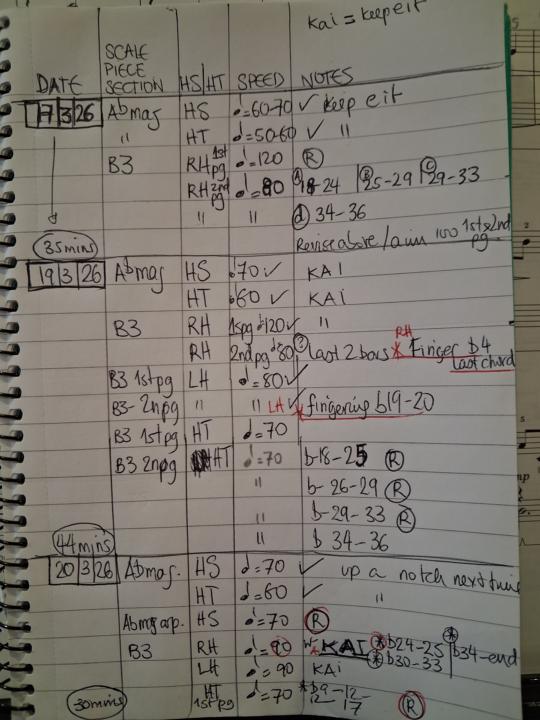
Does anyone have advice to encourage me please? I set aside time to practice, but lots of the time after sitting at the stool, I get distracted and start addressing other tasks that I've got to get done! I feel like it's really inhibiting my piano progress (despite being productive in other areas!) Thank you.
🎥 Workshop Highlight — Breaking & Linking: A Smarter Way to Fix Tricky Passages
We’ve all been there — you reach a tricky bar, stop, restart, and hope that repetition will make it stick.But repetition alone doesn’t build fluency — it just reinforces the stumble. The Breaking & Linking method offers a calmer, more structured way to rebuild fluency without losing musical flow. 💡 Key idea: Break down sections into smaller chunks, then link them together. 🎹 Try this next time you practise: 1️⃣ Break the tricky section into small, meaningful musical phrases (not random bar numbers). 2️⃣ Link them — overlap by one bar so that every join feels natural and smooth. 3️⃣ Gradually widen the overlap until the full passage feels effortless. It’s a simple shift — but it completely changes how you handle frustration and build control. 👇 Watch the highlight below, then try the method on your current piece. Afterwards, share what section you worked on in Progress & Wins — or post a short clip showing how the linking helped your fluency return. (Full workshop replay → Classroom → Workshop Replay Library → “Beating Piano Frustration”)
2
0
1-20 of 20
powered by
The Self-Taught Pianist Circle
skool.com/the-self-taught-pianist-circle-7074
A safe space for adults teaching themselves piano — share progress, ask questions, and grow your skills your way.
Build your own community
Bring people together around your passion and get paid.
Powered by