
Write something
Pinned

21d •
8/28 – Market Update: Bitcoin Is Back. But Why? And Is It Here to Stay?
- BTC: ~$77,000–$80,000 - ETH: ~$1,600–$1,700 - 30 year fixed mortgage: ~6.6%–6.7% We haven't done a full crypto market update in a while but it was for good reason, we simply needed to hold and wait. We laid out our stage by stage expectations of what we thought was coming so we just needed to give it time to show us if we were right or not..… Well, Bitcoin is now pushing 80k... but the question now is, will this move last? To understand what’s going now, we have to revisit what we were talking about since before July. The sequence looked a little like this: Iran war not over → oil pressure high → inflation risk from oil prices → Fed stuck can't cut, can't raise → dollar strong → Bitcoin stuck → AI booming → Labor cracks (this was the chain) Bitcoin was stuck in that boring, uncomfortable $59k to $65k range. Oil was keeping inflation messy. The Fed had no clean room to cut. Mortgage rates were still painful. Regular people were getting squeezed. And crypto was feeling the pain first because crypto usually reacts before the rest of the market admits what is happening. We were waiting for the labor market to continue to show cracks and inflation to cool so that we could see potential rate cut news. So what changed? Why is bitcoin pushing up now without rate cut news? Well, the dollar got worse but lets expand on that because it's not the only thing.. because markets as a whole saw the U.S. government blink. They saw them step in and act to prevent the free market from pushing bond yields higher. But what does it mean? It means the dollar debasement trade is back. *(Debasement trade: If people think the dollar is being weakened, they move money into things that are harder to create like gold, bitcoin, silver.)* Bitcoin caught a bid that pushed it to 80k because they can smell potential money printing again and this recent move at the very least tells the market that this government will act if needed to rescue the markets. That is bullish for asset prices like stocks, gold and bitcoin. But it's not all sunshine and rainbows. We're going to see more pain before we get there because at the end of the day... something has to break before it can be fixed. This "something" is already starting to show.. the labor force participation rate is continuing to tank down to levels not seen since 1975!!! This is the percentage of civilians who are working or actively looking for work. See the chart below. This number also doesn't account for the people that never found work, they're called "discouraged workers"... they just drop off the list and never get counted again so it could be much worse.

Pinned
24d •
What's Actually Behind This Bitcoin Rally? Explained here.
It's not Bitcoin getting "Better" per se, it's your dollar getting "worse"... and this is really the story the of this current rally so let me explain. It really comes down to a question we get all the time "how is my money losing value when 1 dollar = 1 dollar?" and I'll explain below why this is the essential question and why it relates to today's topic. The simple answer to the question above is that the value is not in the money itself....yes 1 dollar will always be 1 dollar...but the real value is in the services, products, things that you buy with it. For example, a gallon of milk use to cost about $3.26 in 2010. Now in 2026, the National data from the U.S. Bureau of Labor Statistics places fresh whole milk at an all-time high of $4.32 per gallon. This means your dollar got weaker. It takes more dollars to buy 1 item because each dollar doesn't have the "strength" it use to have so you have to use more of them to buy the same item. It's not because milk got more nutritious or they added specks of edible gold into it. It's the same average gallon of milk, but let's use another example. A house worth $300,000 five years ago and sells for $380,000 today, why? It didn't get anything done to it. Same house with no renovations, same location, no additions, no upgrades. So what changed that increased it's price? The dollar got "weaker". Because we've been taught incorrectly how money works from the start, creating a new mental model of how it actually works is what trips people up. We're taught to think of a dollar as a fixed thing, like an inch or a pound. Twelve inches is always a foot. So when prices go up, it feels like the world got more expensive because it did but not the way you think because the "value" of the dollar is not a fixed thing. The dollar is more like a ruler that quietly shrinks every year. It still measures inches and centimeters, but every year you're not able to measure the same length as before. When your ruler shrinks, everything you measure with it looks bigger, even when nothing actually changed. This is really all a "weak dollar" means. Your dollar buys less than it used to. A "strong dollar" means it buys more. That's it....no mystery.
1
0

Pinned
Mar 19 •
Welcome to The School of Bits — Start Here!
In our 10+ years of combined experience being in this industry, we watched good, capable and smart people miss the most important financial shift of our lifetime. Not because they weren't paying attention, but because the first thing they heard was "scam" and nobody gave them an honest explanation to learn otherwise. We're not here to push a "get rich" strategy, or convince you of doing anything. We're here because the biggest financial shift of our lifetime is unfolding right now. So we built the education we wish existed, compressed it into lessons that take minutes, and made sure you never have to feel like you're already too late. This is that place. _____________________________________________________________________ Here's where to begin: Step 1 — Download The Bitcoin Castle: Before you touch a single lesson, grab our free visual guide: The Bitcoin Castle: A Visual Beginner's Guide That Explains Why Bitcoin Has Value. It's the foundation everything else is built on. If you've ever struggled to understand why Bitcoin has value at all, this is the thing that makes it click. You'll find it waiting for you at the start of the Beginner Course below. Step 2 — Start the Beginner Crypto Crash Course: This is your home base. We built this course around the questions real beginners actually ask without the weird crypto jargon and techy explanations. By the time you finish, you'll understand what Bitcoin is, why it exists, why it matters, and why the timing of this conversation is important. Step 3 — Follow the Market Breakdowns: We publish regular news breakdowns and market analysis discussions so you can start connecting what you're learning to what's actually happening in the world right now. This is where the theory you're learning becomes real and you'll start to understand that Bitcoin isn't getting more valuable, it's your dollars getting weaker. ___________________________________________________________________ What's coming: The School of Bits is a growing school and this is just the beginning.

Jul 23 •
7/23 – Market Update: Wait and See. That's the Honest Truth This Week.
- BTC: ~$64,700 (swap in your number at posting) - ETH: ~$1,910 - 30 year fixed mortgage: ~6.6% (what a regular person pays to borrow for a house, still stuck high) Some weeks the story is loud and some weeks the market just sits on its hands, and this is one of those weeks. Everyone is waiting on two things at once. The Fed meets next Tuesday and Wednesday, and the whole world is watching to see whether the Iran war cools off or keeps spreading. Until one of those breaks, nobody wants to make a big move, and honestly neither do we. I'm not going to invent a bold prediction just to have one. But there's still plenty worth understanding this week, so let's get into it. The quick stats: - Oil: Brent crossed $100 a barrel (the world price of oil, up more than 30% this month, and the single biggest driver of inflation right now) - Rate hike odds for next week: jumped to roughly 40% (the market's guess that the Fed raises rates, up from nearly zero just days ago because of oil) - BTC: holding around $64,000 to $65,000 (top of the range we've been tracking between 59,500 and 65,000) - Bitcoin ETF flows: 7 straight days of money coming in, about $1 billion this month (big investors buying through funds, after two months of heavy selling) - Nasdaq: down 2.65% yesterday (the tech heavy stock index, hit by worries that AI spending got ahead of profits) ________________________________________ The war got uglier, like we said it would. We told you weeks ago that we didn't believe this war ends this year, and that it probably drags into 2027, because the people in control of Iran clearly don't want peace. They were handed a sweet deal and burned it to the ground. This week proved the point again. Trump is now threatening to destroy a bridge or power plant every time Iran touches a ship, Iran is threatening energy targets across the whole region, and attacks are spreading beyond the strait to Saudi tankers in the Red Sea. That's why oil crossed $100.
1
0

Jul 16 •
7/16 – Market Update: Inflation Down - BTC/ETH Up - Time to buy?
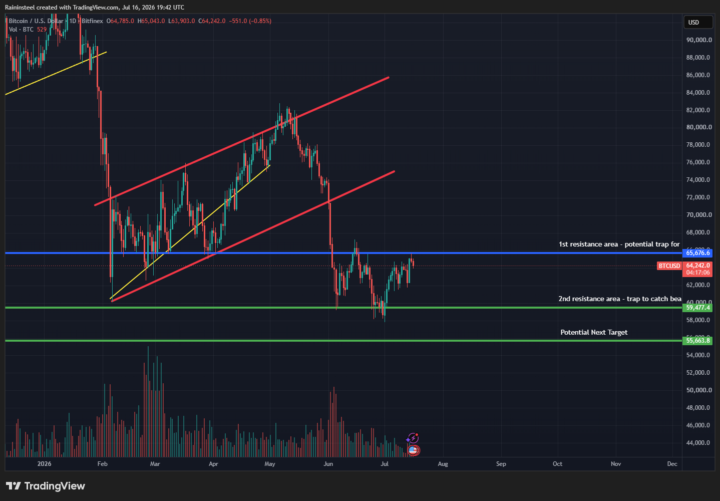
- BTC: ~$64,000 (the price of one Bitcoin, up on the good news) - ETH: ~$1,900 (the price of one Ethereum, quietly outrunning Bitcoin lately) - 30 year mortgage: ~6.6% (what a regular person pays to borrow for a house, still stuck high) Quick one this week, because honestly the story kind of tells itself. The inflation number we've been waiting on for months finally cooled off, and it cooled off harder than pretty much anyone expected, which is exactly the direction we said things would head once oil started coming back down. But (and you knew there was a but coming) the timing on it is rough, because that cool number is from June, and the Iran war reignited right at the start of July, which means the exact thing that pulled prices down last month could turn around and shove them right back up this month. So we take the win, we enjoy it, and we keep one eye open while we do. Because with this war, anything can happen. Here's what actually came out: - Inflation (CPI): 3.5%, down from 4.2% (how fast prices climbed over the past year, and it's finally slowing) - Core inflation: 2.6% (same idea, just ignoring gas and food since those two bounce around too much to trust) - Prices last month: down 0.4% (the biggest one month drop in about six years) - Gas: down 9.7% (basically the whole reason the number cooled) - Fed rate: still 3.5% to 3.75% (unchanged again, still no cut, and Warsh made clear he's in no rush and said he will not cut even if that's what Trump wants - but honestly I think he's just allowing things to happen that will lead to cuts anyway. Chart Update: Price is still tracking in that channel we talked about ranging from 65k down to potentially 59k. We're still dollar cost averaging by buying a little every week. Nothing big just waiting for our timeline to continue. --------------------- New Members ----------------------- If you just found us, pretty much everything we talk about each week fits inside one story, a chain of events we laid out months ago that tends to play out in order. Once you can see the whole map, it gets a lot easier to understand why we keep saying now is a fine time to be buying slowly instead of waiting around for perfect news. So here's the sequence, start to finish.
1
0
1-30 of 71
powered by

skool.com/the-school-of-bits-4553
Everything you need to learn about bitcoin, crypto and investing fundamentals with lessons you'll remember forever.
Suggested communities
Powered by