

🔥
15d •
The Second Move
DISPATCH April 2026 I’ve been watching the Iran situation this week. The threats, the counter-moves, the escalation. My first move is always a verdict. I notice that. The second move is one I have to choose. It starts with curiosity. What would have someone do what they’re doing? How does this make sense to them? What invisible forces are pushing their hands? Not to excuse it. Just to actually see it. Demonizing is easy. It’s also a dead end. Once I’ve named the villain I’ve stopped looking and this isnt useful to anyone trying to navigate what’s actually happening. The question I keep returning to: if there’s a larger logic at play here, what is it? What values are in genuine collision? What fears? What historical weight? I don’t always find the answer. But the question keeps me in contact with the greater more layered reality rather than my story about it. That feels like the right place to navigate from. One question worth living with: Where are you meeting the world right now with a verdict and what opens up if you get curious instead? Dave
🔥
24d •
What “Moving Without Maps” Actually Points To
I often talk here about navigating without maps in these times. Underneath that is something more specific. It’s what happens when your usual sense of orientation drops. Not just the absence of a plan. The absence of the feeling that tells you how to move. What to trust. How to read what’s in front of you. When that goes, most people reach for a map. Old ones. Or someone else’s. But that’s exactly the moment the phrase points to. Not having a map isn’t the challenge. Losing orientation is. And what begins to form in its place when you stay with it isn’t another map. It’s a different way of orienting altogether. That distinction matters. Because the work isn’t learning to navigate without a map. It’s learning to trust a different kind of knowing.
🔥
Mar 17 •
THE PIVOT COMMONS — DISPATCH No. 01 March 2026
From the field: I've been building this space slowly, on purpose. Small. Intentional. The people here were invited because something in their work or life is navigating similar terrain to what I explore in The Pivot. You're not a list. You're a commons. What I'm sitting with: Somewhere along the way, most of us learned to treat a failing map as a personal failure. The strategy stops working. The framework that guided ten years of good decisions suddenly produces nothing useful. The leadership approach that earned you trust starts generating confusion instead. And the almost universal first response is: what did I do wrong? I want to name something about that moment. The map didn't fail because you misread it. It failed because the terrain changed. These are genuinely different problems, and they call for different responses. One calls for correction. The other calls for something harder: the willingness to put the map down entirely and begin learning to read the terrain directly. That second move is what most of the people I work with are actually navigating. Not incompetence. Not a gap to close. A threshold. The old map got them here, and here is genuinely new ground. What I find interesting — and what I keep watching in myself and others — is how long we keep consulting a map we already know isn't working. There's something almost devotional about it. The map represented a version of ourselves that succeeded. Putting it down feels like more than a tactical adjustment. It feels like a small kind of loss. I think that loss deserves acknowledgment before we move on to what comes next. One question worth living with: What map are you still consulting — not because it's working, but because putting it down would mean admitting something has genuinely changed? Welcome to the Commons. More soon. ~ Dave
🔥
Mar 30 •
The background hum
There’s something in the air right now. Not dramatic. Not even that obvious most of the time. But if you slow down a bit, you can feel it. A kind of low-level pressure. Things are shifting—costs, geopolitics, the general sense that the ground isn’t as steady as it used to be. Most of us just carry on. We adjust. It becomes normal pretty quickly. But underneath… I notice it takes a bit more energy to stay steady. To not get pulled into reaction. To make sense of what’s actually going on. It’s subtle, but it’s there. And the instinct—especially if you’re used to being capable, on top of things—is to tighten up a bit. Get clearer. Get ahead of it. Try to regain some control. Sometimes that works. But sometimes it just adds more pressure to something that’s already carrying a lot. What feels more useful right now is simpler. Just paying attention to how you’re relating to all of this. Where you’re gripping. Where you’re bracing. Where you’re trying to force clarity that isn’t really there yet. No big move needed. Just noticing. What’s become “normal” for you lately that, not long ago, wouldn’t have been?
🔥
Mar 13 •
When Competence Meets Uncertainty
There’s a particular disorientation experienced leaders rarely name. Not being in over your head - you know how to handle that. This is subtler. It’s reaching for the thing that has always worked, and finding it isn’t quite there. Your competence is real. The pattern recognition, the judgment, the ability to read what’s needed — that doesn’t disappear. But something has shifted in the terrain, and you’re meeting situations your tools weren’t designed for. What I notice, in myself and in the leaders I work with, is the automatic pull toward performing certainty. The old identity activates. And underneath it, something quieter and more honest: I don’t actually know what to do here. That sentence, if you can let it land without immediately fixing it, might be the most important thing you say this year. Competence and uncertainty aren’t opposites. The leaders navigating this moment well aren’t pretending to know. They’re developing a different relationship with not-knowing. Less a problem to solve. More a terrain to move through with presence and awareness. When did your usual move last fail to fit the situation — and what did you do in that moment?
1
0
1-5 of 5
powered by
skool.com/the-pivot-commons-4650
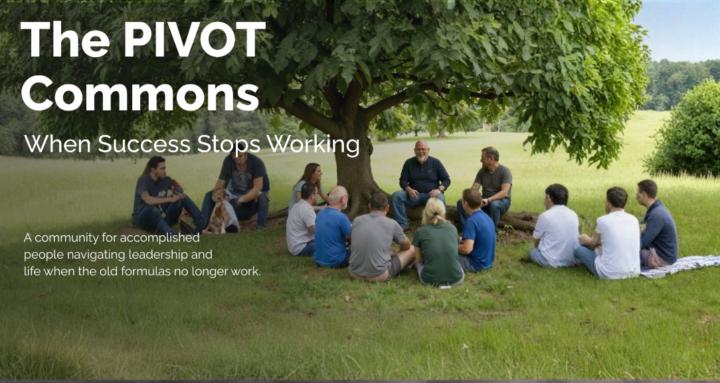
A community for accomplished people navigating the moment when success stops working in a time of metacrisis. Conversations and field notes.
Suggested communities
Powered by