
Write something

21d •
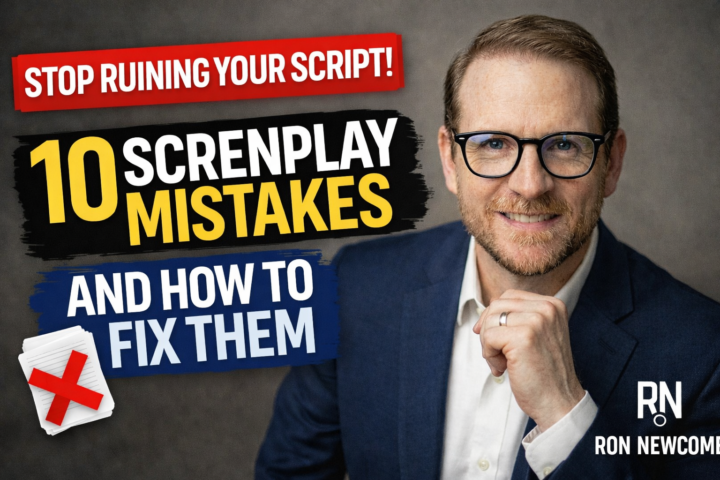
10 Mistakes That Will Sabotage Your Screenplay - And What To Do Instead
Most screenplays don’t fail because the idea is bad. They fail because of 10 avoidable mistakes that quietly kill momentum, weaken characters, and make readers stop caring. If your script isn’t getting the response you hoped for, this may be why. I broke down the biggest screenplay mistakes, and exactly how to fix them. https://www.linkedin.com/pulse/10-mistakes-sabotage-your-screenplay-what-do-instead-ron-newcomb-jfhie
0
0
Mar 28 •
Great dialogue doesn’t just sound cool. It reveals character, creates tension, and keeps people watching.
Why do some lines land like a punch… while others sound like bad exposition? In this episode, I sit down with Jeffrey Elkins, aka The Dialogue Doctor, to break down what makes dialogue actually work on the page and on the screen. https://youtu.be/XNsR_Iyp6e4 https://www.podbean.com/eas/pb-es86c-1a84737
Mar 11 •
Free Training/Resources
I just heard that this training is actually really good and FREE! IngramSpark | Free Resources Free Online Self-Publishing Courses | IngramSpark
Feb 19 •
If You’re Not Using AI as a Screenwriter in 2026… You’re Competing With Someone Who Is (SKOOL-Exclusive)
Let’s start with something uncomfortable. In 2026, if you’re not using AI in your screenwriting process, you are competing against writers who are, and they’re moving faster than you. This isn’t about replacing creativity. It’s about leverage. And the writers who understand leverage will win. The Moral Question Everyone Is Afraid to Address Yes, there are legal conversations happening. Yes, AI models are trained on existing works. But let’s zoom out. No artist creates in isolation. C. S. Lewis drew inspiration from George MacDonald. MacDonald drew from myth and earlier storytellers. We absorb. We synthesize. We remix. AI does something similar, without lived experience, without emotion, without scars. That’s the difference. AI recognizes patterns. You bring intent, pain, memory, belief, contradiction. AI can assist structure. It cannot generate soul. Every Screenwriter Has Two Paths: Sell It or Make It You either: 1. Sell it 2. Make it If you sell it, you’re entering a gatekeeper ecosystem. You’ll need: - A manager (career-focused, fewer clients, long-term development) - An agent (project-focused, market validation-driven) - A producer (rare, but possible) - Or a work-for-hire opportunity - Here’s the reality: “Good script” is no longer enough. It needs: - A clear hook - Audience clarity - Market awareness - Strong packaging AI can help you: - Refine your logline - Identify comparable titles - Stress-test your premise - Analyze genre performance trends But the path I strongly recommend you consider? Make it. Not alone, but lead it. Because permission is the slowest currency in Hollywood. The Three-Project Strategy (Why You Should Never Have Just One Script) You should always have three projects active: 1. A studio-level project only major streamers or studios can realistically produce 2. A mid-level project requiring partners and investors 3. A backyard project you could shoot with a small team this year Why? Because hope is not a strategy. Momentum is.


May '25 •
Change in my book.
While I have been writing, I have noticed holes in my story, as well as my power system, and that's perfectly okay. First drafts are rough, and I wanted to go over some of the changes I made since I recorded my pitch. Setting—Torrey, Utah, is now out the window! The entirety of the book will be in Mesquite, Nevada, to LA, which sparks the question, 'Why?' Well, Torrey, Utah, actually has a population of just over one hundred, which is extremely low, too low for my book. Zarth's last name—our protagonist in this story is 'Zarth Tadashi.' I felt that the last name 'Tadashi didn't feel original enough so I have updated it too 'Kagari.' Power system—The biggest change in the book was this. There is just so much to go over that I wouldn't be able to write it here. For those of you that are interested, I have attached a file going through all the changes. Villains I have added a new villain race called 'Titans.' If you're interested, I have included that in the file I have attached. Writing style—One thing I have learned is that writing is a skill, and it takes time to learn how to do that. I started over when I hit ten thousand words. I felt that at that time I didn't have the story put together enough to start writing, and it was more than beyond editing. Extra—If any of you are interested in reading the new prologue or first chapter, I would be more than happy to share it with you. Also, if anyone has any questions, I would be happy to explain.
2
0
1-11 of 11
powered by
skool.com/the-indie-coach-6663
Where indie storytellers get unstuck, get support, and get it done.
Filmmaking | Games | Comics | Books
Suggested communities
Powered by