
Write something
Pinned

2d •
This Is What Commitment Actually Looks Like
I just want to take a moment to say this... I’m genuinely proud of you. Not because this is easy. Not because you have it all figured out. But because you’re leaning into the work anyway. Adapting is uncomfortable. Learning new tools stretches you. Changing how you think, move, and operate takes effort. And most people avoid that. Most people wait until it feels simple. Until it feels familiar. Until someone else proves it first. You didn’t. You are committed to the tools. You are staying in the room. You choose to get better instead of staying comfortable. That tells me everything I need to know. When things change and you don’t opt out… When you feel resistance and lean in anyway… That’s what separates the few from the many. This is how real growth happens. Not overnight. Not perfectly. But consistently. Keep going. You’re exactly where you should be.

9d •
What You Can Try Today with AI: Transcribing
I had a little bit of technical difficulty (the platform I was using had some adjustments, and I didn't consistently navigate from screen to screen 🫣), but I still thought it would be a great training to share since so many people don't know that transcription is possible with AI. Feel free to use the "gear" at the bottom to speed up the video and if this was something new for you, I would love to hear in the comments.

10h •
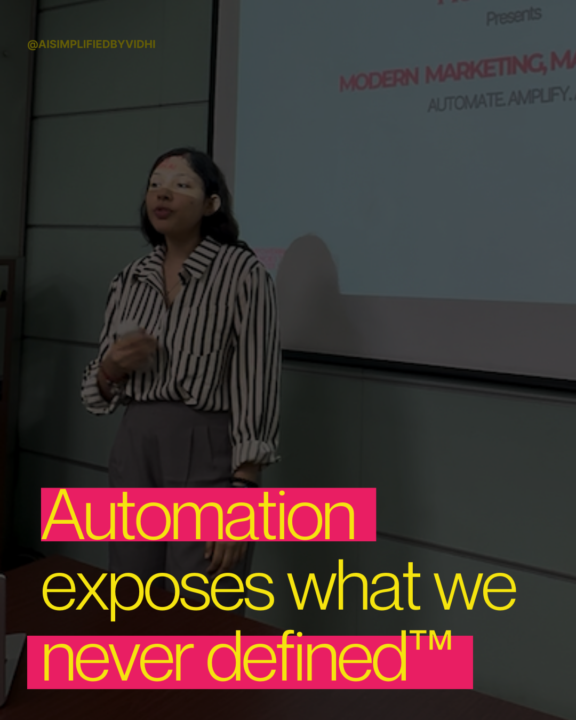
Automation Doesn’t Remove Work. It Reveals It.
Today, here’s the next thing I’m noticing. Everyone’s suddenly talking about AI agents, automations, copilots, workflows that “run on their own.” And on paper, it all sounds incredible. AI that books meetings. AI that follows up. AI that summarises, tracks, reminds, executes. But here’s the quiet truth most people discover in less than a week: Automation doesn’t remove work. It exposes where work was never clearly defined. If a team doesn’t know: - who decides what - when something is “done” - where information actually lives then automating it just makes the confusion grow faster. I see this a lot. People don’t need more automation. They need fewer unclear handoffs. That’s why, in my work, AI automation is never about “what can we automate?” It’s about: “What should never have required human energy in the first place?” Once that’s clear, automation feels magical. Before that, it feels noisy. The future of AI at work isn’t about replacing people. It’s about protecting attention. And the teams that get this right won’t look the busiest. They’ll look the calmest. That’s the kind of system I’m building. Lets connect on comments section to hear how the community is dealing with AI Automations!

2h •
🧠 When AI Feels Hard, It’s Usually Because We’re Treating It Like We’re Being Tested
Most of us don’t struggle with AI because it’s confusing. We struggle because, subconsciously, we think we’re being evaluated. Evaluated on how well we prompt.On whether we “get it.”On whether we’re using it the right way. So we tighten up. We overthink our inputs.We hesitate to experiment.We quietly assume everyone else understands this better than we do. That pressure doesn’t come from AI itself.It comes from the mental frame we bring into the interaction. And until we change that frame, AI will continue to feel heavier than it needs to. ---- Why We Turn AI Into a Performance ---- Most tools we’ve used throughout our careers rewarded correctness. You followed steps. You learned the system.You mastered the interface. Once you knew how it worked, results were predictable. So when AI entered the picture, we carried that same expectation forward. We assumed there was a right way to interact with it. A correct prompt. A level of fluency we were supposed to reach before we could rely on it. But AI doesn’t reward mastery in the traditional sense. It responds to engagement. When we approach it like a test, every imperfect output feels like a personal failure. When we approach it like a system that needs to be guided, those same outputs become information. The friction isn’t the technology.It’s the invisible pressure we place on ourselves. ---- The Shift: From Performing to Participating ---- The most effective AI users aren’t trying to sound smart. They’re trying to be clear. They don’t aim for perfection on the first input. They expect to shape the result over time. That mindset changes behavior immediately. Instead of asking, “Did I prompt this correctly?”They ask, “What can I clarify next?” Instead of stopping when output misses the mark, They respond, refine, and redirect. This is the moment AI stops feeling like a judge and starts feeling like a collaborator. Not because the tool changed.Because the relationship did. ---- Language Isn’t a Command, It’s a Steering Wheel ----

2h •
Ways to incorporate AI into your business (big or small)
As a business owner and agency owner who educates people in my local community about AI (through the library and small businesses), I wanted to share a few ways that I have discovered that people can implement AI without feeling overwhelmed. The suggestions that I am giving below aren't to say you have to incorporate them all, but just pick one or two and as you get comfortable, incorporate a few more that make sense for your business... - You can use ChatGPT as your partner to run ideas by- analyze your strategy, challenge your approach, assist you in identifying your target audience if you are just getting started. Use the "voice" mode and ask it to ask you challenging questions to get to the core issue you are having based on the topic and it will transcribe the conversation on the back end so you will always have it. - You could create an app through vibe coding that holds your SOPs or Training information (nothing confidential or proprietary) so new people joining your team can learn from that tool vs. you or a team member having to take the time to train them (instead, you can question what they learned afterwards or have AI create a flash-card or memory based quiz, crossword, etc. to test their knowledge in fun/creative ways) - You can include a web chatbot on the home page of your website to answer questions about your business and even schedule appointments - You can reinvigorate your email list by having ChatGPT come up with creative email campaigns per quarter that are 75% educational (about your industry or business) and 25% Calls to Action for Sales so they don't feel like you are consistently selling. Ask AI what perks you can offer your customers (like birthday discounts for their birthday month or referral rewards). If you use a platform like GHL, you can set everything up with automations on a quarterly basis as well. - You could get a voice concierge agent that works 24/7 and never misses a call if you are a business that could benefit from that. They sound human, and their knowledge-base knows everything about your company and website and it can answer most questions and book appointments if connected correctly to your calendar. - You could use AI to create presentations for you. I am speaking at an AI Summit next year, and I put the information I wanted to talk about in Claude, then asked it to fill in any gaps about AI I might have overlooked or missed that would be important to cover for that audience and asked it to put it into more of a "TedTalk" type format...then once I liked the result, I took it to the presentation creation app (Gamma) and in about 50 seconds, I had the full presentation with images and graphs completed. Game Changer!
1-30 of 10,153

skool.com/the-ai-advantage
Founded by Tony Robbins & Dean Graziosi - AI Advantage is your go-to hub to simplify AI, gain "AI Confidence" and unlock real & repeatable results.
Leaderboard (30-day)
1

🔥
+1302
2

+862
3

+821
4

+796
5

+420
Powered by