
Write something
Pinned

14h •
Fable 5 is Back! Here's the Best Way to Use It...
Anthropic finally brought Fable 5 back and in the same week, they also launched the new Sonnet 5 model. In this video, I break down everything you need to know about these models and explains which one you should be using. Enjoy!
Pinned
14h •
📥 The Backlog You Built Was Supposed to Disappear
There was a reasonable expectation, early in AI adoption for most people, that a faster production process would mean a shrinking to-do list. If drafts take a fraction of the time, if research compresses dramatically, if content generation accelerates, the backlog of things waiting to get done should get smaller. For a lot of people, that hasn't happened. The backlog is roughly the same size it always was, or in some cases it's larger. Understanding why is one of the more important things to get clear on, because the answer changes what "productive use of AI" actually means. ------------- Context ------------- AI doesn't shrink backlogs. It relocates them. Specifically, it moves the bottleneck from creation to output volume, and output volume has a way of expanding to fill whatever capacity becomes available, which means the backlog doesn't disappear so much as it changes shape. Before AI, the backlog was gated by creation time. There was a natural limit on how much content, how many proposals, how much analysis could get produced in a given period, because each piece took a meaningful amount of time to create. That limit set a ceiling on total output, and the backlog reflected demand against that ceiling. AI removes the creation-time ceiling. Suddenly it's possible to produce significantly more, faster. The intuitive expectation is that this closes the gap between demand and output. In practice, what often happens instead is that the definition of "enough" output expands to match the new capacity. More content gets planned because more content is now possible. More proposals get pursued because they're faster to produce. More variations get generated because generating them is nearly free. The backlog persists, just at a higher absolute level of output on both sides of the equation. A content strategist described this directly: she had assumed that once AI compressed her drafting time, her content backlog would finally clear. Instead, her team's content calendar expanded to include significantly more planned pieces, because the capacity was there and it felt wasteful not to use it. The backlog she was working through six months after AI adoption was, if anything, larger than before, just made up of more ambitious and more numerous pieces of content.

Pinned

4d •
What Success Actually Buys You
Most people think success is about money. It's not. Money is just what buys you options. I've worked hard for decades. Not because I fell in love with the grind, but because I fell in love with what the work could create. Every uncomfortable conversation. Every risk. Every time I wanted to quit but didn't. None of it was just to make more. It was to own my time. To be there for the people I love. To create memories instead of regrets. To have the freedom to say yes to what matters and no to what doesn't. Don't chase success because you want to look successful. Chase it because one day you'll realize time is the only thing you can't earn back. Work hard. Do the uncomfortable things. Become the person capable of creating the life you want. Because real success isn't measured by what you own. It's measured by how fully you get to live. Question for you: If you had complete freedom over your time one year from now, what would you spend more of it doing... and who would you spend it with?


14h •
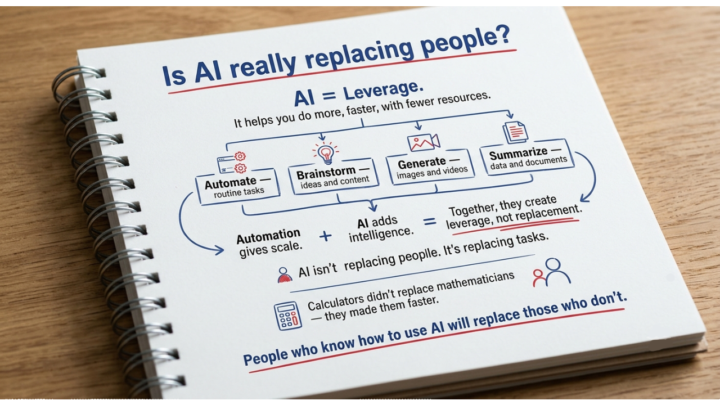
Is AI really replacing people?
What's really happening 👇 The core idea of AI is Leverage, It gives you Leverage- to do more faster, with fewer resources:- ~Automate : Routine tasks ~Brainstrom : Ideas & content ~Generate : Image & videos ~Summarize : Data & Documents Automation gives scale AI adds intelligence together they create leverage not replacement. ~Ai isn't replacing people. It's actually replacing takss. ~Just like calculators didn't replace mathematicians they made them faster. ~People who know how to use AI will replace those who don't. Do you agree? different opinions are most welcomed 👇 Harsh Singh
1-30 of 19,928

skool.com/the-ai-advantage
Founded by Tony Robbins, Dean Graziosi & Igor Pogany - AI Advantage is your go-to hub to simplify AI and confidently unlock real & repeatable results
Leaderboard (30-day)
1

+517
2

+365
3

+236
4

+164
5

+115
Powered by