
Write something
Pinned

14h •
🗂️ The Version Control Problem Nobody's Solving
Ask most teams how many drafts exist for their last significant piece of AI-assisted work and you'll usually get a shrug. Somewhere between three and eight, probably, spread across different tools, different conversations, different people's individual sessions. Nobody has a clean record of which version is actually current, what changed between iterations, or why one direction got chosen over another that also looked reasonable at the time. This is the version control problem, and it's one of the least discussed costs of fast AI-assisted iteration. When content generation was slow, there weren't many versions to track because there wasn't time to produce many. Now that generation is nearly free, teams routinely produce far more versions than they used to, and almost nobody has built a system for managing that volume. The result is a growing category of time loss that happens quietly, in the confusion of figuring out where things actually stand. ------------- Context ------------- Version confusion isn't a new problem in professional work. But it used to be naturally bounded, because producing a new version required real effort, which meant versions were relatively few and the history of how a piece of work evolved was usually still fresh enough in someone's memory to reconstruct if needed. AI has removed that natural bound. A single person working on a proposal might generate six or seven distinct drafts in an afternoon, exploring different angles, adjusting tone, trying different structures. Multiply that across a team where several people are independently iterating on related pieces of work, and the total version count for even a single project can climb into the dozens within days. Most of this iteration happens inside individual AI tool conversations that aren't connected to any shared system, which means the history lives in scattered chat threads rather than anywhere a team member could reliably find it later. The cost shows up in specific, recurring moments: someone asks which version is final and nobody's sure. Two people unknowingly work from different drafts and produce conflicting output. A decision gets revisited because the reasoning behind an earlier direction wasn't recorded anywhere and has to be reconstructed from memory, imperfectly. None of these moments individually costs much time. Across a project, across a team, across a year, they add up to a meaningful and largely invisible drain.

Pinned
4d •
OpenAI Just Rebuilt ChatGPT
OpenAI put out a ton of new stuff this week including the public release of the GPT-5.6 family of models, the new ChatGPT Work app that will be merging Codex and ChatGPT capabilities, a new voice mode, improvements to the speech-to-text dictation, and more! I break it all down for you here, enjoy! Want to save time, get more leverage, and stop figuring this AI stuff out from scratch? I put the clearest map and support inside the AI Advantage Club
Pinned

2d •
Keep Going. You're Building Something Bigger Than You Think.
There's a season where you're doing everything right... You're showing up. You're putting in the work. You're staying consistent. And it still feels like nothing is changing. No momentum. No big breakthrough. No proof that it's working. This is the moment that separates people. Not because the work got harder... but because they mistake a lack of results for a lack of progress. What I've learned after decades in business is this: The invisible season is where everything important gets built. Your discipline. Your resilience. Your standards. Your identity. The results come later. Success rarely announces itself while it's being built. It compounds quietly... until one day everyone calls it an overnight success. If you're in that season right now, don't quit. The work you're doing today is building the life you'll eventually be grateful you didn't give up on.
4d •
⏰ AI Made Everything Feel Urgent. Most of It Isn't.
There used to be a natural pace to work that came from the friction embedded in doing it. Drafting something took time, so a request for a draft naturally sat in a queue for a while before it could be addressed. Research took time, so a question requiring research had a built-in delay before an answer could arrive. This friction wasn't designed as a prioritization system, but it functioned as one anyway: things that required more effort naturally got triaged and sequenced, because they couldn't all happen immediately. AI has removed a significant amount of that friction, and in doing so, it's removed the informal prioritization system that used to come with it. Nearly everything can now be actioned immediately. And immediate actionability is quietly getting mistaken for immediate necessity, in a pattern that's driving a specific and underexamined form of overwhelm. ------------- Context ------------- Before AI, the time required to complete a task functioned as a natural filter on what could realistically happen right now versus what had to wait. A request that would take three hours to fulfill couldn't be actioned in the next ten minutes, regardless of how urgently it was framed, simply because the work took time. This created an implicit form of triage: things got sequenced by a combination of actual priority and practical feasibility, and the feasibility constraint did a lot of quiet work in keeping the pace of a day manageable. AI has collapsed the feasibility constraint for a huge range of tasks. A request that used to require hours can now be actioned in minutes. This is a genuine advantage in many cases. But it also means that the natural pacing mechanism that used to exist alongside the feasibility constraint is gone, and nothing has automatically replaced it. Everything that arrives now carries an implicit invitation to be handled immediately, because immediate handling is now technically possible in a way it never used to be. The psychological effect of this shift is significant and underappreciated. When something is technically actionable right now, there's a pull toward treating it as though it should be actioned right now, even when the actual priority of the task hasn't changed at all. Feasibility and urgency are different things, but in a world where almost everything has become instantly feasible, the distinction is easy to lose.


1h •
First Sale!
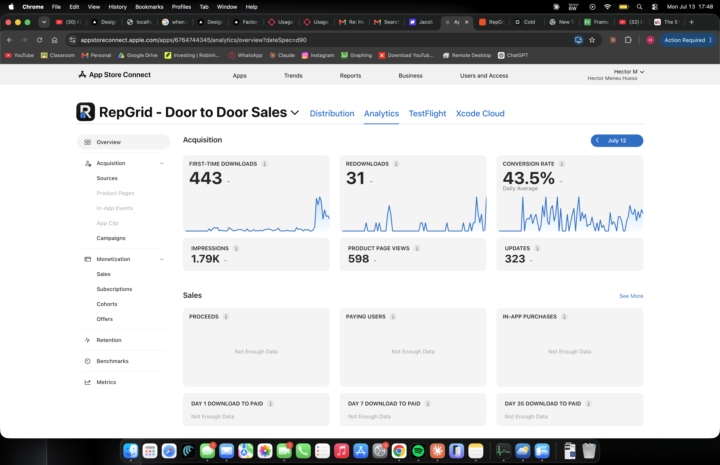
I know I haven't been nearly as active lately but that's just because I've been working hard on my app RepGrid. I currently have over 400 downloads with over 250 of those being in the last week. I started paying my affiliate with a monthly promotion of $100 if he makes 20 vids in a month. One of those videos hit 52,000 views and has over 1k likes already, here's the reel that did good if anyone wants to check it out: https://www.instagram.com/p/DaV9qlvhB27/. So far I've gotten 3 subscriptions. 2 at $99/m and 1 at $25/m. The $25 payment hit last night at 4 am and I stayed up just to see it hit and it felt amazing to finally make my first few dollars off this app, because it proved that it's actually something people are willing to pay for. The others are still on their free trial period and one got a whole free month because of a promotion I made where if you add 3 team members you get your first month free. I think it's working because that guy has actually been using the app extensively. I'm getting a lot more interest in the app and a lot of people are interested in becoming affiliates, I have signed one more affiliate onto the app so far and he's yet to post his first video but he's a detailer, so he will be covering a different niche compared to the other affiliate. My goal for next month is to be past $500 MRR, which should hopefully be possible since I would already be at $225 MRR if none of them cancelled.
0
0
1-30 of 20,030

skool.com/the-ai-advantage
Founded by Tony Robbins, Dean Graziosi & Igor Pogany - AI Advantage is your go-to hub to simplify AI and confidently unlock real & repeatable results
Leaderboard (30-day)
1

+476
2

+336
3

+268
4

+249
5

+209
Powered by