
Write something
Pinned

13h •
The Reason I Refused To Quit
Everybody wants success until success starts testing them. Because eventually this journey asks a question most people aren’t prepared for: “How bad do you really want it?” Not when things are easy. Not when the money starts coming in. Not when everyone is cheering you on. I mean when you’re doubting yourself. When nothing seems to be working. When you’re exhausted. When you feel embarrassed. When you fail publicly. When it would honestly be easier to quit. That’s the moment your WHY matters. For me, it was my mom. Mother’s Day always reminds me of this… I watched my mom work herself to exhaustion trying to provide for us. Multiple jobs. Constant stress. Doing the best she could with what she had. And as a kid, I remember the moments that stuck with me most weren’t the things we didn’t have…It was watching how hard she worked and realizing she still couldn’t buy back time. She missed games. Missed moments. Missed parts of life because survival demanded everything from her. I remember thinking very early on: “One day I’m going to change this.” Not because I wanted fancy things. Not because I cared about looking successful. I just wanted freedom. Freedom for her. Choices for her. Relief for her. That became the thing I held onto anytime life punched me in the face. And trust me, there were a LOT of moments where quitting would’ve been easier. But when your reason is emotional enough, you find another gear. That’s the part people don’t talk about enough. Success is rarely about intelligence alone. It’s usually about emotional conviction. The people who make it have something that pulls them forward when motivation disappears. So, I’d love to ask you: What’s the reason behind your drive? Who are you fighting for when life gets hard? P.S. Happy Mother’s Day to all the moms out there doing their best, carrying more than anyone sees, and loving through it all. You’re appreciated more than you know. ❤️
Pinned

15h •
👥 One Agent Is Helpful, but Agent Teams Are the Bigger Shift: Why Workflow Orchestration Could Be the Next Time Advantage
A lot of AI adoption still revolves around a simple pattern. One person opens one assistant and asks it to help with one task. That model is useful, and it has already returned real time to many people. But another shift is starting to matter more. The conversation is moving from single assistants toward coordinated groups of agents, each handling a different part of a larger workflow. That may sound technical, but the underlying idea is very practical. Complex work rarely depends on one skill alone. It depends on research, synthesis, formatting, checking, follow-up, and execution moving in sequence. When a single person handles every step manually, the work slows in the handoffs between them. When a single AI assistant handles everything, the result can still become muddled because too much is happening inside one interaction. But when specialized helpers coordinate well, the workflow can become faster, cleaner, and easier to manage. ------------- Context ------------- Most meaningful work is multi-step. A proposal needs research, structure, drafting, review, and revision. A project kickoff needs context gathering, note synthesis, task extraction, and communication. A content campaign needs ideation, formatting, visual translation, distribution planning, and follow-up. Even if one person owns the work, the work itself still contains many different motions. This matters because time is often lost not inside the steps, but between them. The research is done, but now someone has to turn it into a brief. The brief exists, but now someone needs to create the draft. The draft is ready, but it still needs checking and distribution prep. Each handoff introduces delay, cognitive switching, and the risk of context loss. That is why workflow orchestration is becoming such an important AI theme. The question is not only whether one assistant can help with the whole task. The question is whether a coordinated system of specialists can reduce the friction between the parts of the task. In time terms, that is a very different proposition.

Pinned

⭐
12d •
🔥 Quick Clarification: The Difference Between Our 3 AI Advantage Communities
Hey everyone, we’ve received a few questions in the customer service inbox, so we wanted to take a moment to clearly explain the difference between the groups and experiences inside the AI Advantage ecosystem. --------------------------------------------------------------------------------------------------- 1. This Skool Community (Free) This group right here is our free community. It’s where Igor Pogany, our team, and the community continue to share value, insights, resources, conversations, and support. Inside here you can expect: - Free trainings and resources inside the Classroom - Ongoing conversations - Community support - Updates of the latest AI News - Updates and announcements for AIA - Valuable insights to help you grow with AI This group is completely free and we fully encourage you to stay engaged, ask questions, connect, and use everything available here. And just because the Summit is over, doesn’t meant mean this group is going anywhere! --------------------------------------------------------------------------------------------------- 2. AI Advantage Club (Paid Membership) The AI Advantage Club is our premium membership for those who want to go deeper and continue building their AI skillset consistently. Depending on how you joined: - VIP members received a 30-day trial - Bootcamp members receive 3 months included And if you took the VIP upgrade AND joined the Bootcamp, you would have 4 months free inside the Club. Inside the Club, the experience goes deeper with things like: - Advanced trainings - Step-by-step guides and our “Hacks of the Week” - AI workflows - Prompt libraries you can copy - Business use cases - Time-saving systems - Ongoing implementation support - New resources added regularly - A Technical Support Team who can answer questions if you hit roadblocks trying to implement an AI tool Think of this as your AI gym membership. It’s the place where you will train those AI muscles and really focus on implementing AI into your life and business.

9m •
What's actually killing your growth (and you don't even know it)
Ran a quick poll. Here's what most people said is killing their growth: 📵 Leads falling through because no one followed up 🌐 Website that looks good but converts nobody 📱 No content = no trust = no sales 💸 Ads running with zero ROI The crazy part? Every single one of these has a systematic fix. Which one hits closest to home for you? 👇

🔥
7h •
Growth Starts With Responsibility
The moment you stop blaming everything around you… is the moment your life starts changing. Not because things suddenly get easier,but because you take back control. Your habits.Your mindset.Your actions. That’s where real growth begins. What’s one area of your life you’re taking more responsibility for lately?
1-30 of 18,890
skool.com/the-ai-advantage
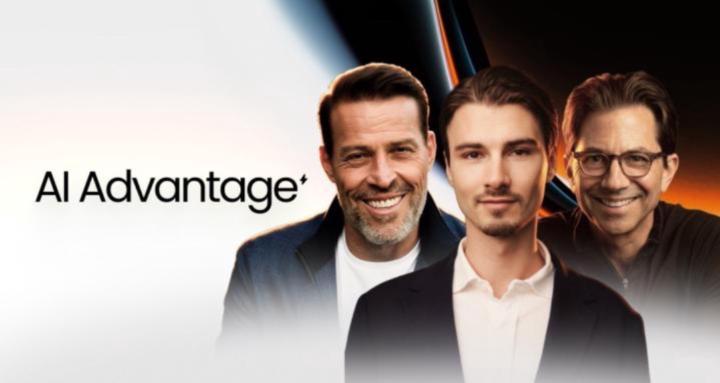
Founded by Tony Robbins, Dean Graziosi & Igor Pogany - AI Advantage is your go-to hub to simplify AI and confidently unlock real & repeatable results
Leaderboard (30-day)
1

🔥
+1882
2

+785
3

+772
4

+743
5

+552
Powered by