
Write something

May 22 •
Spring Pruning
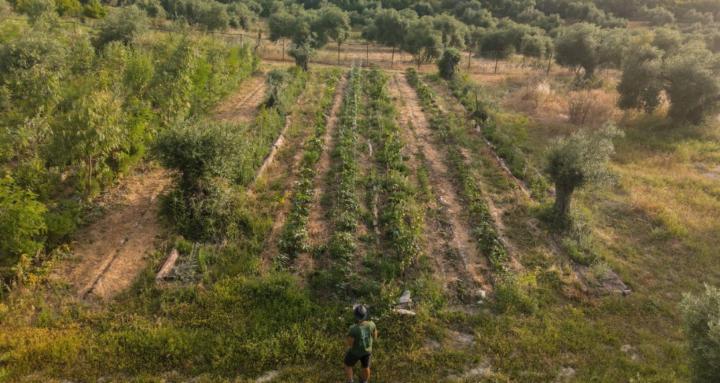
Hey guys wanted to share with you an update of the trial line planted a year and a half ago post pruning. After a month and a half, plants are regrowing very well and here's the mix of factors : -I irrigated 3 times that week (a couple times too pre-pruning) - there's plenty of water in wells so it's using unlimited water at that time. -The heat didn't come yet, the bar of 30 degrees wasn't reached yet, plants are still in a strong vegetative state. Hope you got something useful out of this video !
Apr 18 •
Spring Growth from Above - Video
Hey y’all! I wanted to share a video filmed by some friends of mine who were here about a month ago hosting a course on the property. It’s mostly in Spanish, but you can turn on the auto subtitles ! This gives you some great drone footage and a better look at the growth of the lines and management of the grasses this spring - across the trial line and almond grove about 1.1 km linear in total. Hope you find something valuable in it! 🌱
May 12 •
Ornemental Agroforestry - With a Twist
Most conventional ornamental landscaping is far more dependent on herbicides like Roundup and synthetic fertilizers than most people realize. The quantities are lower than in industrial agriculture, but the dependency is often similar. In ornamental hedge maintenance, it’s common practice to apply chemical fertilizer after pruning -especially since hedges are trimmed frequently to maintain that “perfect” formal appearance. Then there’s the establishment time. Depending on the species, a conventional hedge can take anywhere from 4 to 10 years to properly fill in and reach the desired density. Over time, another issue comes up : repeated pruning in exactly the same place year after year can cause plants to become overly woody. This often leads to gaps, reduced vigor, disease pressure, and eventual plant losses. And honestly... most hedges end up looking pretty boring anyway. At my job, I plant several hundred meters of ornamental hedges every year. Instead of following the conventional landscaping model - which here would require more irrigation and could take close to a decade to establish properly; I went for something else : Rather than planting a single-species hedge, I designed a stratified living hedge, combining: - Emergent and high trees - eucs, acacias, grevillea robustas, bottle trees, casuarinas, mulberry - Medium and low strata shrubs - myoporum, pittosporum, tree germander, viburnum, boldo. The result is already seen after 3 months : instead of waiting years for density, the space fills visually in about a year and a half or less. To accelerate the effect even further, I also introduced succulent plants - tree aeoniums (Aeonium arboreum). These create a sense of fullness within the first 6 months. As the longer-term species establish, these pioneers can be chopped and dropped, feeding the system and making space for the next stage of succession. I also planted white mulberries every 5 meters. The idea is they’ll eventually produce fruit for guests walking along the path. As well, I will plant some stonefruit seeds like apricot or plums, probably 1 to 2 years down the line.
May 4 •
Never plant your fruit trees alone
Hey guys, had to take a little break to think of other things in the last week ! But I wnated to share with you a very good example of when planting trees alone is not an option. In poor soil like this one, that is so compacted and has 0 topsoil, planting plants at an even higher density is key, because some won't even make it. Will share an update of how this planting went at the end of Summer !
6
0
Apr 1 •
Almond grove update - March 28th
Hey you all ! I’m starting to document all the plantations I’ve designed and planted and plan to update you every few months so you can track growth and refer back to past videos. This is the largest plantation I’ve designed and planted so far—with the help of volunteers, it covers 6,000 m². This is an almond grove with seedless grapes climbing eucalypts in between. This is what I call a “hybrid infestation – plant all at once”, as we’re really seeing the planting in two steps: 1- The placenta and secondary species - letting the myoporum, eucs, casuarinas and acacias form a continuous hedge in between the almonds. 2- Years down the line when appropriate - when almonds start producing well - coppice the acacias, eucs, casuarinas, tamarix and myoporums let them regrow for the ones that recover. Then plant the next wave of succession on a growth pulese : grevillea robusta as a long-term emergent - Planting it now alongside the eucalypts is an experiment to see if it can survive next to their sizable trunks; some may need replanting. I would also plant the low-ish strata - Main : Viburnum tinus good drought-resistance and reliable - Others: Prunus lusitanica, Ruscus apophyllum, and Acanthus mollis (testing them out) The only ick is that I have to make sure that I find a plant that can handle coppicing really well when harvesting the almonds. One challenge is finding plants that can handle coppicing well during almond harvesting. One idea is to have two people pulling nets while another shakes the tree, allowing almonds to drop without stressing the understory. The other is to use plants like Acanthus mollis, which go dormant in summer, then the ground is free to put nets down. Finally, I’ve considered seed bombs of primary forest species like carob, olive, lentiscus, Italian buckthorn, etc.. - an idea Scott Hall gave me. Birds might naturally assist with this in 5 years, but adding seed bombs then would act as “biomass insurance.” Although slow initially, with improved soil fertility after 5 years, these species should establish much faster than in the current poor soil.

1-7 of 7
powered by
skool.com/syntropic-agroforestry-w-milan-3000
Mediterranean Syntropic Agroforestry made practical.
Efficient design, minimal water, low inputs — maximum impact.
Suggested communities
Powered by