
Write something

23d •
🚀 I Just Finished a Call With NASA—and Here’s Your Reminder to Show Up!
When I thought about NASA, I thought about space exploration. I honestly didn’t think our work in medical equipment, consulting, and education would have much connection to what they purchase. Well, lo and behold! 😊 I joined NASA’s small business information session, introduced CFS, and asked where our capabilities might fit. They gave me contacts and information about locations that purchase the types of products and services we offer. If I hadn’t shown up and asked, I wouldn’t have made those connections. NASA also provided a customized market research report based on our primary NAICS code—the code that describes our business activity. It identified purchasing history, relevant NASA buying offices, and other federal agencies purchasing within our industry. That gives us something concrete to research and follow up on! Here are a few takeaways for anyone growing a business: ✅ Reach out to the agency’s small business office. Depending on the agency, it may be called the Office of Small Business Programs (OSBP) or the Office of Small and Disadvantaged Business Utilization (OSDBU). Ask about information sessions, buyer contacts, and resources for your industry. ✅ Ask questions—even when the connection isn’t obvious. You don’t have to know every answer before attending. Sometimes your question is what opens the door. ✅ Understand what the agency needs. NASA’s report encouraged us to start with the agency’s requirements and consider how our capabilities can help meet them. ✅ Explore relationships with prime contractors, too. Subcontracting and supplier partnerships may offer another path to supporting an agency. ✅ Follow through. Save the contacts, review the resources, and send a thoughtful introduction explaining what you can provide. Whether you’re pursuing government contracts or growing another part of your business, relationships matter. A supplier, small business specialist, or fellow business owner may connect you with a resource you never knew existed. Today wasn’t a contract award—it was a valuable step toward understanding where CFS can fit. And that’s progress.
3
0

Oct 14 •
I feel stuck
I’d love some feedback from those of you who have successfully built a GovCon business using a prime contractor/integrator model. Right now, I’m continuing to build out my company’s core offering around leadership, resilience, workforce development, and training, while also pursuing additional certifications that strengthen what we can deliver directly. In the meantime, I’m trying to better understand how to legitimately and profitably pursue opportunities where my company serves as the prime/integrator and brings in qualified subcontractors or teaming partners to perform portions of the work. My challenge has been finding opportunities where the pricing actually makes sense. I’ve been bidding for about a year, and in several cases the subcontractor pricing leaves very little—or no—margin for the prime once you factor in management, compliance, risk, proposal costs, and contract administration. So my questions are: How are you identifying contracts that are actually viable for an integrator/subcontracting model? How do you determine whether there is enough margin before spending time on the bid? Are there certain contract types, industries, or dollar ranges that work better for this model? And while you’re still building out your own direct capabilities, how do you structure the business so you’re adding legitimate value as the prime rather than simply passing work through? I’m not looking for shortcuts. I’m trying to understand how people have built this model correctly, compliantly, and profitably while continuing to develop more in-house capability. Would really appreciate hearing what has worked and what hasn’t from those actually doing it.
Sep 26 •
🚨 September 26, 2026 – Saturday Live Gov Contracting Q&A 🚨Replay
🆓 FREE Government Contracting Q&A 📅 Saturday, September 26, 2026 🕞 3:30 PM – 4:00 PM PST Today's discussion: 💼 Can Government Contracting Help Stabilize & Grow Your Business? https://us06web.zoom.us/j/89874291649?pwd=zNMWWPL77HwbptKouWfQRblQpCpnN5.1 🌞 Good Morning & Happy Saturday, CFS Government Contracting Community! Today's conversation is especially important for business owners: CAN GOVERNMENT CONTRACTING HELP STABILIZE YOUR BUSINESS? Every day we hear about businesses struggling, cutting expenses, laying people off, or closing altogether. And when sales slow down, many business owners immediately think: “I need more customers.” Yes—but maybe you also need to think differently about WHO your customers can be. Your business doesn't have to depend entirely on individual consumers or private-sector customers. The government can be a customer too. Federal, state, county, city, school districts, healthcare systems, correctional facilities and other public agencies purchase products and services every day. And this isn't a tiny marketplace. According to the U.S. Small Business Administration, small businesses received approximately $179 BILLION in federal prime contracts in FY2025 and nearly $273 BILLION when prime and subcontract awards are combined. Think about that. There is an entire marketplace that many small businesses never seriously pursue. DIVERSIFICATION MATTERS. If 100% of your revenue comes from private customers and that market slows down, your entire business feels it. But imagine building multiple revenue channels: Private customers + commercial customers + government contracts + subcontracting opportunities. Now you're not depending on one customer base to carry the entire company. That doesn't mean government contracting is easy. It's work. You have to learn the process. You have to research opportunities. You have to understand what agencies buy. You have to price correctly.
1
0

Aug 30 •
🔥 Yesterday's Government Contracting Calls Were FIRE!
Yesterday's free Community Call turned into such a great conversation around something that doesn't get talked about enough in government contracting: How do you actually approach manufacturers, suppliers and potential teaming partners? We talked about why there isn't one script that works for every situation. You have to research who you're approaching, understand the company, learn their history in the government space, know what you're asking for, and sometimes adjust your approach based on what you learn. We discussed building relationships with manufacturers and suppliers before you need them, keeping track of companies that could become future partners, using your past performance strategically, and learning from both your wins and your losses. We also had @Shanaé Murraine one of our new community members who previously worked on the government side, join the free call. I asked her to share her perspective, and it added another great layer to the conversation. One of my biggest messages yesterday was: Government contracting isn't learned from one place. You research. You make calls. You build relationships. You join communities. You listen. You learn from other people's experiences. You learn from your own experiences. And then you take a little from here and a little from there and develop strategies that work for your business. I'm posting the full free Community Call replay here this morning for anyone who missed it. We then continued this conversation during our paid Member Program Call, where we went deeper into these strategies and had another great discussion. Both replays will be added to the paid Government Contracting Program library so members can return to them as they build their own supplier and teaming relationships. Don't just watch the replay and move on. 😊 Think about the products or services you want to offer the government and ask yourself: “Who should I start building relationships with NOW—before I need them for an opportunity?”


1-20 of 20
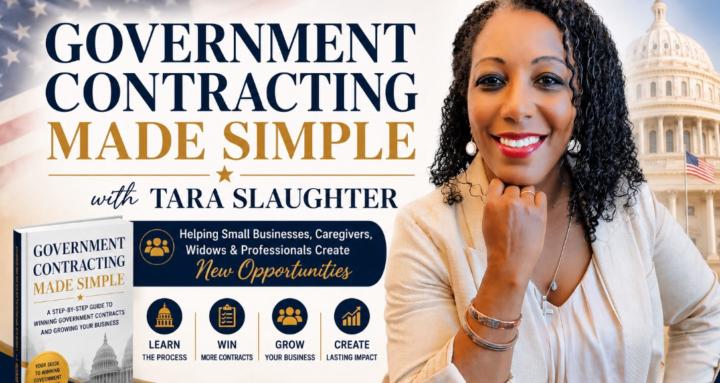
skool.com/secondchaptershub
A real-world government contracting hub for caregivers, healthcare professionals & small businesses.
Leaderboard (30-day)
1

+2
2

+1
3
+1
Powered by