
Write something

🔥
Jan 27 •
Why I deleted our staff WhatsApp group (and why you should too)
If you own a restaurant, your WhatsApp probably looks like a war zone. - "Can anyone cover my shift Saturday?" - "The walk-in is leaking again." - "Where is the new hiring playbook?" - "Happy Birthday, Sarah! 🎉" (followed by 45 notifications) WhatsApp is where information goes to die. Important SOPs get buried under memes and shift swaps. When a new hire starts, they have zero history of what’s been done. It’s noisy, it’s messy, and it’s stressing you out. The Better Way: Skool.com We moved our "Internal Brain" to Skool, and the difference is night and day. Here is why: - Organized Chaos: Our playbooks aren't in a "chat history"—they are in the Classroom. New staff can train themselves without me repeating the same instructions 100 times. - Searchable Knowledge: Need the closing checklist? Type it in the search bar. No more scrolling through 400 messages. - Focused Communication: We use Categories. Shift swaps stay in one place. Maintenance issues stay in another. Your "General" feed stays clean. - The Culture Boost: Staff actually get "points" for helping each other and completing training. It turns work into a game they want to win. The Mogul Move: Stop managing your business in a chat app meant for families. Put your systems in a place that’s built for growth.

🔥
Jan 12 •
The Reverse Review: How to find your restaurant's "Silent Killers."
Most performance reviews are a waste of time. You sit a nervous server down, tell them they’re doing a "good job," mention they were late twice, and give them a $0.50 raise. Nothing changes. If you want a team that stays for years and treats your restaurant like their own, you need to flip the script. You need the Reverse Review. The Strategy: Once a quarter, take your top performers out for a 15-minute coffee (off-site). Your goal isn't to grade them. Your goal is to let them grade you and the business. Ask these 3 "High-Stakes" Questions: 1. "What is the most annoying part of your shift that has nothing to do with customers?" 2. "If you were the owner for a day, what’s the first thing you’d change to make the kitchen/floor run faster?" 3. "What is one thing I (or the Manager) do that makes your job harder than it needs to be?" Why this is a "Profit" Move: It costs roughly $3,000 to $5,000 to recruit, hire, and train a new staff member. If a 15-minute "Reverse Review" uncovers a small frustration that prevents your best server from quitting, you just put $5,000 back in your pocket.
2
0

🔥
Jan 11 •
The "$50 Permission Slip": How to buy back 10 hours of your week.
The reason most restaurant owners are exhausted isn't the "work"—it’s the Decision Fatigue. - "Can I comp this table’s dessert?" - "The steak was overcooked, what should I do?" - "It’s their anniversary, can I give them a glass of bubbles?" Every time a staff member asks you for permission, they are training themselves to be robots and training you to be a bottleneck. Stop making them ask. Instead, give every server a $50 "Weekly WoW" Budget. The Rules: 1. No Permission Needed: They have $50 (in cost, not menu price) per week to use at their total discretion to "Wow" a guest or fix a mistake. 2.The "Why" Log: They don't have to ask before, but they must record the why after. (e.g., "Table 4 was celebrating their 50th anniversary, so I bought them a round of lemoncellos.") 3.The "Hero" Story: At every pre-shift meeting, the person who used their budget the most creatively gets a shoutout. Why this is a "Cool" Marketing & Staff Hack: - For the Staff: They feel like owners. They get the dopamine hit of being the "hero" for their table. This is the #1 way to stop "Quiet Quitting." - For the Customer: A "freebie" from a server feels more authentic and special than a manager coming over in a suit to "authorize a comp." - For You (The Owner): You just eliminated 20-30 micro-decisions a night. You are now free to work ON the business, not IN the chaos. How this ties into the 80/20 KOS™: This is a core component of Manager Independence. If you can't trust your staff with $50, you can't trust them to run a million-dollar facility.
2
0

🔥
Dec '25 •
The "First 48" Rule: Why you lose your best employees before their first paycheck
Most restaurant owners think staff quit because the work is "too hard" or the "pay is too low." The reality? They quit because they feel stupid. The "First 48 Hours" of a new hire's life in your restaurant determines if they stay for 2 years or 2 days. If they spend their first shift standing in a corner, waiting for a busy manager to tell them what to do, they feel like a burden. By day three, they’ve already called their old boss for their job back. The Strategy: The "Zero-Management" Onboarding You don't need to be there to train them. You need a System that trains them for you. Use the "3-Tier Shadow" method: 1. Shift 1 (The Watcher): They are assigned to your best server/cook. Their only job is to carry a notebook and write down 10 questions. 2. Shift 2 (The Doer): They do the work, and the veteran watches. 3. Shift 3 (The Solo): They fly solo, but the manager does a "5-minute audit" at the end of the shift. The Result: The employee feels "seen," the veteran feels like a leader, and you didn't have to spend 12 hours explaining where the extra napkins are.
🔥
Dec '25 •
The "Google Blitz" – 3 Tweaks to Steal Traffic from Competitors
If your Google Business Profile (GBP) hasn't been touched in six months, Google assumes you’re "stale" and pushes you down the list. You could be the best chef in town, but if you're on page two of search results, you don't exist. The Solution: The 5-minute Google Blitz to wake up the algorithm. The 3-Step Blitz 1. Update Your "Attributes": Google recently added specific attributes like "Outdoor seating," "Great cocktails," or "Wheelchair accessible". Checking these boxes tells Google exactly who to send to your door. 2. The "Keyword" Description: Most descriptions are boring. Use AI to rewrite yours to include the specific dishes people search for (e.g., "Best wood-fired pizza in [Your City]"). 3. The Freshness Signal: Upload one photo of your dining room or a dish today. Profiles with photos updated weekly get 35% more clicks than those that don't. The "Local SEO" AI Prompt Don't guess what keywords to use. Let AI write your "About" section for maximum search impact. [PASTE THIS PROMPT] *"Act as a Local SEO Expert for restaurants. I want to optimize my Google Business Profile description for [Restaurant Name] in [Your City]. Context: We are known for [Signature Dish/Vibe] and our target customers are [e.g., families, date-night couples]. Your Task: > 1. Write a 750-character business description that naturally includes high-volume keywords like 'best [cuisine] in [City]' and '[Signature Dish].' 2. List 5 'Service Keywords' I should add to my profile settings to show up in 'Near Me' searches. Tone: Inviting, professional, and optimized for search."* Why this works: - Free Traffic: You aren't paying for ads; you're just making it easier for Google to find you. - Conversion: A complete, keyword-rich profile makes you look like the "authority" in your area. - Mobile Dominance: Most restaurant searches happen on Google Maps while people are driving. This puts you at the top of their map. Action Step: Open your Google Business Profile manager right now. Run the prompt, update your description, and upload one photo from your phone.
9
0

1-6 of 6
powered by
skool.com/restaurant-owner-community-6305
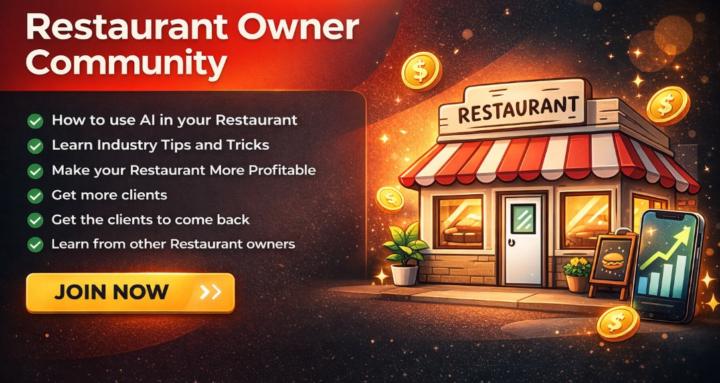
The Restaurant community is where smart Restaurant Owners learn how to use AI to save time, cut costs, and bring in more customers every week.
Suggested communities
Powered by