
Write something
Pinned

Apr 8 •
Why I Built This (and Why I Want to Know Your Story)
Hey! I am Tamara Gordon and I am so glad you are here. A little about me: I spent 15 years as an educator before making the leap into tech. I have managed enterprise accounts worth $50M+ ARR, led AI implementation for thousands of employees, completed an AI Generalist Fellowship, and built tools from scratch that changed how entire organizations work. Then I got laid off. And I found myself doing what so many of you are probably doing right now. Sending applications into the void, prepping for interviews alone, and trying to figure out how to stand out in one of the most competitive job markets in recent memory. So I did what any AI nerd would do. I built a system. I personally used Claude and Perplexity to research roles, craft responses, prep for panels, negotiate my offer, and ultimately land a Senior TAM role at ClickUp in 30 days. But this system works with whatever AI tool you already use. Inside the guide I walk you through setup in ChatGPT and Gemini too so no one gets left behind. Every prompt in this guide is one I actually used. Nothing made up. Nothing generic. Just what worked. I built Prompt to Offer (P2O) because I did not want that system to die in my little Claude project. I want it to work for you too. Now your turn. Two ways to introduce yourself: Option 1: Drop a comment right here in this thread and tell me your name, where you are in your job search right now, and the one thing you are struggling with most. Option 2: Start a new thread and introduce yourself so the whole community can rally around you. Either way, show up. This community is only as powerful as the people in it. Welcome to Prompt to Offer. Let's get you to the offer.

Pinned
Jun 2 •
🔑 LinkedIn is hiding the freshest jobs from you. Here's how to fix it.
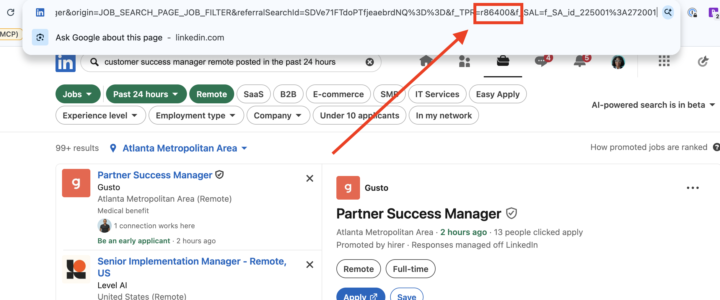
Most people filter by "Past 24 hours" and think they're seeing recent postings. You're not. You're seeing jobs that could be 23 hours old with hundreds of applicants already in the pile. Here's the trick: LinkedIn builds its time filter directly into the URL. When you search with the 24-hour filter, you'll see a parameter in the address bar that looks like this: r=86400 That number is seconds. 86,400 seconds = 24 hours. Change it to r=14400 and you're now seeing jobs posted in the last 4 hours. Change it to r=28800 for the last 8 hours. You can type those numbers directly into the URL and hit enter. I'd recommend starting at 8 hours and dropping to 4 when you want to go even fresher. But here's the second part: once you find a role you want, don't hit Easy Apply. Go find that company's careers page and apply directly there. You'll stand out more, your application is less likely to get lost in a LinkedIn bulk pile, and it signals actual intent. The only exception is if the company has no careers page and LinkedIn is the only option. Then Easy Apply is fine. Fresh role plus direct application is the combination. That's how you get to "Be an early applicant" before it means anything. Try it tonight and drop what you find below.
2
0
Pinned
Apr 14 •
🚨 7 Resume Myths Killing Your Job Search in 2026 (and what to do instead)
Let's be real. Most resume advice online is recycled from 2015. Here's what's actually true in 2026: Myth 1: Your resume must be one page. Reality: One to two pages is completely acceptable if you have 10+ years of experience. What matters is that your BEST work is on page one. Recruiters give it 6 to 8 seconds. Myth 2: Keyword stuffing beats the ATS. Reality: Modern ATS tools read context and natural language now. A "keyword salad" actually works against you. Weave terms into your achievement statements instead. Myth 3: A high-design resume gets attention. Reality: Complex graphics and tables break when AI software parses your file. Clean, skimmable, and standard wins every time. Myth 4: Listing responsibilities shows competence. Reality: Nobody cares what you were responsible for. They care what you accomplished. Use the Action + Impact formula: "Led a team of 6, reducing project turnaround by 20%" beats "responsible for project management" every time. Myth 5: One resume works for every application. Reality: Spray and pray is dead. Tailor your resume to each role, especially around skills like data literacy, AI collaboration, and industry tools. Myth 6: AI replaces human recruiters. Reality: ATS is a filing cabinet, not a final judge. Optimize for AI to get in the door. Write for a human to get the interview. Myth 7: Employment gaps are deal-breakers. Reality: Gaps are common and explainable. Caregiving, upskilling, freelancing? Say it briefly. Transparency beats mystery. The bottom line for 2026: your resume is a positioning document, not a job description. Show growth, quantify impact, and make your value visible in under 10 seconds. Which of these myths were you still following? Or what do you need help with? Drop it below. 👇🏽
5d •
BOO! Skip the aggregators with boolean search
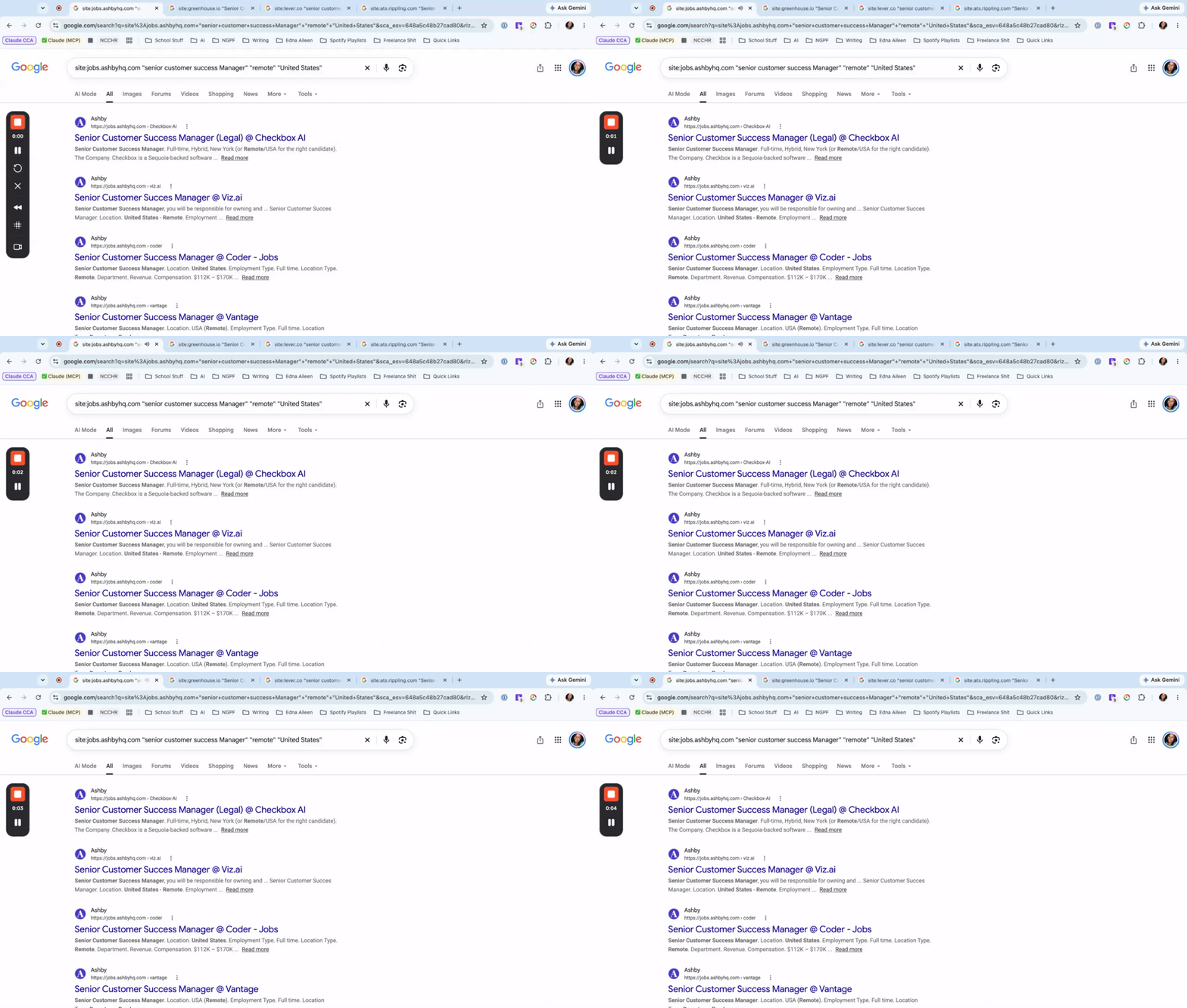
Quick thing that changed how I look at job listings: a lot of what you see on LinkedIn and other aggregators was first posted on the company’s own job board. The aggregator is a copy, and sometimes the copy is stale. A boolean search on Google lets you look at those boards directly. Two pieces do most of the work. The first is site:, which tells Google to search only one domain. The second is quotes plus OR, which lets you search for several job titles at once. Here’s what that looks like in practice: site:jobs.lever.co “technical account manager” OR “customer success manager” One line, one job board, two titles. No algorithm deciding which listings you see first. The AI part: if writing strings by hand feels fiddly, you can give Claude, ChatGPT, or Gemini your target titles and ask it to build the boolean string for you. Then you read it, adjust it, and run it yourself. That last step matters, because AI can get the syntax slightly wrong, and a quick test search tells you right away. I recorded a full walkthrough of the process. Video is linked below. If you give it a try, I’d love to hear which job board gave you the best results.
20d •
Closing out September
Closing out the surge month. Whatever happened this month—an offer, an interview, a single callback, or just showing up consistently when it would have been easier to give up—that’s worth naming. Drop your biggest win of September below. I want to hear everyone’s.
1-30 of 55

Suggested communities
Powered by