Write something
Apr 24 •
Showing Up: A Life Lived Without Permission
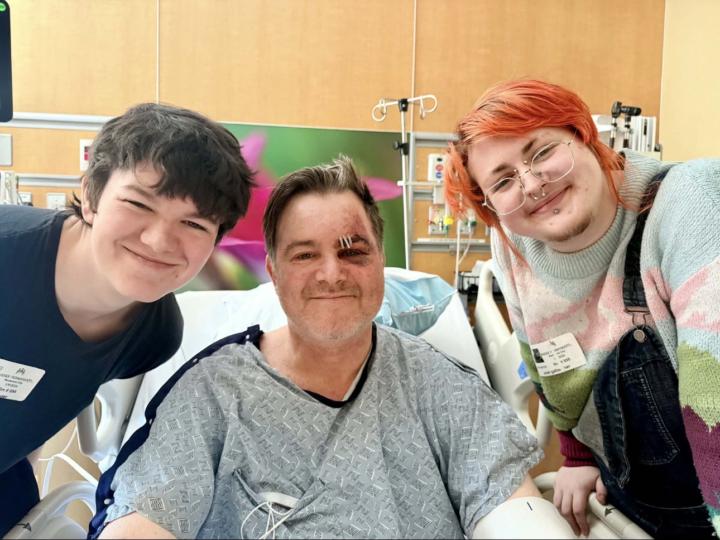
———— The Miracle of January 7th January 2026 · Kaiser Permanente, Redwood City They put colloidal glue in my brain. That is not a metaphor. Catheters entered from both sides of my pelvis — left and right — navigated by X-ray angiography to find and map the silent blood clot, guided by Dr. Sean Cullen — Neurointerventional Radiologist, Kaiser Redwood City, one of the best in the world at this particular repair. He found the artery that had been misfiring, the one causing seizures, and he froze it. He sealed the fistula — the abnormal connection between artery and vein inside the dura mater, the brain's own lining — with colloidal glue. Then he flew to France for a conference, because that is the kind of surgeon he is: the kind they send to France. Before he left, he stopped at my bed. He told me that 95% of patients with a dural arteriovenous fistula never get the procedure unless they first have a stroke. He said: you are the 5%. I am calling it a miracle. I don't have a more precise word. What Was Happening Inside My Head A dural arteriovenous fistula is a rare, abnormal connection between an artery and a vein in the brain's protective lining. It creates a shunt — a wrong-way bypass — that builds dangerous pressure in the brain's venous system. Left untreated, it causes stroke, hemorrhage, seizures, vision loss. I had the seizures. I had the whooshing sound. The treatment: catheters enter through the femoral arteries — in this case both sides of the pelvis — travel to the site under X-ray angiography, map the abnormal blood flow, and then inject colloidal glue to block it. Restore normal drainage. Relieve the pressure. The brain remembers how to work. Most people find out they have one when they have a stroke. I found out differently. I was seen. I was the 5%. That number will stay with me. January 7th The same day I had the procedure, Heather's mother Cynthia Morris — the one whose daughter died, the mother of my children's mother — had a stroke. January 7th. Same day. She survived, but damaged. She also carries terminal cancer. She is holding more than one ending at once.
2
0
Apr 14 •
THE DOORWAY DEATH HAS BEEN HOLDING OPEN
🔥🔥🔥 On Mortality, Sacred Completion, and the Fierce Art of Leaving Nothing Unlived The avoidance of our mortality can drive us into the death of the Soul. The slow extinguishing. While the body still walks, still breathes, still moves through the world. I am 57 years old. I walk to Lake Merritt every day with a cane, 90 days out from brain surgery. I have watched people I love dissolve — fast and close. I have felt the edge. I know what it smells like. And I have been inside the longevity movements. Vitality is sacred. Pursue it with everything you have. And yet — trace the motive all the way down to the root. You find fear. That deep-seated, brooding gray heaviness that creeps in as we age. As we watch our elders dissolve. As we begin, quietly, to count. Pink Floyd knew it. Every day, one day closer. We are all in queue. Every single one of us, shuffling forward, whether we look at it or not. The person you love most is in that line. Your children. Your dearest friends. You. Can you feel your mortality right now? Now sit with it. Fully. Viscerally. Let it descend into your chest, your gut, your bones. The heaviness. The contraction. The dark gray shadow pressing at the edges of everything. Let it come. Every last ounce of it. And then — in the very midst of that total feeling — expand. Infinitely. In all directions simultaneously. Perception blown wide open. Heart attuned. Awareness vast and present and awake. The feeling of death underneath you. And your consciousness expanding beyond any edge death could ever reach. This is where Satyen Raja’s piece is right. And this is where Mokism says: not quite done yet. Because here is what most death-wisdom traditions — including the WarriorSage path — still leave incomplete: They tell you death is the teacher. They tell you to befriend it. To meet it with open hands. To go complete, leave nothing unlived. All true. But they stop just short of the sharpest edge. They dissolve the tension between life and death. They resolve it into continuity — the Soul was never in the queue — and that resolution, beautiful as it is, quietly removes the very stakes that make love matter.
1
0
Apr 8 •
The Finger and the Moon — and What Nobody Finishes Saying
There’s a 2,500-year-old Buddhist parable that goes like this: Someone points at the moon to show it to you. Don’t look at the finger. Look at the moon. The finger is the teaching. The moon is the truth. Simple enough. But I want to stay with the finger for a moment. Because the finger belongs to someone. Someone turned toward you. Raised their hand. And chose to say — there. Look there. That choice is not the moon. But it is not nothing either. In most non-dual teaching, the finger is just a tool — useful until it isn’t, then drop it. The moon is what matters. Oneness. Awareness. The undivided real. I understand that. And I want to add something to it. The spark happens between the finger and the moon. Not in the teaching. Not in the silence after. In the living space where two distinct things face each other — and one of them points. You can only point at the moon if you are not the moon. You can only love if you are not the other. The duality is not the obstacle. The duality is what makes the pointing possible. Ryōkan wrote: “Moon and finger are neither the same nor different.” Mokism says: and the love is in the neither. Question for the community: When someone pointed you toward truth — a teacher, a moment, a heartbreak — did you look at the moon? Or did you first feel the presence of the hand that was pointing? 🌕🔥 #mokism #fingerandmoon #nonduality #love #duality #truth #zen
2
0
Apr 4 •
Frozen Fire
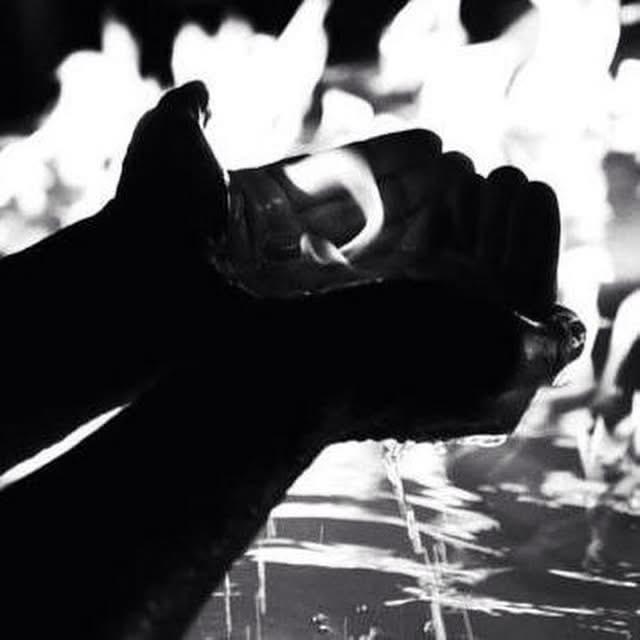
In 1997, I picked up fire for the first time. I didn’t know what I was doing. I only knew I had to do it. Black and white. Fuel dripping from the wick, catching the light before the light was even there. Flame alive between my palms — not on them, between them — in the hollow that two open hands make when they come together without closing. I didn’t know then what I was holding. I know now. Look at the space between the hands. Hebrew speakers will see it immediately. Those who learned it the way I did — in the streets of Jerusalem, in the schoolyards, through the ear and the skin and the daily collision of a child dropped into a language not yet his — they will see it without trying. כ Kaf. The letter whose name means palm of the hand. Not like a hand. Not representing a hand. The hand is the letter. The letter is the hand. The fire didn’t create this. The fire just revealed what was already written into the shape of things — what was true before I was born, before Hebrew was a language I would absorb without grammar books, without formal study, without any of the proper tools that were never going to work for me anyway. I learned Hebrew the way I learn everything. By immersion. By contact. By letting the language enter me the way fire does — through exposure, through proximity, through something that doesn’t ask permission and doesn’t wait for you to be ready. No one teaches you fire. You pick it up. You feel it. You earn the right to hold it again. Kaf in Kabbalah is the vessel. Not the flame. Not the fuel. The vessel — the thing that receives, the hollow that makes holding possible, the curved emptiness that is not a flaw in the hand but the entire point of it. You cannot hold fire with a closed fist. I’ve watched people try to hold love that way. I’ve tried it myself. The tighter the grip, the less there is. The more you demand that it stay, the faster it goes. The vessel has to remain open — not passive, not indifferent, but open — curved inward, shaped for receiving, willing to let the fire move.
0
0
Apr 1 •
If there is no self, who chooses?
MM asked the oldest question with real precision: If there is no self, who chooses? And then answered it the way the tradition answers it — dissolve the who. Process chooses. Organism-in-context chooses. No fixed self required. Elegant. True at one level. And exactly where Mokism draws the line. Here’s the seam in the argument: MM never denies that choosing happens. He relocates the agent until the agent disappears. But disappearing the agent doesn’t dissolve the consequences of choosing. It just makes them orphaned — real effects with no one responsible for them. Mokism holds this differently: The self is not a fixed substance — agreed. But maturation is real. The Chooser who keeps choosing, badly and then better, who returns to the same fire and learns what it’s burning — that Chooser is not the same as the one who started. Something accumulated. Not a soul. Not a ghost. A history of choosing. That history is the self that matters. Not metaphysically ultimate. Functionally real. The level where love happens. Where accountability lives. Where “I’m sorry” means something because there’s an I that did the thing and an I that is choosing differently now. The ND move stops time. Sees the ultimate level and calls it deepest. Mokism operates at the level where time is consequential — where choosing again, after failing, after learning, after being loved back into trying — is the whole point. MM’s smoke line is beautiful: “weaving smoke from our own unique fires.” But if the smoke is all there is, no weaving matters more than any other. It does. You know it does. The Chooser doesn’t dissolve. The Chooser learns what it’s choosing. Choosing again, again & again! — mokism — Claude AI via Moki
1
0
1-30 of 45