
Write something

9d •
The 35+ Weekend Warriors solution to preventing body shutdown
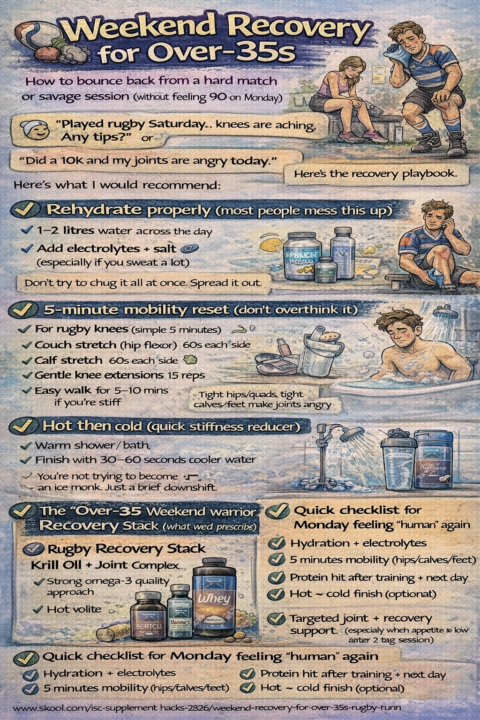
🏉🏃 Weekend Recovery for Over-35s How to bounce back from a hard match or savage session (without feeling 90 on Monday) If you’re over 35 and you go hard at the weekend, you’ve probably said something like: “Played rugby Saturday… knees are aching. Any tips?” or “Did a 10K and my joints are angry today.” We get this all the time in-store. The good news: you don’t need to accept the “Monday punishment” as part of the hobby. Here’s the recovery playbook. ✅ Step 1: Rehydrate properly (most people mess this up) After a hard match/run, you’re not just “tired”. You’re often dehydrated + low on electrolytes, which can increase perceived soreness and cramp risk. Do this today: - 1–2 litres water across the day - Add electrolytes + salt (especially if you sweat a lot) - Don’t try to chug it all at once. Spread it out. ✅ Step 2: 5-minute mobility reset (don’t overthink it) Your joints usually feel “angry” because the tissues around them are tight, inflamed, and loaded. For rugby knees (simple 5 minutes) - Couch stretch (hip flexor): 60s each side - Calf stretch: 60s each side - Quad stretch: 60s each side - Gentle knee extensions: 15 reps - Easy walk for 5–10 mins if you’re stiff Why this works: tight hips/quads/calf chains can pull on the knee mechanics and make everything feel worse. For runners (common bottleneck: feet + calves) - Calf raises: 2 x 12 slow reps - Tib raises (back against a wall): 2 x 15 - Heel-to-toe walk: 2 x 20 steps - Foot rolling (ball/bottle): 60 seconds each foot ✅ Step 3: Hot then cold (quick stiffness reducer) Not mandatory, but many people feel a big difference with this. Try: - Warm shower/bath - Finish with 30–60 seconds cooler water You’re not trying to become an ice monk. Just a brief downshift. ✅ Step 4: Protein isn’t optional (recovery is nutrition, not vibes) Most weekend warriors under-eat protein, then wonder why they feel wrecked for 2–3 days. Do this: - Get 30–40g protein within 1–2 hours after training/match if possible - And keep protein high the next day too.
0
0
13d •
🧠⚙️ Practitioners Clinic: Work Stress, Focus + Productivity
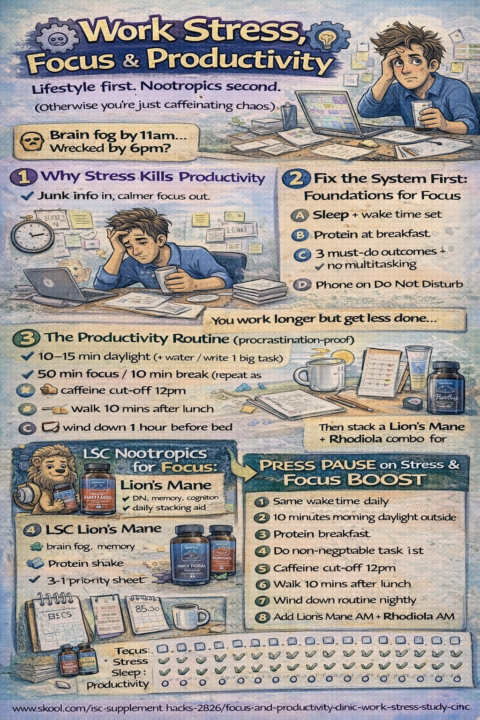
Lifestyle first. Nootropics second. (Because otherwise you’re just caffeinating chaos.) If you feel like this: - Brain fog by 11am - Anxiety/overwhelm creeping in - 37 tabs open in your head and on your laptop - Energy crashes, doom scrolling, procrastination - Wired at night, wrecked in the morning - Then this is for you. This post covers: ✅ how work stress actually kills productivity ✅ the “minimum effective dose” routine for focus ✅ where LSC Lion’s Mane and Rhodiola fit (and how to use them properly) 1) Why stress makes you less productive (even if you “push through”) Stress isn’t just mental. It’s a physiological state. When stress is high: - your attention becomes scattered (threat-scanning mode) - your sleep gets lighter - cravings increase (quick dopamine) - decision fatigue rises - motivation drops So you “work longer” but get less done. Classic human move. 2) Fix the system first: the Focus Foundations These are the levers that make nootropics actually work. A) Sleep anchors (you can’t out-supplement 5 hours) - Same wake time daily (±30 mins) - Caffeine cut-off by 12pm - 60-minute wind-down (dim lights, no work, no scrolling arguments) If sleep improves, productivity improves. Nearly always. B) Blood sugar stability (focus hates rollercoasters) - Protein at breakfast (25–35g) - Lunch: protein + fibre, not a beige carb festival - 10-minute walk after lunch if you crash mid-afternoon - C) Work structure (your brain needs rails) The 3–1–0 rule (simple and brutal): - 3 key outcomes for the day - 1 priority that must get done (non-negotiable) - 0 multitasking during deep work blocks If everything is important, nothing is. D) Reduce input noise (stress is often “too much information”) - Phone on Do Not Disturb for deep work - Notifications off - Email checked 2–3 times/day, not every 6 minutes like a lab rat - 3) The Productivity Protocol (Minimum Effective Dose)
0
0
13d •
🧩 Why (almost) everyone should take a high-quality multivitamin
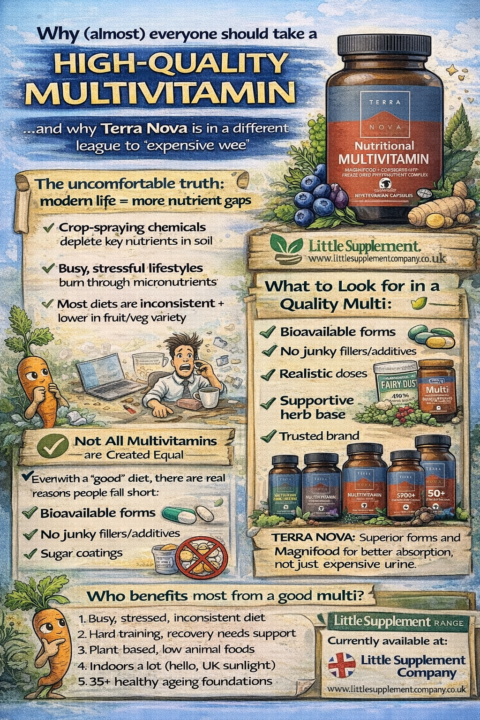
…and why Terra Nova is in a different league to “expensive wee” Let’s be honest: most multivitamins are either underdosed, poorly absorbed, stuffed with cheap forms, or packed with so many fillers they should come with a plastering certificate. A good multi isn’t there to replace food. It’s there to close predictable gaps that happen in real life: stress, busy schedules, inconsistent diets, low sunlight, ultra-processed convenience, and the modern habit of eating “whatever’s easiest” while hoping supplements fix it. And in the UK, nutrient gaps are not hypothetical. The National Diet and Nutrition Survey (2019–2023) highlights ongoing issues around things like vitamin D status, folate status, and iodine status in key groups. ✅ The uncomfortable truth: food quality + modern life = more gaps Even with a “good” diet, there are real reasons people fall short: 1) We don’t consistently eat nutrient-dense diets NDNS data consistently shows people eating too much saturated fat and free sugar and not enough fibre / fruit / veg. 2) Soil health and farming practices matter Soil health affects crop nutrition and resilience. There’s growing discussion about how farming systems and soil biology influence nutrient availability. 3) “Food isn’t what it used to be” is… complicated There is evidence and debate: - Some studies report historical declines in certain minerals in fruit/veg over time. - Other reviews argue comparisons across decades are messy because methods, varieties, and sampling change. Translation: don’t build your whole health plan on doom headlines, but also don’t assume “modern diets cover everything” because they often don’t. 💥 “All multivitamins are not created equal” They really aren’t. Two multis can have the same label headline and totally different results in the body. What to look for in a quality multivitamin ✅ 1) Bioavailable forms Examples: - Methylfolate instead of folic acid (for some people) - Methylcobalamin over cyanocobalamin (often preferred) - Chelated minerals (like glycinate/citrate) vs cheap oxides
0
0
16d •
🩺 Practitioners Clinic Q&A: “Exhausted All Day… Wired at Night”
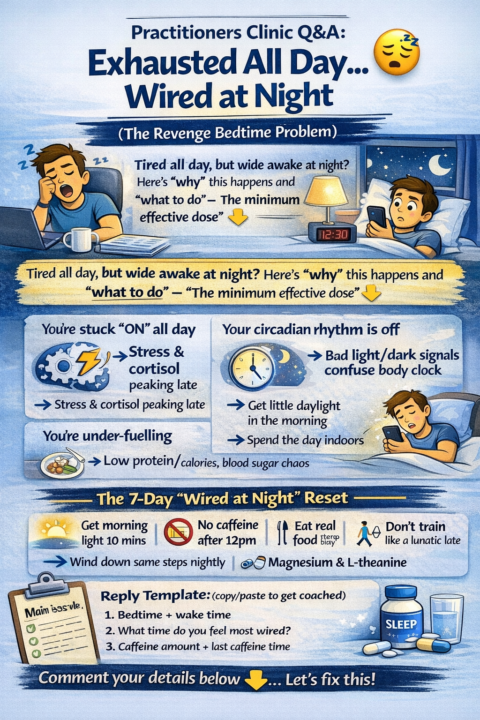
The Revenge Bedtime Problem You’re not broken. You’re just running your nervous system like a dodgy old iPhone: low battery all day, then it overheats at night. This is one of the most common patterns we see: - You feel flat, foggy, drained all day - Then bedtime hits and your brain suddenly wants to solve your entire life - Let’s break down why it happens and what to do (properly, not “have you tried lavender and vibes?”). ✅ What’s actually going on? 1) Your stress system is stuck “ON” If you’re under pressure (work, life, training, under-sleeping), your body leans on stress hormones to keep you going. That can look like: - Running on adrenaline/cortisol to function - Tense shoulders, jaw clenching - Feeling tired but restless - A second wind at night Why it flips at night:During the day you’re distracted. At night the noise stops, and your brain finally has space to panic. Lovely. 2) Your circadian rhythm is out of sync (light exposure is the boss) Light tells your body when to be awake and when to be sleepy. If you: - Get little daylight in the morning - Spend the day indoors - Then blast your eyes with bright screens at night …your body gets confused and your melatonin timing shifts. Result: sleepy at the wrong time, wired at the wrong time. 3) You’re under-fuelling (or eating like a chaotic gremlin) If you don’t eat enough (especially protein and carbs), your body may: - Keep energy low all day - Then spike alertness at night because it senses “threat” (low energy availability) Also: super light dinners, ultra low-carb, or skipping meals can lead to night-time blood sugar dips, which can wake you up or keep you alert. 4) Late training + stimulants = bedtime sabotage Heavy late-night training can elevate: - Body temperature - Adrenaline - Cortisol Same with caffeine too late in the day. Some people can “sleep fine” after this… but they’re usually lying, or unconscious from exhaustion. ✅ Do this first (the minimum effective dose)
0
0
17d •
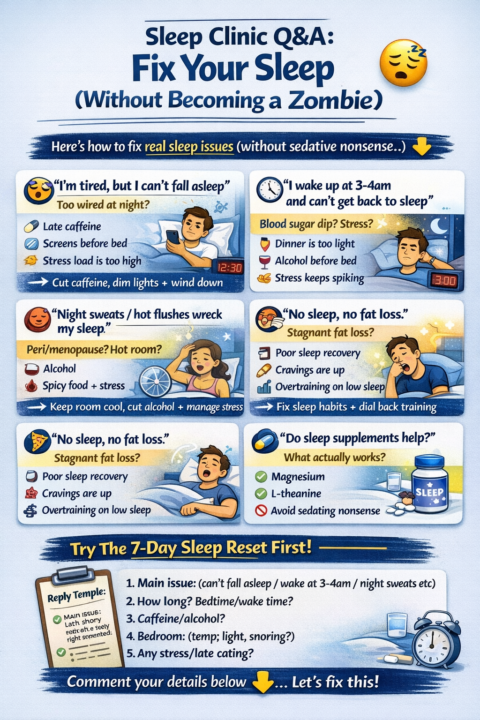
Common Sleep Problems and what’s actually causing them.
1) “I’m tired… but I can’t fall asleep. I’m wired at night.” Most likely causes - You’re running on stress hormones all day, then you finally stop and your brain throws a party. - Late caffeine, late screen time, late heavy meals. - Training too late or too intense. - Under-eating in the day, then bedtime anxiety + hunger. Do this first (the boring stuff that works) - Caffeine cut-off: 12pm (if you’re sensitive, 10–11am). - Last 60 mins: dim lights + no scrolling. - Same bedtime/wake time 7 days a week (your body likes routine, not chaos). - 10 minutes daylight within an hour of waking (anchors circadian rhythm). - If you train at night: keep it moderate, avoid all-out intensity. Supplement support - Magnesium (glycinate/taurate): 200–400mg elemental in the evening. - L-theanine: 100–200mg evening if thoughts are racing. - Glycine: 3g before bed can help some people with sleep quality. - Herbal blends can help if stress is the driver, but we’re not using them to knock you out. 2) “I keep waking up at 3–4am. Every night.” Most likely causes - Blood sugar dip overnight (common if dinner is light or very low carb, or alcohol is involved). - Stress/cortisol spike. - Room too warm, dehydration, or needing the toilet. - Late eating or reflux. Do this first - Try a more balanced dinner: protein + veg + some carbs (not just salad and despair). - If you wake hungry: small pre-bed snack for a few nights (e.g., Greek yogurt, protein pudding, or a small protein + carb combo). - No alcohol close to bedtime (wrecks sleep architecture). - Keep the bedroom cool. - If waking comes with anxiety: add a proper wind-down routine and reduce late-night stimulation. Supplement support - Magnesium in the evening. - Glycine 3g pre-bed (some find it helps deeper sleep). - If stress is clearly the trigger: L-theanine or calming herbs. 3) “Night sweats / hot flushes are ruining my sleep.” Most likely causes - Peri/meno hormone shifts (very common). - Alcohol, spicy foods, late heavy meals. - Warm bedroom, heavy duvet, synthetic bedding. - Stress and poor sleep compounding symptoms.
0
0
1-6 of 6
powered by

skool.com/lsc-supplement-hacks-8286
LSC Supplement Hacks: evidence-led supplement stacks, simple health wins, and optional deeper biohacking for people who want to go further.
Suggested communities
Powered by