Activity
Mon
Wed
Fri
Sun
Aug
Sep
Oct
Nov
Dec
Jan
Feb
Mar
Apr
May
Jun
What is this?
Less
More
Owned by Mark
Elite biohacking community covering SARMs, SERMs, peptides, risks, rewards, and real industry insight for serious performers.
LSC Supplement Hacks: evidence-led supplement stacks, simple health wins, and optional deeper biohacking for people who want to go further.
55 contributions to LSC Supplement Hacks

Apr 28 •
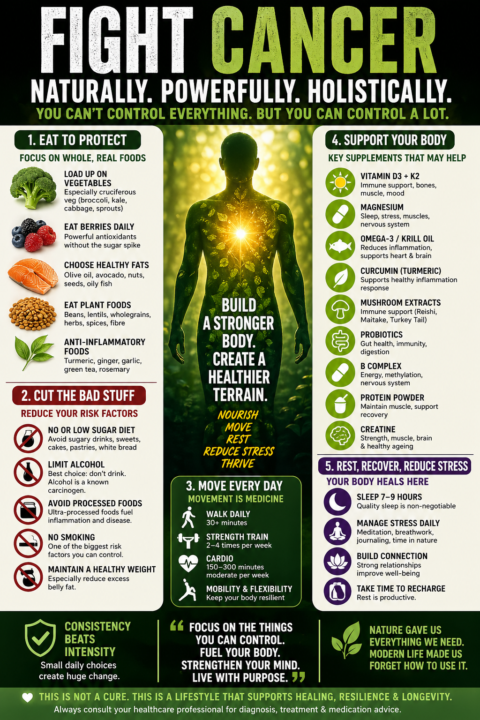
Fighting Cancer Holistically: Lifestyle, Nutrition & Supplement Support
A no-fluff deep dive into creating a body less friendly to disease Cancer is one of the most feared words in health. And because of that fear, people often feel forced into two extreme camps: one side says “only medical treatment matters”, and the other says “only natural approaches matter”. As usual, humans have taken a serious subject and turned it into a shouting match in a burning building. Here’s the more useful truth: Your lifestyle matters massively.Your nutrition matters massively.Your blood sugar, body fat, inflammation, gut health, sleep and stress levels matter.Supplements may support the terrain of the body. But, and this is important, anyone diagnosed with cancer should still get proper medical advice, scans, blood tests and monitoring. Choosing a holistic approach does not mean guessing in the dark and hoping broccoli has a legal department. This article is about taking back control of the things you can control: food, movement, sleep, stress, toxins, blood sugar, body composition and targeted nutritional support. The holistic view: change the terrain A holistic approach looks at the whole person, not just the tumour. That means asking: - Is blood sugar constantly elevated? - Is insulin resistance present? - Is the person overweight or under-muscled? - Is inflammation high? - Is the gut damaged or sluggish? - Is sleep poor? - Is stress constantly switched on? - Is alcohol intake too high? - Is the diet full of ultra-processed food? - Are nutrient deficiencies present? - Is the immune system under pressure? The goal is to make the body’s internal environment healthier, stronger and less chaotic. Cancer is complex. No lifestyle plan guarantees prevention or recovery. But a healthier internal environment may support better resilience, better recovery, better immune function and better long-term health outcomes. 1. Sugar, cancer and the blood sugar problem Let’s deal with the big one. You’ll often hear: “Sugar feeds cancer.” There is some truth hiding inside that phrase, but it gets oversimplified online, because apparently nuance died in a comments section.
1
0
Apr 28 •
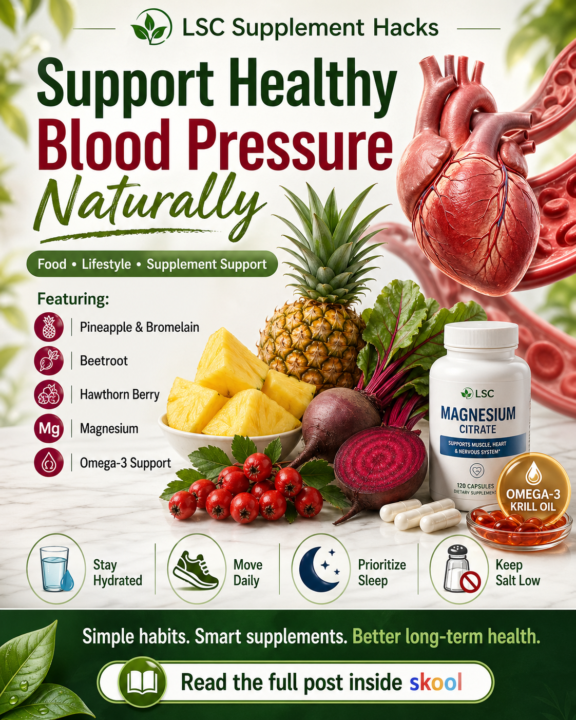
Controlling Blood Pressure Naturally: Food, Lifestyle & Supplement Support
LSC Supplement Hacks High blood pressure is one of those health issues that can quietly build in the background without making much noise. That is why it is worth paying attention to early. Healthy blood pressure is important for your heart, brain, kidneys, circulation and long-term wellbeing. The good news is that there are plenty of positive steps you can take through diet, lifestyle and carefully chosen supplements. This article looks at some natural ways to support healthy blood pressure, including pineapple, bromelain, beetroot, hawthorn berry and a few everyday habits that can make a real difference. Why Blood Pressure Matters Blood pressure is the force of blood pushing against the walls of your arteries. When that pressure stays too high for too long, it can put extra strain on the cardiovascular system. Supporting healthy blood pressure is really about supporting: - Better circulation - Healthy blood vessels - Heart health - Energy and vitality - Long-term wellness - The key is consistency. Small daily habits can have a big impact over time. Sadly, consistency is the bit most people treat like optional software updates. Pineapple & Bromelain: Tropical Support for Circulation Pineapple is more than just a sweet tropical fruit. It naturally contains bromelain, a group of enzymes that have been studied for their potential role in supporting inflammation balance, circulation and cardiovascular health. Bromelain is particularly interesting because it may help support the body’s natural processes involved in healthy blood flow and normal fibrin balance. Fibrin is a protein involved in clot formation, and keeping the circulatory system working smoothly is an important part of overall cardiovascular wellbeing. Adding pineapple into the diet is a simple, refreshing way to bring in bromelain, vitamin C, antioxidants and digestive enzymes. How to Use It Fresh pineapple can be enjoyed: - In smoothies - With Greek yoghurt - As part of a fruit bowl - After meals to support digestion - As a refreshing snack
0
0
Apr 11 •
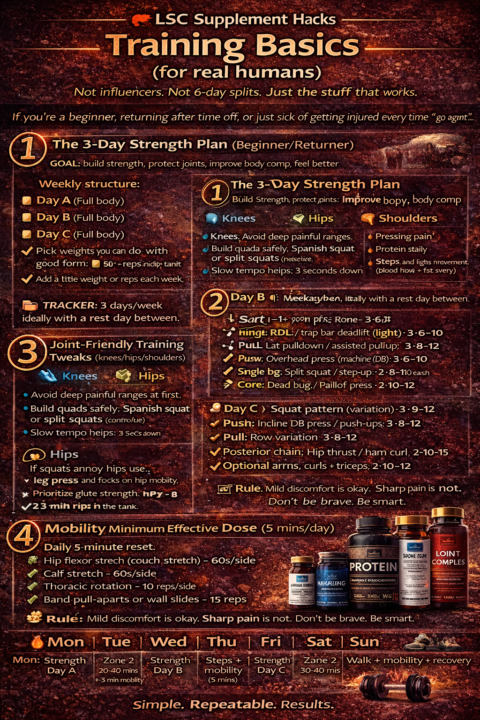
🏋️ Training Basics (for real people)
Not influencers. Not 6-day splits. Just the stuff that works. If you’re a beginner, returning after time off, or just sick of getting injured every time you “go again”… this is your training blueprint. This post includes: ✅ a simple 3-day strength plan ✅ joint-friendly tweaks for knees/hips/shoulders ✅ 5-minute mobility minimum effective dose ✅ Zone 2 cardio without burnout ✅ recovery rules (why you’re sore + what to do) ✅ recommended supplements that actually support the plan 1) The 3-Day Strength Plan (Beginner/Returner) Goal: build strength, protect joints, improve body comp, feel better. Weekly structure: - Day A (Full body) - Day B (Full body) - Day C (Full body) Rules - Pick weights you can do with good form. - Leave 2 reps in the tank (RPE 7–8). - Add a little weight or reps each week. Day A 1. Squat pattern: Goblet squat / leg press – 3 x 6–10 2. Push: Dumbbell bench / machine press – 3 x 6–10 3. Pull: Seated row / chest-supported row – 3 x 8–12 4. Hinge: RDL (light) / hip hinge machine – 2 x 8–12 5. Carry/core: Farmer carry or plank – 2–3 rounds Day B 1. Hinge: RDL / trap bar deadlift (light) – 3 x 6–10 2. Pull: Lat pulldown / assisted pull-up – 3 x 8–12 3. Push: Overhead press (machine/DB) – 3 x 6–10 4. Single leg: Split squat / step-up – 2 x 8–10 each 5. Core: Dead bug / Pallof press – 2 x 10–12 Day C 1. Squat pattern (variation): Leg press / box squat – 3 x 8–12 2. Push: Incline DB press / push-ups – 3 x 8–12 3. Pull: Row variation – 3 x 8–12 4. Posterior chain: Hip thrust / ham curl – 2 x 10–15 5. Optional arms: curls + triceps – 2 x 10–12 Frequency: 3 days/week, ideally with a rest day between. 2) Joint-Friendly Training Tweaks (knees/hips/shoulders) 🦵 Knees - Avoid deep painful ranges at first. Use box squats or leg press to a comfortable depth. - Build quads safely: Spanish squat or split squats (controlled). - Slow tempo helps: 3 seconds down. 🦴 Hips - If squats annoy hips, use leg press and focus on hip mobility. - Prioritise glute strength: hip thrusts, RDLs, step-ups.
0
0
Apr 11 •
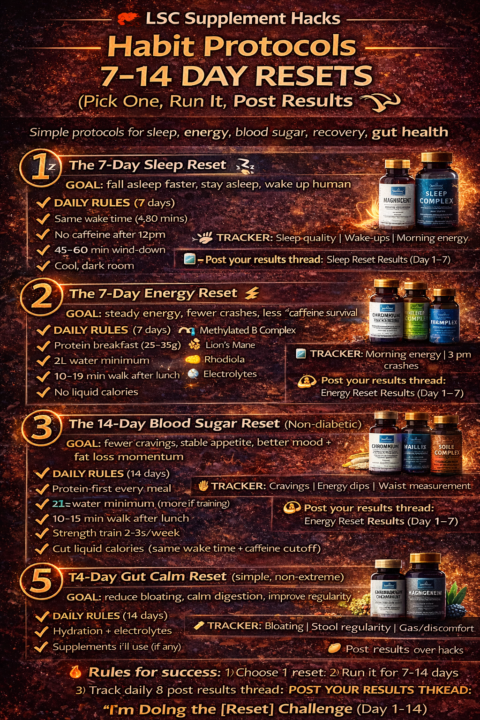
🧪 Habit Protocols: 7–14 Day Resets (Pick One, Run It, Post Results)
Most people don’t need more motivation. They need a simple protocol they can actually follow. Here are five resets we use all the time because they work in the real world.Pick ONE. Run it properly. Track it. Post results. No perfection. Just consistency. 😴 1) The 7-Day Sleep Reset Goal: fall asleep faster, stay asleep, wake up human Daily Rules (7 days) ✅ Same wake time (±30 mins) ✅ No caffeine after 12pm ✅ 45–60 min wind-down (dim lights, no work, no scrolling wars) ✅ Cool, dark room ✅ 10 mins daylight within 1 hour of waking Supplement Support (optional) - LSC Magnificent (evening) - LSC Sleep Complex (30–60 mins pre-bed) - LSC Ashwagandha (evening or split dose if stress-driven) - Sleep Tracker (post daily) Sleep quality (0–10) | Time to fall asleep | Wake-ups | Morning energy (0–10) ➡️ Post your results thread: Sleep Reset Results (Day 1–7) ⚡ 2) The 7-Day Energy Reset Goal: steady energy, fewer crashes, less “caffeine survival mode” Daily Rules (7 days) ✅ Protein breakfast (25–35g) ✅ 2L water minimum (more if training) ✅ 10-min walk after lunch ✅ No liquid calories ✅ Caffeine cut-off 12pm ✅ Steps: +2,000/day from your current baseline Supplement Support (optional) - Terra Nova Methylated B Complex (AM) - LSC Lion’s Mane (AM daily) - LSC Rhodiola (AM/early PM only if needed) - Electrolytes (especially if you sweat or feel “flat”) Energy Tracker Energy AM/PM (0–10) | 3pm crash (yes/no) | Cravings (0–10) | Focus (0–10) ➡️ Post your results thread: Energy Reset Results (Day 1–7) 🍽️ 3) The 14-Day Blood Sugar Reset (Non-diabetic) Goal: fewer cravings, stable appetite, better mood + fat loss momentum Daily Rules (14 days) ✅ Protein-first every meal ✅ Fibre daily (build gradually) ✅ 10–15 min walk after biggest meal ✅ Strength train 2–3x/week ✅ Cut liquid calories ✅ Sleep routine (same wake time + caffeine cutoff) Supplement Support (optional) - Chromium (daily) - Cinnamon (with meals) - Alpha Lipoic Acid (earlier in the day) - Taurine (daily, especially if training)
0
0
Apr 11 •
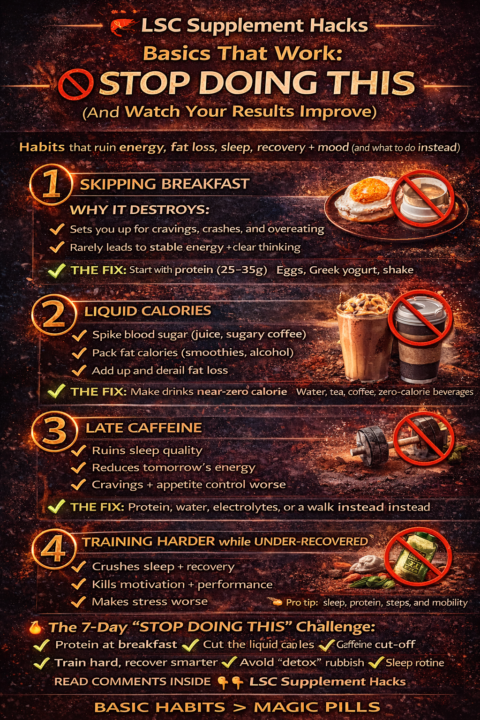
🚫 Basics That Work: “STOP DOING THIS” (and watch your results improve)
People love complicated hacks because it lets them avoid the basics. Tragically, the basics still win. Here are 5 common habits that quietly wreck energy, fat loss, sleep, recovery, and mood. 1) ❌ Skipping breakfast (why it backfires for most… and when it doesn’t) Why it often backfires Skipping breakfast is fine in theory… but most people don’t “skip breakfast” elegantly. They: - have coffee - push through - then crash + crave - then eat a beige lunch - then snack all afternoon - then go feral at night Result: worse appetite control + worse energy + worse food choices. The fix If you struggle with cravings, fatigue, or 3pm crashes:✅ eat a protein-first breakfast (25–35g protein) Examples: - eggs + fruit - Greek yogurt + berries - whey shake + oats - leftovers (yes, you’re allowed) When skipping breakfast can work If you: - feel great fasting - don’t binge later - have stable energy - can hit protein targets across the day Then fine. You’re the rare adult who can handle it. 2) ❌ Liquid calories (why they ruin fat loss and energy) Liquid calories are the stealth villain because they: - spike quickly - don’t fill you up - make it easy to overeat without noticing Common offenders: - sugary coffees - juice (yes, even “fresh”) - “healthy smoothies” with 400–700 calories - protein shakes used as snacks plus meals (double dipping) The fix ✅ Make drinks low-calorie by default: - water, sparkling water, tea - black coffee (or minimal milk) - if you use smoothies: treat them as a meal, not a “drink” If fat loss is stuck, liquid calories are usually one of the first things to audit. 3) ❌ Late caffeine (why it wrecks sleep AND appetite) Caffeine has a long half-life. Translation:That “harmless” 3pm coffee can still be messing with your sleep at midnight. Even if you fall asleep, it can reduce sleep quality, and then: - cravings rise the next day - appetite control drops - stress increases - energy becomes caffeine-dependent
0
0
1-10 of 55

@mark-hamilton-7500
No-fluff health & supplement masterclasses. Learn what works, avoid expensive wee, and get Practitioner-style Q&As. Join free while it lasts.
Active 1d ago
Joined Jan 30, 2026