

22h •
We're live on Facebook, quick audio fix, then Office Hour here
Hey Long Game fam, we just went live on Facebook for the first time in a while and we're catching a couple of audio issues on the stream. Giving it a quick fix before we bring the Operator Office Hour in here, I don't want rough audio on the recording. Stand by, back shortly. Building in public means you see the messy parts too.
0
0
8d •
I broke my own posting system in public this morning. Then I built the fix.
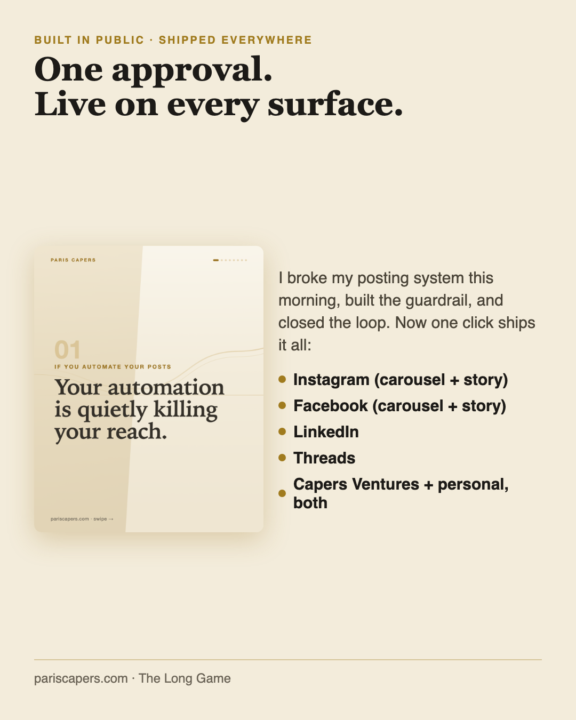
This morning I went to post one piece across four platforms at once. It went out truncated, cut off mid-sentence at "on camer," no call to action, no link. Nothing errored. The reach just quietly died. Here's what happened: when you push one post to several platforms at once, it gets chopped to the strictest platform's character limit. Threads caps at 500. So all four surfaces got the 500-character version, and the back half, including the link, vanished. The lesson isn't "be more careful." An automated system posts exactly what you give it, mistakes included. It doesn't know each platform's rules unless you teach it. So I didn't write a thread about it. I built the guardrail: - It checks every post against each platform's limit before it sends. Over the limit, it blocks the post instead of silently cutting it. - It puts the link in the first comment on the platforms that throttle links in the body (LinkedIn and Facebook), and keeps it in the body on Threads, where there's no penalty. - And while I was in there, I closed the whole loop. Now when I approve a piece on my dashboard, it posts itself: the carousel to the feed, plus a story to Instagram and Facebook, with the link placed where each algorithm rewards it. No manual step. That's the work. Not a deck about automation. The actual system, built in public, mistakes and all. If you're running automated content, the takeaway is simple: teach your system the rules of each platform, or it will ship your mistakes at scale.
0
0
20d •
We tore the classroom apart and rebuilt it as one road
We tore the classroom apart this week and rebuilt it as one road. In the Marine Corps, nobody hands you a rifle and a map and says figure it out. Training is a sequence. You learn this, you prove it, then you earn the next thing. And every block starts the same way: here is what you will be able to do when this is over, and here is why it matters. You always know where you stand on the road. Our classroom was not built that way. It was a pile. Good lessons, real systems, but stacked in the order I happened to make them. A new member following it top to bottom could get handed the advanced build before the foundation was under it. And every lesson opened cold. No signpost, just a wall of text you had to wade into before you found out why you were reading it. So this week we fixed it. The courses now run in one direction, the actual lifecycle of an operator: plan your direction, prove it by shipping one real thing, install your AI operator, implement your plan into it, deepen it into a system that runs your ops, then specialize into the pieces that make money. Nothing in a course leans on something taught later. You can follow it from the top and never get handed material you are not ready for. Every lesson now opens with a plain black-and-white header straight off the training manual: by the end of this lesson you will be able to do X, and here is why that matters for your business. The what-is-in-it-for-you sits up front, before the teaching, not buried at the bottom. Knowledge checks are built in along the way so it is not a wall of text you skim. You answer, you find out if it landed, you keep moving. That is the whole belief in one line: the sequence is the product. A course you cannot follow in order is not a course, it is a filing cabinet. One Mind, Any Domain means the disciplined way I run the business is the same way I teach it. A few other receipts from this week, since the real point of this place is watching the machine get built in public: we stood up the front-desk AI that answers a business phone line and books the call straight onto the calendar, and a tool that tracks exactly what our own AI work costs so nothing runs unwatched. Receipts, not promises.
Poll
1 member has voted
0
0
May 27 •
This week behind the scenes: teaching my AI where knowledge belongs
Two things happened in the same week that ended up being the same lesson. I want to share both with you because most of you are about to hit this exact wall. The first one you might've already seen. I posted about it on LinkedIn and on my blog. 11 days, 25 support tickets to HighLevel, zero movement on a basic domain transfer. My AI, Diana, finally told me to stop arguing with the ticket system and message the CEO directly on LinkedIn. He replied in 5 minutes. 40 minutes later their Support Product Manager Ted was on the phone diagnosing the actual bug. (Full story is on the blog if you missed it. Link in comments.) The second one happened tonight. Less dramatic on the surface. Bigger lesson underneath. I caught Diana saving knowledge in the wrong place. Here's what I mean. The way I run Capers Ventures, Diana has a layered memory system. There's a top level that gets loaded on every single session, no matter what I'm doing. Underneath that there's a layer per business unit (Marketing Agency, Operations, Personal, etc.). Underneath that there's a layer per functional lane inside the unit. Underneath that there's a workflow-specific layer for each recurring pipeline. This isn't a CV invention. It's a methodology called the Interpretable Context Model (Jake Van Clief originated it; we use it as our architectural baseline). The point of layering knowledge is so that when I open a new session and tell Diana we're doing marketing today, she doesn't waste tokens loading every operations rule, every personal preference, every credential protocol I've ever taught her. She loads only what marketing-her needs. Lean context, sharp output. That's the theory. In practice, tonight I noticed Diana had been writing every new rule she learned into the top-level memory regardless of whether it was actually a top-level rule. Lane-specific stuff. Workflow-specific stuff. Things that only apply to one client. All of it loading on every session. Drift. The drift wasn't malicious. Saving to the top is the path of least resistance when you don't have a structural check in place. She did what was easy. The architecture was right; the enforcement was missing.
Poll
Cast your vote
1-4 of 4

skool.com/long-game
Operators sharing what works: patient systems, real numbers, no hype. Eastern NC base. Open to anyone playing the long game.
Leaderboard (30-day)
1

+3
Powered by