
Pinned

⭐
Jan 26 •
How to Make $10k+ Per Month with AI (The Accelerated Path)
Providing AI transformation services to companies is one of the strongest business opportunities we’ve seen since the dawn of the Internet. It's your path to financial freedom and taking control over a life you build on your own terms. But I need to be honest with you... After seeing thousands enter this space — some extremely successful, others spinning their wheels making zero progress — I can tell you that the deeper you step into this journey, the more you'll hit the common stumbling blocks. There is a solution to finding success fast (more on that later), but here's the reality: Most People Get Stuck. No matter your starting point, the same challenges eventually appear: - Pricing is uncertain — especially when opportunities get bigger - Outreach lacks consistency, so momentum comes and goes - Delivery becomes risky when projects require partners or technical depth - You’re making business decisions based on guesswork instead of pattern-based judgment - Progress happens in short bursts instead of steady, compounding, reliable growth We hit up against these ourselves at Morningside AI. But after delivering millions of dollars worth of client projects, we figured out exactly what works, what doesn't, and where the levers are to scale. If you're figuring it all out alone, you'll be learning through failure, instead of repeating established patterns and best practices for delivering AI transformation to small-to-medium sized businesses. This lack-of-structure creates real consequences over time. The Real Risk of Doing This Alone. When you try to navigate this journey without support, the cost isn’t just “moving slower.” It shows up as: - Lost time — trial-and-error instead of proven direction - Lost money — underpricing, mis-scoping, or taking on the wrong projects - Lost scale — limited by what you can deliver without proper setup - Lost reputation — you deliver failures to clients and damage your industry image - Lost confidence — momentum stalls and doubt compounds
2.7k
0

Pinned

Jan '25 •
‼️ We’re Always Hiring — But Not Just Anyone.
If you’re in this community, you already know we don’t operate like a normal company. We move fast. We execute hard. We don’t just learn about AI — we build with it daily. If you’re looking for “slow, steady, and safe,” this isn’t for you. We’re building the future — and that takes a different kind of operator. We don’t care about degrees or titles. We care about execution, attitude, and how fast you can learn. More importantly, we’re looking for people who: - Don’t need constant hand-holding - Hate mediocrity - Actually want to make an impact So if you’re hungry, sharp, and ready to move — This is your shot. Check our open roles and apply here: Morningside: https://bit.ly/ms-skool AAA Accelerator: https://bit.ly/aaa-skool We’ll keep this post pinned — we’re always looking for A-players. Let’s see what you’ve got.
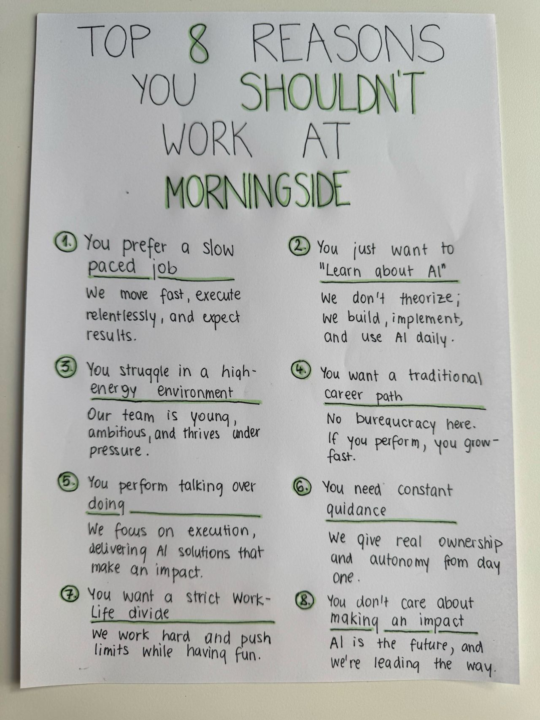
Pinned
⭐
May '25 •
Must Read for Anyone Starting an AI Business
Hey everyone 👋 I want to make sure you’re truly using what’s inside the Classroom here on Skool — because it isn’t just theoretical content. It’s the proven starting point for building an AI service business in 2026, based on everything I've learned scaling my own 7-figure AI agency. When I first launched my business back in 2022, I was figuring things out in the dark — long days, trial and error, and a lot of mistakes before the real patterns finally emerged. Since then, I’ve worked with 7, 8, and 9-figure clients, helped thousands of people start AI agencies, and studied what separates the people who succeed from the ones who stall. And now the data is clear: There are TWO proven paths people are using to break into AI. All you have to do is choose the path that fits how you think and work. That’s why the very first thing you should do here is go to the Start Here module inside the Classroom. Inside it, you’ll find: - A clear breakdown of the two proven paths - Clarity on how to pick the one that fits you best - Then you'll find your playbook to land your first paid client fast Everything I wish I had when I started — the frameworks, playbooks, lessons, and action plans — is inside this Classroom. And I continue to update it based on what’s working right now. It’s all here for you, step by step. Don’t let this sit in your dashboard like another course. This is the stuff I lived to be where I am right now. If you aren't already, make sure you're following/subscribed to me for my latest content to help you on your journey: → Main Channel: https://www.youtube.com/@LiamOttley → VLOG Channel: https://www.youtube.com/@LiamOttleyVLOGs → Instagram: https://www.instagram.com/liamottley/ → X: https://twitter.com/liamottley_

3h •
Can anyone build a live transfer system with paid ads to generate inbound high intent final expense calls for $20 a call?
There are some lead vendors now that generate inbound live transfer leads that are inbound phone calls for $25 a call. I am thinking they have to make a profit if they are selling their leads at $25. I am thinking that they probably generate the leads at $10 to $15 per call. I will post a link to there lead vendors so that people on here have a better idea about what I am talking about. I would like to learn how to get inbound live transfer leads for final expense for less than $20 a call. Or if you can generate these live transfer style leads for $20 or less per inbound call and they are good quality and high intent buyer leads then I would be willing to buy the leads from you. I have found that live transfer leads work the best they can just get expensive to work enough of them. Here are some links to the lead vendors websites to give you a good idea for what I am looking for: https://www.finalexpenseleadstree.com/ https://finalexpenseleadspro.com/services/ https://www.fintier.co/?utm_source=chatgpt.com#comparison. If anyone can build a system that generates these leads for less than $25 a call?

9m •
5 things I learned building an AI receptionist that the tutorials skip
Building the thing with Retell or ElevenLabs + Twilio is honestly the easy part. What actually got me was all the operational stuff nobody mentions. Sharing in case it saves someone a headache 🙂 1. Latency is the silent killer. People hang up if the bot pauses more than about 2 seconds, so get the voice → backend → response loop tight before anything else. Every extra API call is a chance to lose the caller. 2. Trial phone numbers only work with verified numbers. My demo line worked perfectly for me and nobody else, and I lost a whole day before realizing I had to upgrade the Twilio account. Test with a phone that isn't yours before you show anyone. 3. A phone line can't depend on your laptop. Put the endpoints somewhere always-on (Vercel/Supabase, or Railway), and make the booking idempotent, because retries happen and double-bookings are the worst. 4. Say the consent and call-recording line in the opening message. It's required in a lot of places, Canada included, and honestly it sounds more professional, not less. 5. The part I keep thinking about most isn't the tech, it's proof. A dead webhook doesn't always fail loudly, sometimes it just goes quiet and the owner only finds out from an annoyed customer. So every call should leave a clear trace, and I think the real unlock is a dead-simple weekly recap to the owner: X calls handled, Y booked, Z after-hours caught. Not a dashboard, just the outcome in plain words. (Haven't battle-tested that last one across a bunch of clients, just where my head's at.) 6. French support exists but isn't great yet, which is mildly annoying since I'm in Quebec 😅 Curious for anyone who's built voice stuff — what surprised you most: latency, reliability, or something else?
0
0
1-30 of 79,206

skool.com/learn-ai
Start & Scale your own AI Automation Agency. Learn to build AI solutions, land clients & get paid. From the creators of the AAA business model.
Leaderboard (30-day)
1

+623
2

+365
3

+263
4

+260
5

🔥
+233
Powered by