
Pinned

Jan '25 •
‼️ We’re Always Hiring — But Not Just Anyone.
If you’re in this community, you already know we don’t operate like a normal company. We move fast. We execute hard. We don’t just learn about AI — we build with it daily. If you’re looking for “slow, steady, and safe,” this isn’t for you. We’re building the future — and that takes a different kind of operator. We don’t care about degrees or titles. We care about execution, attitude, and how fast you can learn. More importantly, we’re looking for people who: - Don’t need constant hand-holding - Hate mediocrity - Actually want to make an impact So if you’re hungry, sharp, and ready to move — This is your shot. Check our open roles and apply here: Morningside: https://bit.ly/ms-skool AAA Accelerator: https://bit.ly/aaa-skool We’ll keep this post pinned — we’re always looking for A-players. Let’s see what you’ve got.
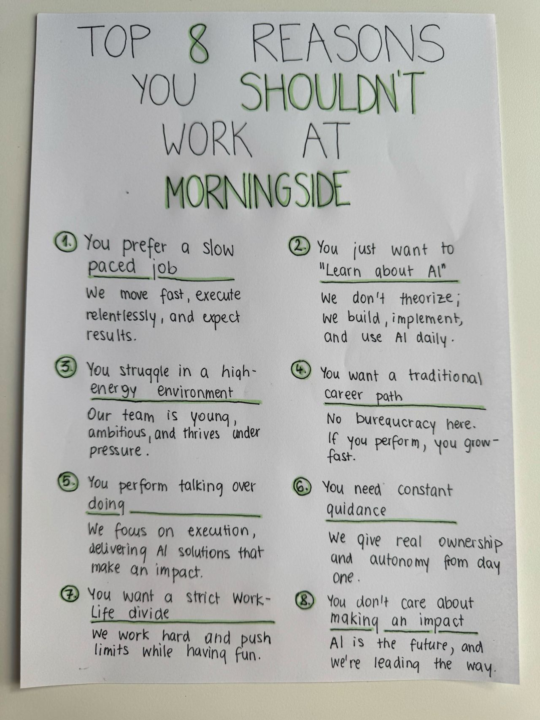
Pinned

⭐
May '25 •
Must Read for Anyone Starting an AI Business
Hey everyone 👋 I want to make sure you’re truly using what’s inside the Classroom here on Skool — because it isn’t just theoretical content. It’s the proven starting point for building an AI service business in 2026, based on everything I've learned scaling my own 7-figure AI agency. When I first launched my business back in 2022, I was figuring things out in the dark — long days, trial and error, and a lot of mistakes before the real patterns finally emerged. Since then, I’ve worked with 7, 8, and 9-figure clients, helped thousands of people start AI agencies, and studied what separates the people who succeed from the ones who stall. And now the data is clear: There are TWO proven paths people are using to break into AI. All you have to do is choose the path that fits how you think and work. That’s why the very first thing you should do here is go to the Start Here module inside the Classroom. Inside it, you’ll find: - A clear breakdown of the two proven paths - Clarity on how to pick the one that fits you best - Then you'll find your playbook to land your first paid client fast Everything I wish I had when I started — the frameworks, playbooks, lessons, and action plans — is inside this Classroom. And I continue to update it based on what’s working right now. It’s all here for you, step by step. Don’t let this sit in your dashboard like another course. This is the stuff I lived to be where I am right now. If you aren't already, make sure you're following/subscribed to me for my latest content to help you on your journey: → Main Channel: https://www.youtube.com/@LiamOttley → VLOG Channel: https://www.youtube.com/@LiamOttleyVLOGs → Instagram: https://www.instagram.com/liamottley/ → X: https://twitter.com/liamottley_

4d •
What's one AI tool you stopped using after all the hype?
Not because it was bad. Because it simply didn't fit the way you work. I think we're at a point where there are new AI tools launching almost every day. Some genuinely improve how we build. Others are exciting for a week... then quietly disappear from our workflow. For me, the biggest difference isn't whether a tool is "the best." It's whether it consistently helps solve real problems. I'm interested to hear from people actually building things. What's one AI tool you tried, thought would become part of your daily workflow, but eventually stopped using? And what made you move away from it?

13h •
An agent that sets you up, teaches you, and builds the AIOS with you
Hi all. Most of you know the AIOS concept, so I'll skip the basics and get into what I built and where I want your feedback. It's heavily inspired by ICM, OKF, and the LLM Wiki work. The shared idea across all three: keep the business as plain, structured, human-readable files (markdown), not a vector DB, so any model can load and reason over the whole thing directly, and so the owner keeps their system instead of renting it. Everything else follows from that. It's your whole business (context, clients or customers, services, workflows, knowledge) as one open, file-based system that any AI can run. You download it and own it, no subscription, provider-agnostic. The autonomous agent is the piece I care most about, and it does two jobs: - Onboarding: a conversation that builds your structure and context as you talk. It replaces the slow manual interview, and the familiarity you build during setup carries straight into using it. - Ongoing assistant: the same agent teaches you the system, builds and updates your skills, runs skills on demand or on a schedule, and pulls from connected tools. Text-first throughout. Some design decisions: - Skills you build and run, not a fixed roster of agents. Easier to grow, version, and maintain. - A shared engine plus per-vertical content packs, so the same system adapts to different businesses without forking. Provider-agnostic model routing, so you can point it at whatever model you want. - Where it's at. I run my marketing agency on it, and I'm now offering it to owners in the 4 verticals I know best (agencies, home services, ecommerce, personal services). I'm actively improving it as I learn from each build. What I'd love feedback on: - The file-native, no-vector-DB bet. Where does it stop scaling? Agent-led onboarding as a pattern. Better or worse than a form plus templates? - Skills-as-capability vs an agent swarm for the ongoing assistant. What would you need to see to trust this to run real parts of your business?

4d •
Honestly.
Hey everyone, It's been a few months since I've posted here. During that time, I've been doing a lot of thinking about where I actually want my career to go. I got into the AI space because of how exciting everything was and, honestly, because of all the hype. But over the last few months, I've realized something about myself: I don't get the same excitement from AI as I do from writing software. Whenever I'm coding, I completely lose track of time. Solving problems, building applications, and writing clean code genuinely makes me happy. It's one of the few things that gives me that feeling of wanting to keep going for hours. I think I reached a point where I felt overwhelmed trying to keep up with how fast AI is moving. Instead of enjoying the process, I started feeling like I was constantly behind, and eventually I stepped away to focus more on school. Now I'm wondering if this is a sign that I should lean into software engineering instead of trying to force myself into AI. For those of you who've been in tech longer: - Have you ever realized you were pursuing something because of the hype rather than genuine interest? - If you discovered you enjoyed software engineering more than AI, would you fully commit to it or keep one foot in both worlds? - Would you pivot your personal brand, including LinkedIn, or would you keep AI as part of your profile? I'd really appreciate hearing your experiences. Thanks in advance! (Though am still a cadet and it's my major in the university)
1-30 of 78,843

skool.com/learn-ai
Learn and become genuinely proficient in AI to get paid for it. From the creators of the AI Automation Agency model.
Leaderboard (30-day)
1

+396
2

+368
3
+357
4

+270
5

+245
Powered by