

12h •
The RESET: DAY ONE POST ONE
We Reset OURSELVES First Before we touch the kids, we touch ourselves. You cannot build a system in your home from a broken, depleted, dysregulated place. A lot of parents come into a reset week fired up ready to make charts, post schedules on the fridge, and announce new rules at dinner. And by Wednesday everything has fallen apart. Not because the system was bad. Because the person trying to run the system never reset first. So today before we talk about your children we talk about YOU. Reset your mind. What have you been telling yourself about your home? About your children? About yourself as a parent? "My kids are out of control." "Nothing I do works." "I've tried everything." "I'm failing." Those thoughts are running in the background like apps draining your battery. And they are affecting every decision you make before you even open your mouth. Today, replace them. Write down three things that are actually working in your home. Three. No matter how small. Find them and write them down. We are recalibrating your starting point. Reset your body. You cannot parent well chronically exhausted. This week pick one thing. Sleep 30 minutes earlier. Drink water before coffee. Take 10 minutes alone before the house wakes up. Just one thing. For your body. This week. Reset your spirit. Before the house gets loud today...get quiet first. Five minutes. Just you and God. Not a long devotional. Not a whole prayer list. Just God I need you today. Show me what to do. Give me patience where I have none. Lead me. That is enough. Reset your standard. Decide TODAY what you will and will not accept in your home this week. Write it down. Put it somewhere you can see it. Not for your children yet. For YOU. So that when the moment comes you are not making decisions from emotion you are making them from a decision you already made in the calm. YOU first. Then the house. Until next time.... stay positive. 🧡
Jun 1 •
Hard Conversations: Death
Nobody wants to be the parent who sat their child down and explained that people die. It feels like stealing something. Like the moment you say it you've taken their innocence and you can never give it back. So most parents wait. They change the subject. They say grandma "went to sleep." They say the dog "went to a farm." They deflect, delay, and distract hoping the question goes away on its own. But here is what happens when we never talk about death: Our children experience it for the first time without any framework. Without language. Without God in the conversation. In the middle of a crisis when they are already devastated they have to figure out what death means all by themselves. And what they figure out on their own is almost never accurate. Almost never peaceful. And almost never anchored in faith. Here is the truth Talking about death does not traumatize your child. Being unprepared for it does. A child who has been taught what death is in a calm, age-appropriate, God-centered way is a child who has something to hold onto when it actually happens. They know where believers go. They know it is not the end. They know they can grieve AND still have hope. That is a gift. And it starts with a conversation you have before you need to. Did anyone ever talk to you about death growing up? How did that or the absence of it shape how you've handled it with your own children? Drop it below. 🌙 Tonight — Im am giving you the actual words to use. What do you say when your child asks "What happens when you die?" We're breaking it down by age.
25d •
What Does an Emotionally Healthy Child Actually Look Like?
When you picture a well-behaved child, what do you see? Quiet. Compliant. Doesn't talk back. Does what they're told. Sits still. Doesn't make a scene. When you picture an emotionally healthy child, what do you see? Most parents pause at that question. Because we were never taught the difference. We were raised to produce behavior. To make children look right on the outside. And nobody talked about what was happening on the inside. So today we are starting this series by defining what we are actually building toward. Because emotionally healthy is not the same as emotionally soft. And understanding your child's feelings is not the same as letting them run your house. We are going to cover ALL of that this week. But today let's define the goal. An emotionally healthy child is not a child who never feels. It is a child who knows what they feel, can name it, can manage it, and knows how to bring it to God and to a trusted adult. WHAT EMOTIONALLY HEALTHY LOOKS LIKE BY AGE AGES 2–5: They can say 'I'm mad' instead of hitting. They can say 'I'm scared' instead of melting down at bedtime. They recover from a tantrum within a reasonable time when redirected. They accept comfort from a trusted adult. They still have big feelings. But they are beginning to have language for them. AGES 6–9: They can identify more than just mad, sad, happy. They are starting to say things like 'I feel left out' or 'I feel embarrassed.' They can calm themselves down with tools you have given them. They come to you with problems instead of always shutting down or exploding. They still have hard moments. But they bounce back and they talk. AGES 10–13: They can sit with an uncomfortable feeling without it controlling their behavior. They understand that feelings are information, not permission slips. They can disagree with you without disrespecting you. They know how to pray about what they feel. They are developing self awareness. And they are watching YOU to learn how to use it. TEENS: They can regulate in high pressure situations, not perfectly, but they have tools. They can identify when they need space and ask for it appropriately. They can repair a relationship after conflict. They know the difference between what they feel and what is true.
22d •
Meltdowns, Shutdowns & Explosions — What Is Actually Happening & What To Do
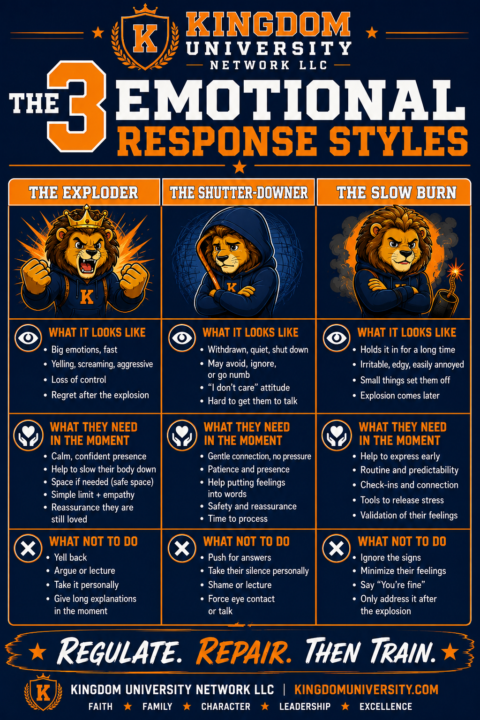
Your child just lost it. Full meltdown. Tears. Screaming. Or maybe the opposite, complete shutdown. Won't speak. Won't move. Blank face. And you are standing there trying to figure out what just happened and what do I do right now. Today we are going to break down what is actually happening in your child's brain and body when they hit that wall. And then I am going to give you a real plan for what to do in the moment AND after. Because how you respond in that moment either builds the bridge or burns it. WHAT IS ACTUALLY HAPPENING IN THEIR BRAIN When your child hits emotional overload their brain does something called an amygdala hijack. The amygdala is the part of the brain that processes threat and emotion. When it gets flooded it takes over. And the prefrontal cortex, the part responsible for reasoning, decision making, and self control — goes offline. In plain language: when your child is in a full meltdown they literally cannot think clearly. The rational brain has left the building. This is not an excuse. But it IS important information. Because trying to reason with a child in the middle of a meltdown is like trying to have a conversation with someone who is underwater. They cannot hear you the way you need them to. You have to help them surface first. Then you teach. THE THREE RESPONSE STYLES — WHICH ONE IS YOUR CHILD? THE EXPLODER: Everything comes out. Loud. Physical. Tears. Screaming. Sometimes throwing things. This child has big feelings and a low threshold for containment. The feeling hits and it comes right out. What they need: A parent who stays regulated. Calm, firm, present. Not matching their energy. Not shutting them down with force. Steady. THE SHUTTER-DOWNER: Goes completely quiet. Checks out. Won't respond. Blank face. This is not calm, this is a nervous system that has decided connection is unsafe and has gone into protection mode. What they need: Gentle, patient presence. No pressure to talk immediately. 'I'm right here. Take your time. I'm not going anywhere.' This child needs to know safety is still available before they can re-engage.
Apr 4 •
Post 12: My exact systems
This is the exact system I’ve been using in my home for the past 3 years. And I’m telling you right now…it works. Not sometimes. Not when I feel like it. When it’s applied consistently it works. This is the system behind: ✔ why I don’t have to keep repeating myself ✔ why I don’t have to raise my voice ✔ why my children know I mean what I say ✔ why my follow-through is strong This system has also worked for 50+ parents I’ve shared it with. This system will not work if: ❌ you’re inconsistent ❌ you don’t follow through ❌ you give up when it gets hard Because the system isn’t magic.… YOUR consistency is what makes it work. So if you’re ready… CHANGE how your home operates. https://www.thejourneytofindgod.com/build-structure-now

1-30 of 90

skool.com/kingdom-university-1883
A welcoming faith-based hub for Kingdom parents, teens, and kids: Bible lessons, life skills, and emotional growth, all in one community.
Leaderboard (30-day)
1

+42
2

+35
3

+30
4

+29
5

+26
Powered by