
Write something

Jul 21 •
New video is live — and this one is worth watching.
Yesterday I posted a new video on the Junk Raider YouTube channel breaking down some real-world lessons for junk removal operators. This one is especially valuable if you’re trying to figure out how to grow faster, price better, avoid rookie mistakes, and think more like a real operator instead of just “a guy with a truck.” The big takeaway: You don’t need to have everything figured out to build a serious junk removal business — but you do need to pay attention to the right things early. In the video, I talk through practical lessons around: - getting customers - pricing jobs - building trust - using ads wisely - creating a better customer experience - thinking beyond just the next pickup Give it a watch when you get a chance, and drop a comment with the biggest takeaway or question you had. Here’s the video: https://youtu.be/l5LznwpoHa4 Let’s keep building. One job, one lesson, one win at a time. 💪
0
0
Jul 3 •
📣 New Drop: What To Pay Your Junk Removal Team (+ FREE Operator's Pay Guide)
Hey team - just posted a new video breaking down one of the questions I get asked the most: "What should I actually be paying my crew?" If you haven't watched it yet, here's the short version so nobody's blindsided 👇 Underpay and you bleed good people. Pay blind and you bleed margin. In the video I walk through what each role really earns in 2026 - helpers, drivers, crew leaders, dispatchers, ops managers - and the pay model that keeps your best people without wrecking your numbers: base + tips + bonus. Then I break down 3 bonus structures you can steal, and the 2-3 KPIs to tie them to. And it's yours free: I put the whole thing into a one-page Team Pay & Bonus Kit — pay ranges by role, the 3 bonus structures, and a monthly KPI scorecard. There's a fillable version too, so you can drop in your own numbers and print it for the shop wall. Grab the guide below (both versions attached). Watch the video, download the kit, and drop a comment: what do you currently pay your crew? Let's compare notes. Ted
0
0
Jun 26 •
New Training: How To Land Commercial Junk Removal Accounts
I just uploaded a new training on something I think every junk removal owner should be taking seriously: Commercial accounts. Residential jobs are great, and they can keep the phone ringing, but commercial accounts are where the game starts to change. Contractors.Property managers.Storage facilities.Apartment communities.Warehouses.Retail stores.Office cleanouts.Municipal work. These are the types of relationships that can create bigger jobs, repeat work, and more predictable revenue. In this training, I walk through a real case study from Junk Raider where a simple cold outreach sequence — literally two emails — opened the door to a new commercial contractor relationship. But the bigger point is not “look what I did.” The point is this: You can do the same thing in your market if you know who to target, what to say, and how to follow up. Inside the video, I cover: ✅ Why commercial accounts are so valuable ✅ Why most owners avoid them ✅ The best types of commercial prospects to target ✅ How to find decision makers locally ✅ What to say in the first email ✅ How to follow up without being annoying ✅ What to say when they respond ✅ How to turn one relationship into repeat revenue Here’s my challenge for everyone in here (where applicable): This week, pick one commercial category in your market. Examples: - General contractors - Remodelers - Apartment communities - Storage facilities - Property managers - Flooring companies - Restoration companies - Office parks - Warehouses Then find 10 real prospects and send a simple, local, specific outreach message. Do not overthink it. Comment below with: 1. What category you’re targeting 2. What city/market you’re in 3. What your biggest hesitation is with commercial outreach I ’ll help you tighten up your approach.
0
0
Jun 25 •
How Would You Price This Job?
Let’s say this lead comes in today: Customer says they have a “small garage cleanout.” Then they send photos and you see: - Loose boxes everywhere - Black bags stacked in the corner - Old furniture - A few heavier items - Tight driveway - Truck can’t back directly up to the garage - Customer says, “It shouldn’t take long.” Here’s the question: Are you quoting it by photos, scheduling a free onsite estimate, or passing altogether? My opinion: This is where a lot of junk removal businesses get burned. The customer says “small.”The photos say “maybe.”The job says, “You better ask better questions.” Before I price this, I want to know: 1. Can the truck get close? 2. Is everything in the garage, or is there more inside? 3. Are the bags light household trash or heavy construction debris? 4. Are there stairs, long carries, or tight access? 5. Are they looking for the cheapest guy or the right guy? A “small” job with bad access, loose items, heavy debris, and unrealistic expectations can turn into a profit killer fast. Rule of thumb: Photos help you quote faster. Questions help you quote smarter. Onsite confirmation protects your profit. What would you do? Quote by photo?Go onsite first?Pass? Drop your answer below.
0
0

Jun 23 •
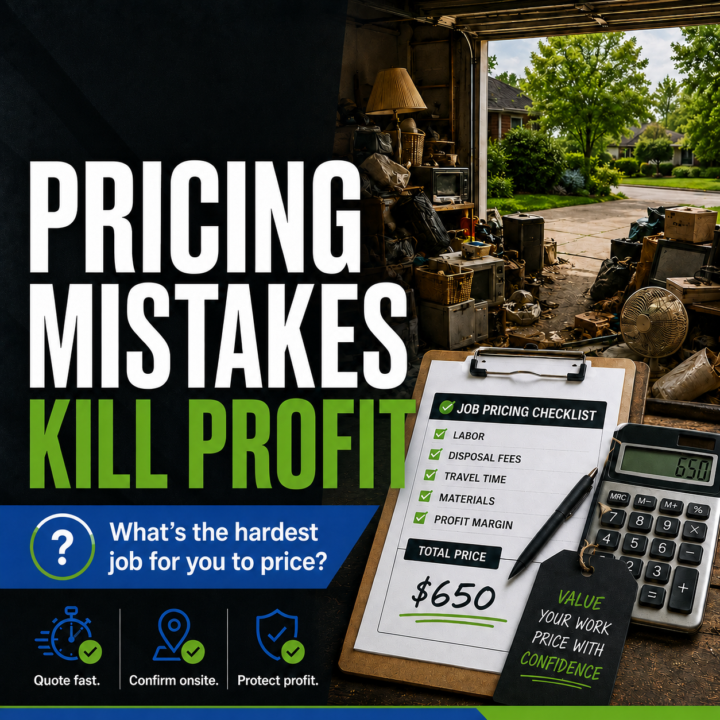
What’s the hardest job for you to price?
One of the biggest mistakes I see in junk removal (and home services) is pricing jobs based only on what you see. That’s how you get burned. A job is not just: “How much space does it take up?” It’s also: - How heavy is it? - How far is the truck from the job? - Are there stairs? - Is it loose miscellaneous stuff? - Is there demo debris? - What are the dump fees? - How long will it tie up your crew? - Is there any risk, access issue, or hidden labor? A half truck of couches is not the same as a half truck of concrete. Same volume.Completely different job. One pricing mistake can turn what looks like a good job into a break-even job… or worse, a loser. Here’s my basic rule: Quote fast. Confirm onsite. Protect profit. When possible, we use photos to give a price range, not an exact price. Something like: “Based on the photos, you’re probably between $225 and $300. Once we arrive and see everything in person, we’ll confirm the final price before we touch anything.” That one sentence protects your business and still gives the customer what they want: a realistic idea of cost. Now I’m curious: What type of job is hardest for you to price? Garage cleanouts? Construction debris? Hot tubs? Pianos? Sheds? Estate cleanouts? Concrete? Something else? Drop it below and I’ll break down how I’d think through it.
0
0
1-9 of 9
powered by

skool.com/junk-raider-university-9923
Real systems from an operator who started from scratch. 8+ years. Multi-Million Dollar Business. No guru BS, just what actually works in junk removal.
Suggested communities
Powered by