
Write something
Pinned

Jun 24 •
Welcome!
I'm so glad you're here. My name is Joy, and I've spent my career teaching literacy across multiple grade levels—from Pre-K through graduate school. I've served as an English Teacher and a Secondary Academic Specialist focused on literacy, and I want to share what the research says about Literacy with Secondary students. I earned my PhD in Curriculum Studies with a research focus on teacher professional learning through social media. Kind of makes sense I'd be here now, right? Communities like this serve as a third space where we can come together across different districts, which is so important in the interconnected world we live in. I created this community because I believe secondary teachers deserve a place where research meets reality. There is no shortage of literacy advice online. What teachers need is clarity about what strategies are research tested and which work in practice. Lets have some honest conversations about what works and help each other out. Community Guidelines 1. Be respectful and supportive. 2. Share ideas, not personal attacks. 3. Focus on evidence, experience, and solutions. 4. Keep discussions student-centered. 5. Help others when you can—we all learn together. Let's Start a Conversation What is the biggest literacy challenge you're facing right now? Is it reading comprehension? Writing instruction? Student motivation? Vocabulary? Something else? I'd love to hear what's on your mind. Introduce yourself in the comments and tell us: • Your role (teacher, coach, administrator, parent, etc.) • What grade level(s) you work with • Where you're joining from • One literacy challenge you'd like help solving this year Welcome to the community—I can't wait to learn alongside you!
0
0
Jul 8 •
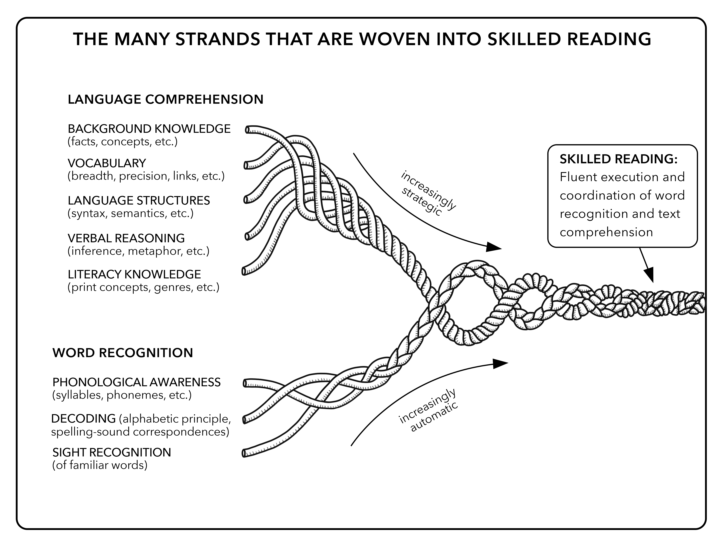
Scarborough’s Rope: Putting it All Together.
When many educators see Scarborough's Reading Rope, they assume it's just a model for teaching young children. Instead, think of it as a model for understanding all skilled reading, including why some adolescents continue to struggle. The rope is made up of two groups of strands that become stronger over time. Word Recognition - Decoding - Sight recognition through orthographic mapping - Reading fluency Language Comprehension - Background knowledge - Vocabulary - Language structures - Verbal reasoning - Literacy knowledge As these strands become stronger and more tightly woven together, reading becomes increasingly automatic and meaningful. This is why two ninth-grade students can both struggle with the same text for completely different reasons. One student may still be laboring to decode unfamiliar words. Another may read fluently but lack the vocabulary, background knowledge, or language skills needed to understand the author's message. If either strand is weak or fraying, reading becomes difficult. Both students are struggling readers who need support. But they do not need the same intervention. Identifying the need and pairing them with appropriate strategies is essential for their growth. Scarborough's Reading Rope reminds us that reading isn't one skill. It's the result of many skills working together.The stronger each strand becomes, the stronger the reader becomes. Lab Takeaway: When an adolescent struggles with reading, don't ask, "What's wrong with this student?" Ask, "Which strand of the rope needs strengthening?" Discussion: Which strand do you think is most often overlooked in middle and high school classrooms, and why?
0
0
Jul 6 •
Reading Difficulty is Not an Intelligence Problem
One of the biggest misconceptions in education is that struggling readers aren't capable of complex thinking. Nothing could be further from the truth. I've worked with students who could solve complicated problems, carry on thoughtful conversations, and ask insightful questions but struggled to read a grade-level passage. This is because reading is not a measure of intelligence. It is a learned skill that depends on developing many smaller skills that work together over time. When one of those skills is weak—whether it's decoding, fluency, vocabulary, or language comprehension—reading becomes much harder. That doesn't mean the student isn't intelligent. It means the student needs instruction that targets the specific barrier. As educators, one of the greatest gifts we can give struggling readers is refusing to confuse reading ability with thinking ability. Lab Takeaway: A student's reading struggle tells us where they need support—not how much they're capable of learning. Discussion: What's one strength you've seen in a student who also struggled with reading?
0
0
Jul 3 •
Reading Fluency: It’s Not a Race
When teachers hear the word fluency, many picture a student reading as fast as possible. That's one of the biggest misconceptions about reading fluency. Fast isn't the goal. Appropriate is the goal. A fluent reader reads at a pace that allows the words to come naturally. They should read without so much effort that decoding consumes all of their mental energy. If a student has to labor over every word, their brain is busy decoding instead of understanding. If they're rushing through the text without thinking, they're not constructing meaning either. The goal of fluency is accurate, expressive reading at a pace that supports comprehension. That's why fluency isn't an end in itself. It's the bridge between decoding words and making meaning from them. When students no longer have to devote most of their mental energy to figuring out the words, they have the cognitive capacity to think, question, infer, and learn. Lab Takeaway: Fluency isn't about reading faster. It's about making decoding effortless enough that the brain can focus on comprehension. Discussion: Have you ever had a student who could read quickly but understood very little, or a student who slowed down and actually comprehended more? What did you notice?
0
0
Jul 2 •
Working Memory- The Brain’s Sticky Note
Have you ever noticed a student who can decode every word on the page but by the end of the paragraph, they can't remember what they just read? It isn't always because they weren't paying attention. Sometimes, their working memory is overloaded. Working memory is like your brain's sticky note. It temporarily holds information while you're using it. When students are using most of that mental energy to decode words, figure out vocabulary, or untangle complex sentences, there's very little capacity left to make meaning. That's why reading can feel exhausting for struggling readers. As teachers, we can reduce that cognitive load by: -Preteaching key vocabulary -Activating background knowledge -Breaking complex texts into manageable chunks -Stopping to check for understanding before students become overwhelmed When we lighten the mental load, comprehension becomes much easier. Lab Takeaway: Reading isn't just about effort—it's about cognitive capacity. What have you found helps students stay mentally engaged with a challenging text without becoming overwhelmed?
0
0
1-12 of 12
powered by
skool.com/joys-group-4945
Join a community focused on secondary education and turning evidence into action, building literacy momentum, and helping every student grow.
Suggested communities
Powered by