
Write something
Pinned

Feb 21 •
Disclaimer
⚠️ Disclaimer I am not a licensed financial adviser or professional. The information shared in these videos is based on my personal experience and my own investing journey with ETFs and is intended for general educational purposes only. This content does not take into account your personal financial situation, objectives, or needs. Please do your own research and consider seeking advice from a qualified Australian financial professional before making any financial decisions.
0
0
Pinned
Feb 8 •
Introduction
Hi Everyone. I'm Renee, 47 at the moment and have a beautiful wonderful son aged 7. I live in Brisbane, Australia. I’m learning how to invest sensibly as a mum, and I’m sharing everything I learn — the wins and the mistakes so we can grow together. Why am I interested in investing you might ask? Well, the property market is out of reach for most people at the moment and I thought I would look at alternatives. That's where I thought about investing, in particular ETFs.
1
0
Pinned
Feb 22 •
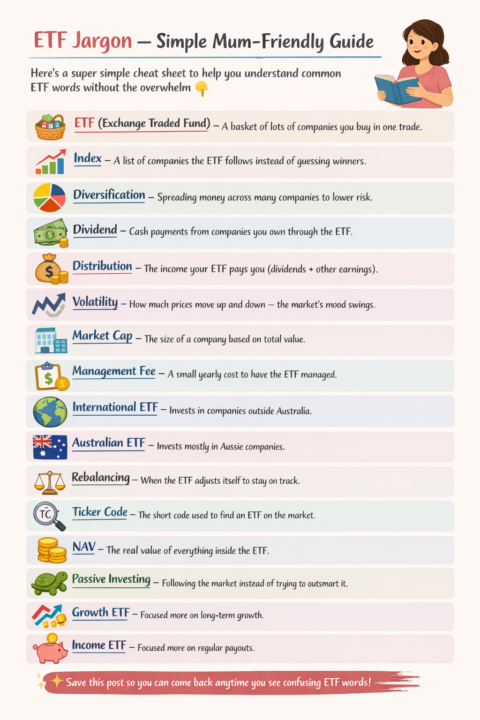
ETF Jargon Cheat Sheet
Here’s a super simple cheat sheet to help you understand common ETF words without the overwhelm. There's also a graphic you can save and download. 👇 👉 ETF (Exchange Traded Fund) — A basket of lots of companies you buy in one trade. 👉 Index — A list of companies the ETF follows instead of guessing winners. 👉 Diversification — Spreading money across many companies to lower risk. 👉 Dividend — Cash payments from companies you own through the ETF. 👉 Distribution — The income your ETF pays you (dividends + other earnings). 👉 Volatility — How much prices move up and down — the market’s mood swings. 👉 Market Cap — The size of a company based on total value. 👉 Management Fee — A small yearly cost to have the ETF managed. 👉 International ETF — Invests in companies outside Australia. 👉 Australian ETF — Invests mostly in Aussie companies. 👉 Rebalancing — When the ETF adjusts itself to stay on track. 👉 Ticker Code — The short code used to find an ETF on the market. 👉 NAV — The real value of everything inside the ETF. 👉 Passive Investing — Following the market instead of trying to outsmart it. 👉 Growth ETF — Focused more on long-term growth. 👉 Income ETF — Focused more on regular payouts. 👉 Asset Allocation — How you split money across investments. 👉 Risk Tolerance — How comfortable you are with ups and downs. ✨ Save this post so you can come back anytime you see confusing ETF words!
0
0
Feb 22 •
Investing in ETF's for Our Children
I have started investing for my son who is 7 this year. We receive money from his Grandparents for him and I decided to invest it. Currently I invest with Betashares. Link: https://www.betashares.com.au/direct/account-types/kids-account Disclaimer: I have no affiliation with Betashares. It is a personal preference I have as I find it very easy to use.
0
0

Feb 22 •
Investing for Mum's
Investing safely as a mum involves prioritizing financial stability, reducing high-interest debt, and using automation to build long-term wealth without taking excessive risks. Key strategies include diversifying investments, leveraging tax-advantaged accounts like superannuation (in Australia), using mortgage offsets, and, for many, focusing on low-cost, broad-market Exchange Traded Funds (ETFs). Here is a guide to investing safely for us mums, focused on practical, manageable steps. 1. Build a Solid Financial Foundation Before investing, ensure your household is secure: - Establish an Emergency Fund: Aim for 3 to 6 months of expenses in a high-yield savings account or money market fund. - Eliminate "Bad" Debt: Pay off high-interest debt (credit cards, personal loans, BNPL) first. Paying off 20% interest debt is equivalent to a 20% guaranteed return on investment. - Budgeting: Use the 50/30/20 rule (50% needs, 30% wants, 20% savings/investments) to automate savings. 2. Low-Risk Investment Options For safety, focus on investments with lower volatility and capital protection: - High-Yield Savings & CDs: FDIC-insured (or equivalent) accounts offer guaranteed returns with no risk to capital. - Government Bonds/Securities: Considered among the safest investments, offering steady, predictable returns. - Blue-Chip Dividend Stocks: Investing in established companies with a history of paying dividends provides income and potential growth. - Mortgage Offset Account: If you have a mortgage, directing spare cash into an offset account provides a "risk-free" return equal to your mortgage interest rate. 3. Smart Investment Vehicles for Mums - Superannuation (Australia): Topping up your super is highly tax-effective (15% tax), making it a powerful, long-term wealth builder, though the funds are locked away until retirement. - ETFs (Exchange Traded Funds): These allow you to buy a "basket" of shares, offering instant diversification across many companies, which reduces risk. - Micro-Investing Apps: These apps allow you to start with small amounts of money (e.g., $500 or even spare change), making it easy to build a habit. - Investment Bonds: These are tax-paid investments that can be useful for higher-income earners to avoid higher personal tax rates.
0
0
1-13 of 13
powered by
skool.com/investing-safely-for-mums-7149
A safe beginner space where mums learn ETFs step-by-step — no jargon, no pressure, just learning together.
Suggested communities
Powered by