Activity
Mon
Wed
Fri
Sun
Jun
Jul
Aug
Sep
Oct
Nov
Dec
Jan
Feb
Mar
Apr
What is this?
Less
More
Owned by Renee
A safe beginner space where mums learn ETFs step-by-step — no jargon, no pressure, just learning together.
Memberships
AI Automation (A-Z)
153.4k members • Free
Skoolers
193.1k members • Free
MI
Moment in God’s Word
81 members • Free
13 contributions to Investing Safely for Mums

Feb 22 •
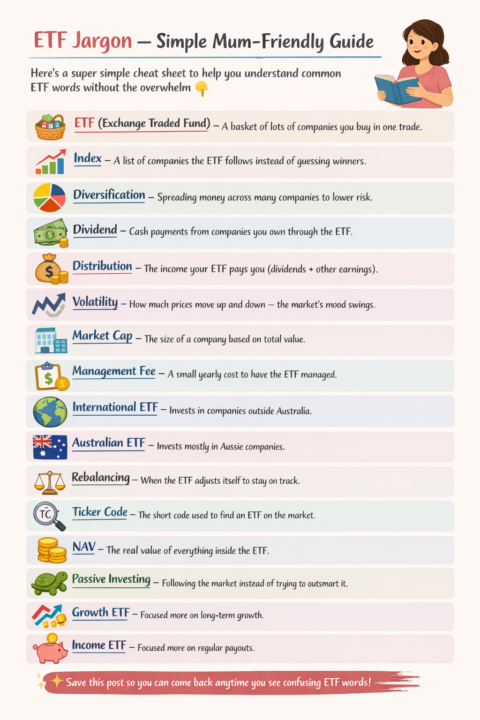
ETF Jargon Cheat Sheet
Here’s a super simple cheat sheet to help you understand common ETF words without the overwhelm. There's also a graphic you can save and download. 👇 👉 ETF (Exchange Traded Fund) — A basket of lots of companies you buy in one trade. 👉 Index — A list of companies the ETF follows instead of guessing winners. 👉 Diversification — Spreading money across many companies to lower risk. 👉 Dividend — Cash payments from companies you own through the ETF. 👉 Distribution — The income your ETF pays you (dividends + other earnings). 👉 Volatility — How much prices move up and down — the market’s mood swings. 👉 Market Cap — The size of a company based on total value. 👉 Management Fee — A small yearly cost to have the ETF managed. 👉 International ETF — Invests in companies outside Australia. 👉 Australian ETF — Invests mostly in Aussie companies. 👉 Rebalancing — When the ETF adjusts itself to stay on track. 👉 Ticker Code — The short code used to find an ETF on the market. 👉 NAV — The real value of everything inside the ETF. 👉 Passive Investing — Following the market instead of trying to outsmart it. 👉 Growth ETF — Focused more on long-term growth. 👉 Income ETF — Focused more on regular payouts. 👉 Asset Allocation — How you split money across investments. 👉 Risk Tolerance — How comfortable you are with ups and downs. ✨ Save this post so you can come back anytime you see confusing ETF words!
0
0
Feb 22 •
Investing in ETF's for Our Children
I have started investing for my son who is 7 this year. We receive money from his Grandparents for him and I decided to invest it. Currently I invest with Betashares. Link: https://www.betashares.com.au/direct/account-types/kids-account Disclaimer: I have no affiliation with Betashares. It is a personal preference I have as I find it very easy to use.
0
0

Feb 22 •
Investing for Mum's
Investing safely as a mum involves prioritizing financial stability, reducing high-interest debt, and using automation to build long-term wealth without taking excessive risks. Key strategies include diversifying investments, leveraging tax-advantaged accounts like superannuation (in Australia), using mortgage offsets, and, for many, focusing on low-cost, broad-market Exchange Traded Funds (ETFs). Here is a guide to investing safely for us mums, focused on practical, manageable steps. 1. Build a Solid Financial Foundation Before investing, ensure your household is secure: - Establish an Emergency Fund: Aim for 3 to 6 months of expenses in a high-yield savings account or money market fund. - Eliminate "Bad" Debt: Pay off high-interest debt (credit cards, personal loans, BNPL) first. Paying off 20% interest debt is equivalent to a 20% guaranteed return on investment. - Budgeting: Use the 50/30/20 rule (50% needs, 30% wants, 20% savings/investments) to automate savings. 2. Low-Risk Investment Options For safety, focus on investments with lower volatility and capital protection: - High-Yield Savings & CDs: FDIC-insured (or equivalent) accounts offer guaranteed returns with no risk to capital. - Government Bonds/Securities: Considered among the safest investments, offering steady, predictable returns. - Blue-Chip Dividend Stocks: Investing in established companies with a history of paying dividends provides income and potential growth. - Mortgage Offset Account: If you have a mortgage, directing spare cash into an offset account provides a "risk-free" return equal to your mortgage interest rate. 3. Smart Investment Vehicles for Mums - Superannuation (Australia): Topping up your super is highly tax-effective (15% tax), making it a powerful, long-term wealth builder, though the funds are locked away until retirement. - ETFs (Exchange Traded Funds): These allow you to buy a "basket" of shares, offering instant diversification across many companies, which reduces risk. - Micro-Investing Apps: These apps allow you to start with small amounts of money (e.g., $500 or even spare change), making it easy to build a habit. - Investment Bonds: These are tax-paid investments that can be useful for higher-income earners to avoid higher personal tax rates.
0
0
Feb 22 •
MooMoo(No Affiliation)
Here is another platform I use. I don't invest in MooMoo yet, but I use it to research. MooMoo website: https://www.moomoo.com/au A Guide to MooMoo: https://youtu.be/V8uBlP9p_GA?si=oiau5pGunguRceC4
0
0
Feb 22 •
Betashares (No Affiliation)
Hi All, Here are some video links on Betashares to give you an idea. Betashares Website: https://www.betashares.com.au/ Betashares Intro Video: https://youtu.be/5hGac_ztQa0 How to Video: https://www.youtube.com/watch?v=2Yn1XnieAf0
0
0
1-10 of 13