

Feb 16 •
Call Recap: LinkedIn Funnel Debugging
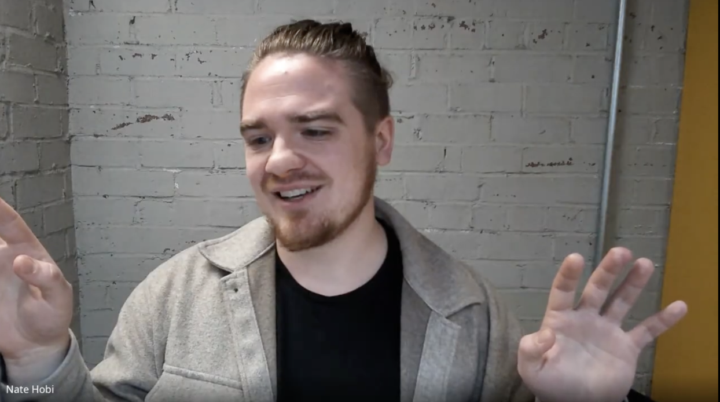
Today’s call was 🔥 — because we hit three things that unblock people fast: 1) How to “map” a messy system design question into a framework Example from the call: “Two users in the same region… same internet… one gets fast load, the other lags… where’s the bottleneck?” Instead of answering like a developer (“I’d start debugging…”), we re-mapped it into a system design prompt: - Functional requirement: the page loads reliably - Non-functional requirement: consistent latency / performance - Then: walk through system components (LB, routing strategy, unhealthy host, etc.) Key move: turn scenario → requirements → components → hypotheses. That’s how you stay calm, structured, and drive the interview. 2) “Don’t keyword shove” — lead with structure, not buzzwords System design interviews usually go high-level → narrow. So your goal early isn’t to flex terminology — it’s to show you can: - clarify requirements - propose a sensible architecture - explain tradeoffs simply 3) We also did funnel debugging on outreach campaigns and found a common issue: If your profile positioning is too general, you’ll get decent acceptance on broad outreach……but company-specific campaigns (bigger brands) will underperform. Fix = lead with what makes you memorable (not just YOE + tech stack).“Python + 4 YOE” isn’t a differentiator by itself. 👇 What you can steal from this call ✅ If a prompt feels messy → map it into the system design framework ✅ In system design, think in components, not code/debugging ✅ Prioritize real data points (what actually happened in interviews) ✅ Your LinkedIn conversion rate is often a positioning problem, not an outreach problem – Nate 🎥 Replay: https://drive.google.com/file/d/1ra6PBumxJgCDC_4tZEBNLwxas5qEoCpI/view?usp=sharing 📝 Notes: https://docs.google.com/document/d/1dJ0d2QwArcBF1flwTYBXxm3AhHnHFxbEfjsAc6xTS6o/edit?usp=sharing
0
0
Dec '25 •
🎄CCM is in Holiday Mode 🎄
Code Career Mastery is in holiday mode until January 5th ☃️ What this means: - ❌ No group calls this week or next - ❌ No office hours this week or next - ✅ Normal schedule resumes January 5th You’re still welcome to post in the community and engage with each other, just know that responses may be a bit slower during this time ⏰ Appreciate everyone’s momentum this year. Rest up, reflect, and we’ll be back to full speed in January 🚀
4
0

Dec '25 •
🚀 Introducing Code Career AI
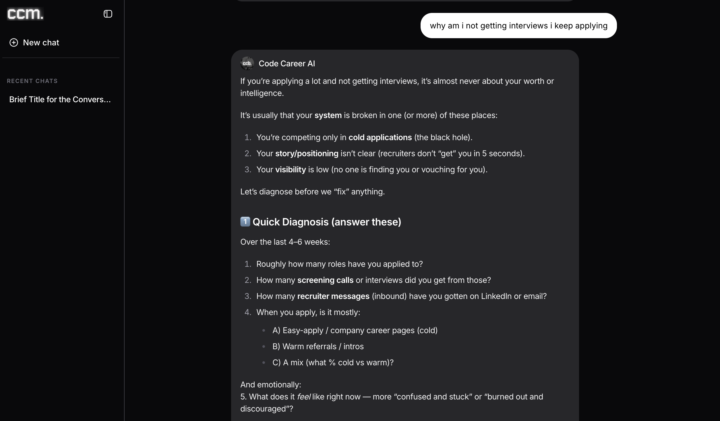
We’re excited to roll out one of the biggest upgrades to CCM yet...a tool designed to make your career growth faster, clearer, and easier: 🔥Code Career AI Your on-demand CCM LLM career coach. This is not a generic chatbot. It’s a career coach trained on the full CCM playbook, including everything we teach about: - Learning DS&A effectively - Building a powerful resume and career narrative - Networking the right way - Handling recruiter screens, HM calls, and panel interviews - Developing confidence, clarity, and momentum You can drop in: - Your resume or project descriptions - Networking messages - Recruiter outreach - DS&A struggles - Coding questions - Job descriptions - Interview prompts …and it will guide you using the exact frameworks we use inside CCM.
Dec '25 •
Code Career AI Feedback 🤖
Use this thread to help us continuously train & give feedback on Code Career AI! We're continuing to improve this over time, so your feedback is super valuable 🚀
1
0

Oct '25 •
Something big coming in Q4...
I have something special to share with you all soon. Behind the scenes, we've been hard at work re-imagining our offer. Faster results, sharper clarity, and somehow even more transformative. Super stoked for you to experience it 🖤 - Nate ✌️
3
0
1-30 of 39
