Activity
Mon
Wed
Fri
Sun
Sep
Oct
Nov
Dec
Jan
Feb
Mar
Apr
May
Jun
Jul
What is this?
Less
More
Owned by Nate
Take control of your code career.
Memberships
91 contributions to Code Career Mastery

Feb 16 •
Call Recap: LinkedIn Funnel Debugging
Today’s call was 🔥 — because we hit three things that unblock people fast: 1) How to “map” a messy system design question into a framework Example from the call: “Two users in the same region… same internet… one gets fast load, the other lags… where’s the bottleneck?” Instead of answering like a developer (“I’d start debugging…”), we re-mapped it into a system design prompt: - Functional requirement: the page loads reliably - Non-functional requirement: consistent latency / performance - Then: walk through system components (LB, routing strategy, unhealthy host, etc.) Key move: turn scenario → requirements → components → hypotheses. That’s how you stay calm, structured, and drive the interview. 2) “Don’t keyword shove” — lead with structure, not buzzwords System design interviews usually go high-level → narrow. So your goal early isn’t to flex terminology — it’s to show you can: - clarify requirements - propose a sensible architecture - explain tradeoffs simply 3) We also did funnel debugging on outreach campaigns and found a common issue: If your profile positioning is too general, you’ll get decent acceptance on broad outreach……but company-specific campaigns (bigger brands) will underperform. Fix = lead with what makes you memorable (not just YOE + tech stack).“Python + 4 YOE” isn’t a differentiator by itself. 👇 What you can steal from this call ✅ If a prompt feels messy → map it into the system design framework ✅ In system design, think in components, not code/debugging ✅ Prioritize real data points (what actually happened in interviews) ✅ Your LinkedIn conversion rate is often a positioning problem, not an outreach problem – Nate 🎥 Replay: https://drive.google.com/file/d/1ra6PBumxJgCDC_4tZEBNLwxas5qEoCpI/view?usp=sharing 📝 Notes: https://docs.google.com/document/d/1dJ0d2QwArcBF1flwTYBXxm3AhHnHFxbEfjsAc6xTS6o/edit?usp=sharing
0
0

Nov '25 •
Respond: Post Your Unique Summary Here
This is where it starts — your professional story, distilled into a few powerful lines. Your summary isn’t about listing tools. I’s about communicating your value, perspective, and unique lens on the work you do. In your comment below, include: - Your specialty — what you do best - Your top affinity — who you connect with naturally (ex. educators, nonprofits, open-source, etc.) - Your previous industry or current vertical (if applicable) — where you’ve built or what you’ve transitioned from Example: Backend developer who thrives in early-stage environments and messy codebases. I’ve worked mostly in FinTech, focusing on API reliability and transaction safety. Former financial analyst — I bring a systems mindset to engineering.
0 likes • Dec '25
@Nimish Vadlamudi it needs to be more clear that your specialty is computational and algorithmic thinking an algorithmic thinker. Including top 5% leetcode does this better than the above.
0 likes • Jan 16
@Sam Wilson FinTech is a good angle here + also I'd say event driven systems is pretty strong too. Are these reflected in your current linkedin title?
Dec '25 •
Introduce Yourself ✌️
What's technology you're stoked about these days? Comment on this post — BUT ALSO tell us where you're from & why you're here! 😎 Feel free to share you're LinkedIn photo and connect with others. Once you introduce yourself, copy the link to your intro and sent it to me on Linkedin
1 like • Jan 7
@Samuel Ngobi amazing to have you Samuel!
1 like • Jan 15
@Hammad Hassan Nice to see you on here! Lets gooo
Dec '25 •
🎄CCM is in Holiday Mode 🎄
Code Career Mastery is in holiday mode until January 5th ☃️ What this means: - ❌ No group calls this week or next - ❌ No office hours this week or next - ✅ Normal schedule resumes January 5th You’re still welcome to post in the community and engage with each other, just know that responses may be a bit slower during this time ⏰ Appreciate everyone’s momentum this year. Rest up, reflect, and we’ll be back to full speed in January 🚀
4
0
Dec '25 •
Ready to take control?
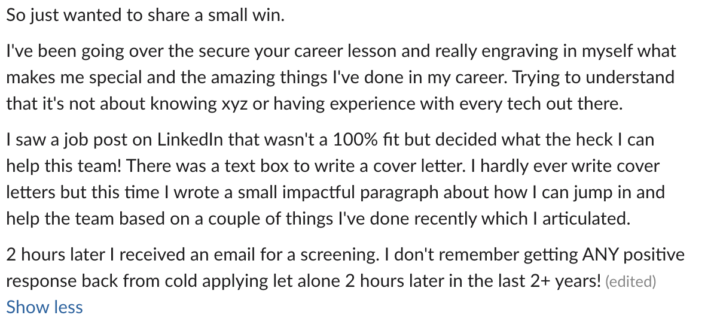
Below is from one of our Accelerator people who recently completed the — "How to Control Your Career" course. It's not sexy because it's not spoon fed box checking and tactics. It requires some thoughtfulness and reflection. But guess what? Once this starts to click... I see people just AUTOMATICALLY doing the things that get them noticed without me having to spell out specifics. From the Accelerator Slack: "So just wanted to share a small win. I've been going over the secure your career lesson and really engraving in myself what makes me special and the amazing things I've done in my career. Trying to understand that it's not about knowing xyz or having experience with every tech out there. I saw a job post on LinkedIn that wasn't a 100% fit but decided what the heck I can help this team! There was a text box to write a cover letter. I hardly ever write cover letters but this time I wrote a small impactful paragraph about how I can jump in and help the team based on a couple of things l've done recently which I articulated. 2 hours later I received an email for a screening. I don't remember getting ANY positive response back from cold applying let alone 2 hours later in the last 2+ years!"
4
0
1-10 of 91

Active 131d ago
Joined Jun 25, 2025
Washington DC