Dec '25 • General discussion
I copied this, still ..
🥋 The Combat Effectiveness of Tai Chi Chuan: From Foundation to Application
1. Introduction
There is no doubt that Tai Chi Chuan (Taijiquan) is a martial art with formidable combat capabilities.
However, many people today question its practical fighting effectiveness — mainly due to the popularization of modern variants.
In reality, the widely 普及 (pǔjí – popularized) forms of Tai Chi, such as the National Standardized Routines or Simplified Tai Chi, were primarily developed to meet the public’s demand for health and fitness.
With this goal in mind, most practitioners focus on strengthening their bodies and improving health — an aim many successfully achieve — while very few pursue combat effectiveness.
Therefore, the genuine martial capability of Tai Chi is now preserved mainly within traditional lineages, where authentic inheritors maintain and transmit its martial essence.
2. Why Combat Skill Was Lost
Unfortunately, many traditional Tai Chi schools have lost the methods for cultivating practical combat skill — in other words, the “real stuff.”
Two main reasons have led to this regrettable situation:
Conservatism: Overly guarding secrets, leading to their eventual disappearance.
Shift in Focus: Neglecting martial training, causing the essential core to be gradually forgotten.
This is not unique to Tai Chi but a common phenomenon in traditional martial arts.
Today, only a minority of true inheritors within traditional lineages still grasp its combat essence.
3. The Training Path to Combat Capability
For Tai Chi to develop real combat ability, a practitioner must first cultivate kung fu (功夫) — skill achieved through time and effort.
So how does one train to develop this kung fu?
The prerequisite is to follow a correct and complete training method.
According to traditional experience, “dead forms” — rigid, mechanical repetition — are not effective.
Even if one becomes proficient in appearance, they may not know how to apply the movements in combat.
When facing an opponent with actual fighting experience, they will easily be defeated.
4. The Complete Tai Chi Training System
A comprehensive and authentic Tai Chi system includes the following components:
Basic Foundation (基本功): The root. Stretches tendons and muscles; ensures correct and precise movement.
Solo Routine (盘架子): The structural framework for practice.
Standing Post (站桩): Builds strength, stability, and internal connection.
Internal Cultivation (内功): Trains internal power and breath control.
Supplementary Exercises (辅助功法): Such as rope training, ball training, etc.
Pushing Hands (推手): Develops sensitivity, responsiveness, and the ability to neutralize force.
Sparring Practice (练对手): Practical combat training.
Each component builds upon the others, forming a progressive pathway from structure to sensitivity, from stability to spontaneity.
5. Correct Method for Practicing the Solo Routine
The basic foundation is the indispensable root.
Practicing the solo routine must not be done “deadly” or mechanically.
“Dead practice” means rigid repetition without spirit or adaptation.
Even decades of this cannot produce practical skill.
For beginners, it is unwise to attempt the entire long routine at once.
Instead, start with individual postures and movements, repeating them until they are thoroughly familiar and skilled.
This is the true entry point. Only then should one progress to more complex sequences.
Equally important is the study of theory — understanding key principles such as:
“Lifting the crown of the head, suspending the perineum.”
“Hollow the chest, round the back.”
The method of whole-body relaxation (放松, fàngsōng).
Concepts like Wuji (无极), Taiji (太极), Liangyi (两仪), Yin-Yang (阴阳), and the Five Elements (五行) are not superstition — they are philosophical foundations that help practitioners understand the inner logic of movement and energy transformation.
6. Yin–Yang Differentiation and the Importance of Low Stances
When practicing the solo routine, a practitioner must train in all three frame heights — high, middle, and low.
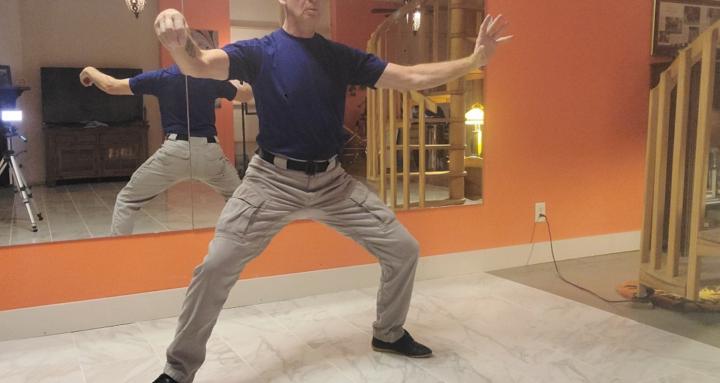
"The low frame mainly builds the root (develops leg strength and stability);
the high frame mainly trains flexibility and sensitivity (particularly in the upper body);
the middle frame integrates the whole body more easily."
Practicing the low frame is physically demanding, but it is also the most direct way to develop true kung fu.
Persistent low-stance practice naturally develops relaxation, groundedness, vitality, and physical endurance.
Over time, it solidifies the root, strengthens the waist and legs, and cultivates whole-body integration — the hallmark of genuine Tai Chi power.
The key lies in clearly distinguishing Yin and Yang.
As classical writings state:
“Double-weightedness leads to stagnation;
partial sinking (偏沉, piān chén) leads to agility.”
“Double-weightedness” means Yin and Yang are not separated;
“Partial sinking” means each movement clearly defines Yin and Yang.
Through this differentiation — and coordination of movement, breath, and intent — the body develops 整劲 (zhěng jìn), or whole-body power, which can be stored and released at will.
7. From Single Movements to Combat Flexibility
Once the solo routine is mastered, practice should no longer be fixed in one order.
The practitioner must be able to freely change the sequence of postures, adapting naturally to any situation.
This transforms rigid form into living martial expression.
Training can be divided into four progressive levels:
Training the Posture (练势): Deeply refine one or two single postures.
Training the Qi (练气): Connect short sequences to move and harmonize energy.
Training the Mechanism (练机): Freely alter postures and transitions.
Training the Principle (练理): Visualize an opponent; practice mentally to understand deeper strategy.
For beginners, a powerful method is to practice standing post (站桩) for each new posture, developing stability and internal connection before moving on.
Although this process may seem slow, it quickly builds internal power (内劲) and a solid foundation.
In contrast, learning the full routine too quickly gives only the illusion of progress, while real kung fu develops very slowly.
8. Conclusion
“Use principle as the foundation to create posture;
use posture to move energy with flexibility.”
This is the true path to unlocking the combat potential hidden within Tai Chi Chuan.
Through correct training, persistent effort, and deep understanding of Yin-Yang dynamics, Tai Chi transforms from gentle movement into a profound martial art — soft yet unbreakable, yielding yet unstoppable.
#TaiChi #Health #Wellness #Mindfulness #AIAssistant #TaiChiBeyondTheHealth.
2
1 comment
I copied this, still ..
powered by
skool.com/hidden-dragon-taichi-3098
Chen Family Style Boxing, THE foundational system for all subsequent TaiChi Quan forms. Improve your health, balance, focus. Start your journey here.
Suggested communities
Powered by